
In this article:
- Molasses, ginger and warm challah
- The overnight soak, and how long is too long
- What you need for the casserole
- Dry cubes drink better
- Whisking the custard and assembling
- A pecan streusel that stays crisp
- Testing the center: jiggle, knife, 160 degrees
- Bread swaps that work
- Lighter mornings and a half batch
- Reheating one slice at a time
- Christmas morning, oven on duty
- Questions about this casserole
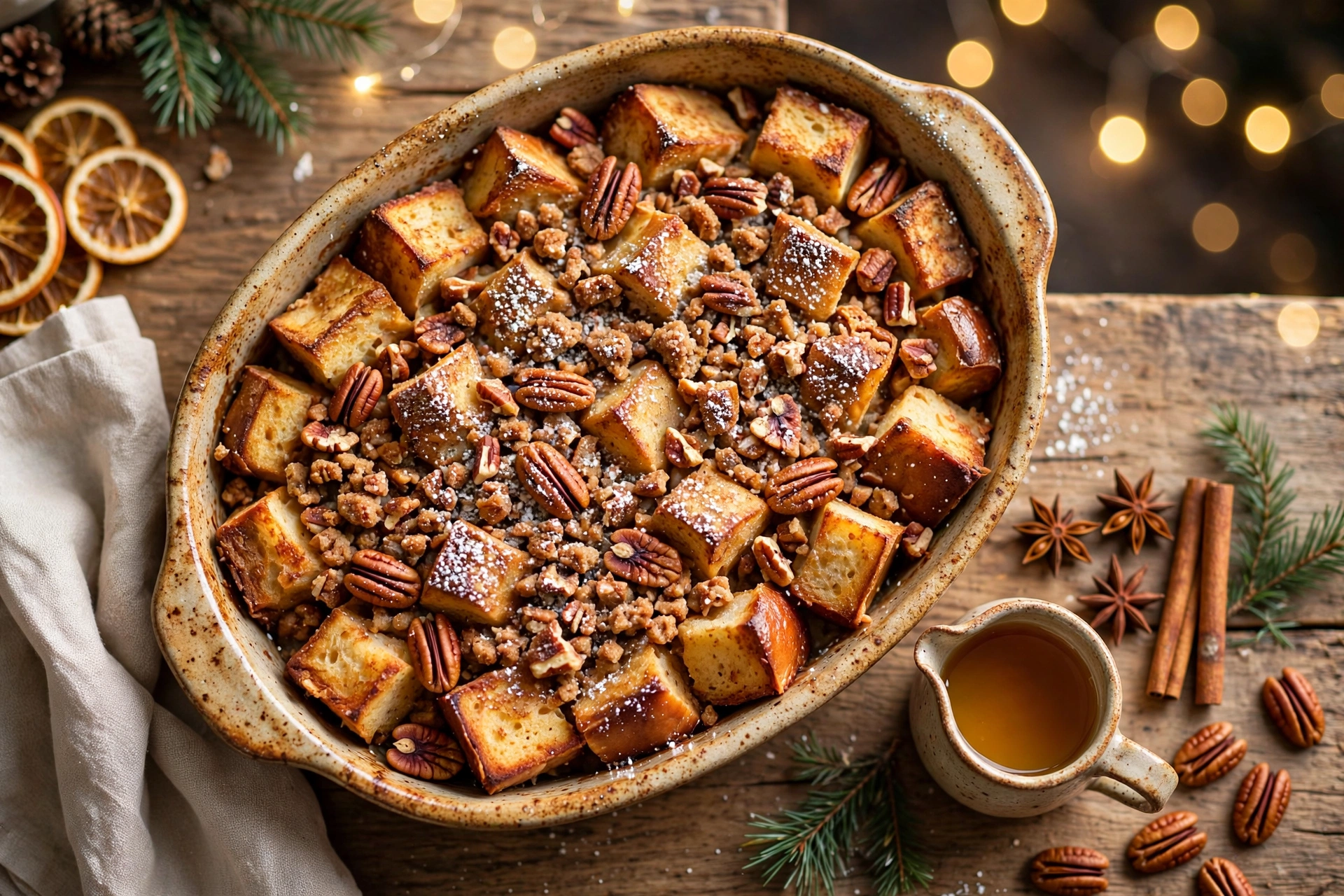
This gingerbread french toast casserole is what Christmas Eve smells like in my kitchen: molasses, ginger and cinnamon folded into a custard that turns plain challah into something between bread pudding and a spiced holiday cake. The cubes soak overnight while the house sleeps. In the morning the dish bakes under a pecan streusel while presents are opened downstairs.
It belongs to the same family as my overnight cinnamon roll casserole, built for hosts who want to sit down at brunch instead of standing at the stove. The gingerbread profile makes it unmistakably December. Molasses brings a deep, almost smoky sweetness that brown sugar alone cannot reach.
Molasses, Ginger and Warm Challah: Why This Bake Tastes Like a Gingerbread House
The custard is where the gingerbread lives. Molasses darkens it to the color of strong tea and carries the mineral edge that makes gingerbread taste grown up. Ground ginger leads, cinnamon rounds, and nutmeg, cloves and allspice fill the background the way they do in a good spice cookie.
Challah is the right bread for this custard. Its crumb is rich and fine, so it drinks the spiced liquid evenly and bakes up tender rather than spongy. Dry cubes are essential: a cube that starts dry absorbs custard into its center, while a fresh cube seals itself and stays bland inside.
The streusel finishes the illusion. Butter, brown sugar and pecans bake into a rubble that crunches like the edge of a gingerbread cookie. Against the soft, dark custard below, that crunch is what makes people go back for a second square.
Serve it warmer than you think it needs. Molasses and spice taste muted when a bake like this cools, because cold dulls both sweetness and aroma. Ten minutes of rest is enough to set the custard; beyond twenty, the ginger retreats and the pan starts to taste like ordinary french toast with good intentions.
The Overnight Soak, and How Long Is Too Long
Eight to twelve hours is the sweet spot for this gingerbread french toast casserole. In that window the custard reaches the center of every cube and the spices settle into the bread itself. The bake comes out uniform, with no pale pockets and no dry corners.
Shorter works in a pinch: four hours gives you a casserole that is good, if a little less merged. Longer is where trouble starts. Past 24 hours the bread begins to dissolve at the edges, and the baked texture turns dense and heavy rather than custardy.
If your schedule slips, bake the casserole rather than extending the soak. A fully baked pan reheats beautifully the next morning, which is a far better rescue than a second night in custard. That rule applies to most overnight bakes, including the classic overnight french toast on this site.
One more timing note for hosts: assemble after dinner, not before. A casserole that goes into the refrigerator at nine in the evening hits its twelve hour mark at nine the next morning, which is exactly when a Christmas brunch wants the oven free for nothing but this pan.
What You Need: Challah, Molasses and Five Warm Spices
One loaf of challah, a jar of regular unsulphured molasses and the standard December spice shelf are the whole shopping list. Do not reach for blackstrap molasses here; its bitterness overwhelms the custard. Everything for the streusel is a pantry staple in the weeks before Christmas.
Bring the eggs and milk out of the refrigerator while you cube the bread. Cold eggs whisk into milk reluctantly and can leave streaks of white in the finished bake. Twenty minutes on the counter is enough to take the chill off and give you a custard that pours evenly.
- 1 loaf challah, about 1 pound, cut into 1 inch cubes, about 10 cups
- Butter, for the dish
- 8 large eggs
- 1 3/4 cups whole milk
- 1/2 cup heavy cream
- 1/3 cup molasses, regular unsulphured, not blackstrap
- 1/4 cup packed brown sugar
- 2 teaspoons vanilla extract
- 2 teaspoons ground ginger
- 1 1/2 teaspoons ground cinnamon
- 1/2 teaspoon ground nutmeg
- 1/4 teaspoon ground cloves
- 1/4 teaspoon ground allspice
- 1/2 teaspoon fine salt
- 1/2 cup all purpose flour, for the streusel
- 1/3 cup packed brown sugar, for the streusel
- 3/4 cup chopped pecans, for the streusel
- 1 teaspoon ground cinnamon, for the streusel
- 1/2 teaspoon ground ginger, for the streusel
- 5 tablespoons cold butter, cubed, for the streusel
- Powdered sugar and maple syrup, for serving
Dry Cubes Drink Better: The Ten Minute Oven Drying Trick
Day old challah is ideal, but a fresh loaf is not a reason to abandon the plan. Spread the cubes on a sheet pan and dry them in a 300°F oven for 10 to 12 minutes, until they feel dry and papery on the surface without taking color. Cool them before the custard goes anywhere near them.
Drying does two things at once. It opens the crumb so the custard travels inward, and it firms the cubes so they keep their shape through a long soak and a full bake. Skipping it is the quiet reason many first attempts come out layered: rich on top, eggy at the bottom.
Cube size is the partner variable. One inch cubes are the standard because they soak through in a night without falling apart. Much smaller and the pan bakes into a uniform pudding; much larger and the centers stay pale and bready no matter how long the soak runs.
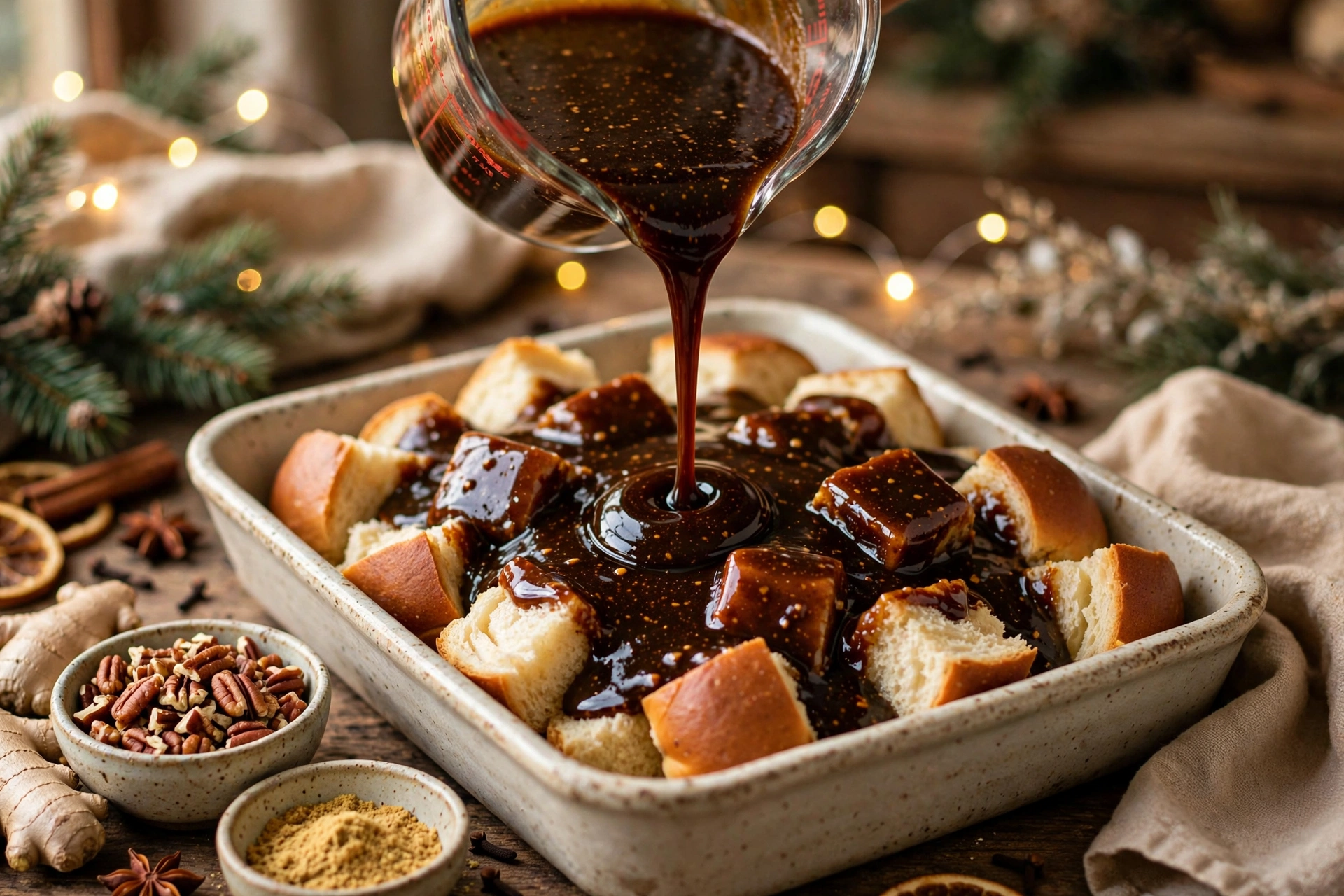
Whisking the Molasses Custard and Assembling the Casserole
Assembly takes fifteen unhurried minutes the night before. Whisk thoroughly: molasses sinks, and an unmixed streak of it will bake into a bitter patch in an otherwise gentle pan.
- Butter a 9 by 13 inch baking dish. Add the dried challah cubes in an even layer, filling the corners.
- Whisk the eggs in a large bowl until uniform. Whisk in the milk, cream, molasses, brown sugar, vanilla, spices and salt until the custard is smooth and dark.
- Pour the custard slowly over the cubes in a spiral, then press gently with a spatula so the top pieces get coated. Cover the dish tightly.
- Refrigerate for 8 to 12 hours, and no longer than 24 hours.
- In the morning, set the dish on the counter for 30 minutes. Heat the oven to 350°F.
- For the streusel, rub the flour, brown sugar, pecans, cinnamon, ginger and a pinch of salt with the cold butter until coarse crumbs form. Scatter evenly over the casserole.
- Cover the dish with foil and bake for 25 minutes. Remove the foil and bake 20 to 25 minutes more, until puffed, deep golden and reading 160°F in the center.
- Rest 10 minutes. Dust with powdered sugar and serve warm with maple syrup.
A Pecan Streusel That Stays Crisp Under the Foil Plan
Streusel has two enemies in an overnight casserole: steam and time. This recipe defends against both. The streusel is mixed in the morning, never the night before, so the butter stays cold and the flour stays dry until the moment it meets the heat.
The foil plan does the rest. Twenty five covered minutes let the custard set without browning anything. Then the foil comes off and the streusel gets twenty open minutes to dry, toast and turn genuinely crisp. Adding the streusel after the soak, instead of before refrigeration, is the whole trick.
Cut the butter in until the crumbs are pea sized, not sandy. Fine crumbs melt into a paste and vanish; coarse crumbs keep their edges and crunch. If your kitchen is warm, park the mixed streusel in the refrigerator while the dish rests on the counter.
The streusel also freezes beautifully on its own, which is a gift in December. Mix a double batch, freeze half in a bag, and a future pan, gingerbread or otherwise, gets its crunch with ninety seconds of work on the morning you bake it.
Testing the Center: Jiggle, Knife and 160 Degrees
Color lies on a dark custard. A gingerbread french toast casserole can look deeply golden while its center is still liquid, because molasses browns early and hides the truth. Test the center, every time, in at least one of these three ways.
Start with the jiggle: nudge the dish and watch the middle. A set center moves as one soft mass, like set gelatin. A liquid center ripples in waves from the point you touched. Then the knife: slide a thin knife into the center and draw it out. It should come out clean or with soft curds, never with runny egg.
The thermometer ends all arguments. The official safe temperature chart puts egg dishes at 160°F, and that is the number to trust in the exact center of the pan. Ten minutes of rest off the heat finishes the setting without drying the edges.
If the edges are set and the center still reads low, do not raise the oven temperature in a panic. Tent the dish loosely with foil and give it five to eight more minutes at the same heat. A dark custard scorches quietly, and patience protects the streusel you worked to keep crisp.
Brioche, Sourdough and Panettone: Bread Swaps That Work
Brioche is the closest cousin to challah here and swaps in one for one, though its extra butter makes the bake a touch richer. Slice it thick and dry it exactly as written; soft brioche collapses faster than challah in a long soak.
Sourdough takes the dish in a different direction: its tang fights the molasses pleasantly and the crumb stays firmer, almost chewy at the edges. Panettone, the December wildcard, brings its own fruit and vanilla; if you use it, cut the brown sugar in the custard by a third and skip the cloves.
Sturdy gluten free bread also works, with one adjustment: dry it five extra minutes, because gluten free crumb drinks custard faster and collapses sooner. Check the center at the early end of the window, and lean on the thermometer rather than the clock.
Lighter Mornings: Milk Swaps and a Half Batch Pan
Whole milk can replace the cream and part of the milk without hurting the set: use 2 1/4 cups of whole milk and no cream, and the custard still bakes up tender. The streusel, not the custard, carries the richness in this recipe, so the trade is barely noticed at the table.
For a small household, halve everything and bake in an 8 inch square dish. The covered time drops to 20 minutes and the uncovered finish to about 15. Leftovers from a half batch are a realistic two mornings of breakfast instead of a week of obligation.
A spiced whipped cream suits the lighter version especially well: soft peaks, a spoonful of molasses and a pinch of ginger folded through. It restores the sense of occasion that the leaner custard gives up, at a fraction of the richness of a glaze.
Reheating One Slice at a Time, and Freezing the Rest
Leftover gingerbread french toast casserole keeps for 3 days in the refrigerator, covered. A single square reheats in the microwave at 70 percent power for about a minute, but the streusel softens. For crunch, reheat slices in a 350°F oven for 10 minutes, or in an air fryer until the top crackles again.
Freeze baked squares individually, wrapped, for up to two months. Thaw overnight in the refrigerator and reheat as above; the texture survives remarkably well because the custard was fully set before freezing. It sits happily on a brunch table next to the gingerbread trifle when one gingerbread dessert is not enough for your family.
Christmas Morning, With the Oven Doing All the Work
This casserole asks for fifteen minutes on Christmas Eve and returns a calm Christmas morning: a dark, spiced bake that perfumes the house while it finishes in the oven. It feeds ten people from one dish and forgives a slow start, a long gift opening, and a second pot of coffee.
Put it beside the easy Christmas morning casserole if your table expects a savory option too, and let the two pans divide the work between them. One sweet, one savory, both assembled the night before: that is the entire strategy, and it has never let this kitchen down.
And when the pan comes back to the kitchen nearly empty, with one corner square left for whoever washed the dishes, you will understand why this bake has earned its place in the December rotation. Some recipes impress. This one simply takes care of people, starting with the cook.
Questions About This Gingerbread French Toast Casserole
My challah is fresh from the bakery today. Can I still assemble tonight?
Yes. Cube it and dry the cubes in a 300°F oven for 10 to 12 minutes until the surfaces feel papery, then cool them completely before adding the custard. Dried fresh bread absorbs almost as evenly as day old bread, and the casserole keeps its overnight schedule.
How do I know the center is set and not still liquid?
Use all three tests if you are unsure: the center should jiggle as one soft mass instead of rippling, a thin knife should come out clean, and a thermometer in the exact center should read 160°F. Color is not a reliable test on a molasses custard because it browns early.
I left the casserole soaking for a full 24 hours. Is it ruined?
Not ruined, but the texture will be softer and denser, with the bottom layer closer to pudding. Bake it exactly as directed, keep the full covered time, and serve it in squares rather than scoops. Next time, bake at 12 hours and reheat instead of soaking longer.
Can I use blackstrap molasses instead of regular molasses?
It is not recommended here. Blackstrap is bitter and mineral heavy, and it dominates the custard instead of warming it. Use regular unsulphured molasses; if you only have blackstrap, replace half of it with honey and expect a darker, stronger flavor.
Can I bake this in individual ramekins for a brunch party?
Yes. Divide the soaked cubes and custard among buttered ramekins, top each with streusel, and bake covered for 15 minutes then uncovered for 10 to 12, until the centers read 160°F. Ramekins chill and bake beautifully, and guests get crisp edges on every side.