
In this article:
- Why These Chocolate Crinkle Cookies Crack So Beautifully
- Dark Chocolate Depth with a Soft, Chewy Middle
- Chocolate Crinkle Cookies Ingredients
- How to Make Chocolate Crinkle Cookies, From Batter to Snowy Tops
- The Double Sugar Roll and Other Tricks for Bold Cracks
- A Calmer December: Chill, Roll and Freeze the Dough Ahead
- Mocha, Peppermint and Orange: Crinkle Variations to Try
- Keeping Crinkle Cookies Soft for Days
- FAQ
Why These Chocolate Crinkle Cookies Crack So Beautifully
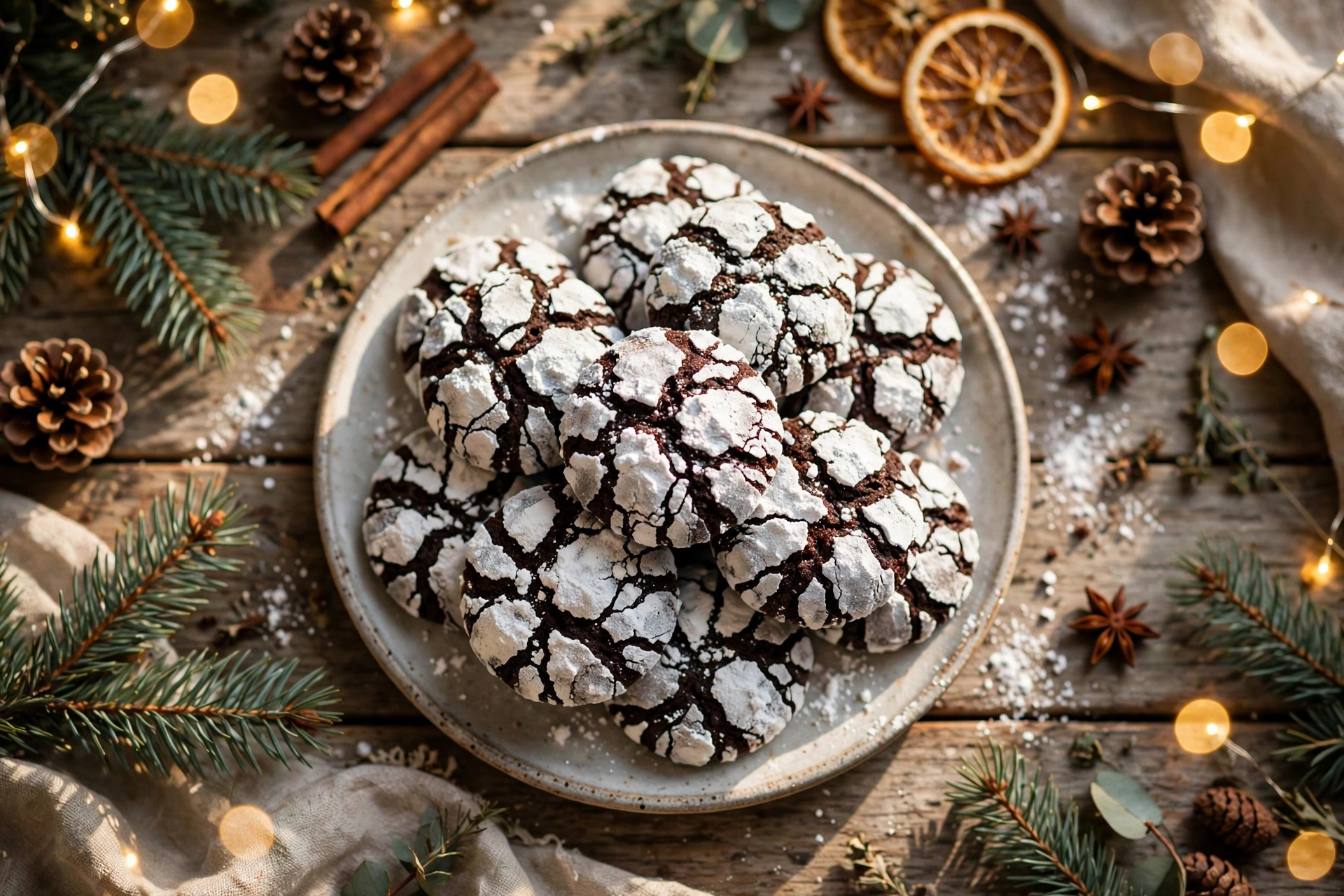
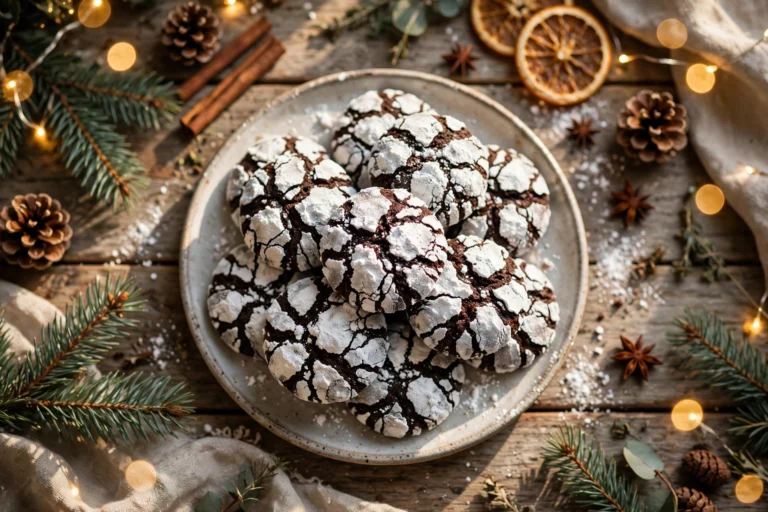
Chocolate crinkle cookies crack because three things happen in the oven at the same time. The cold, well-chilled dough resists spreading, the sugar coating dries out quickly in the heat, and the inside keeps rising and pushing outward underneath it. That dried surface cannot stretch, so it splits into the white-edged fissures that make the cookie famous. Warm dough spreads before the crust can set, which is why under-chilled batches bake up flat with pale, blurry cracks. The second secret is the double base of chocolate. Cocoa alone can read a little flat and dusty, while melted dark chocolate brings cocoa butter, and cocoa butter brings the fudge. Together they give a center that stays moist for days instead of drying out by day two. The oil in the dough plays its own quiet role. It keeps the crumb tender at room temperature, where an all-butter cookie would firm up, and it gives the batter the supple consistency that chills into clean, rollable scoops instead of a crumbly mass.Dark Chocolate Depth with a Soft, Chewy Middle
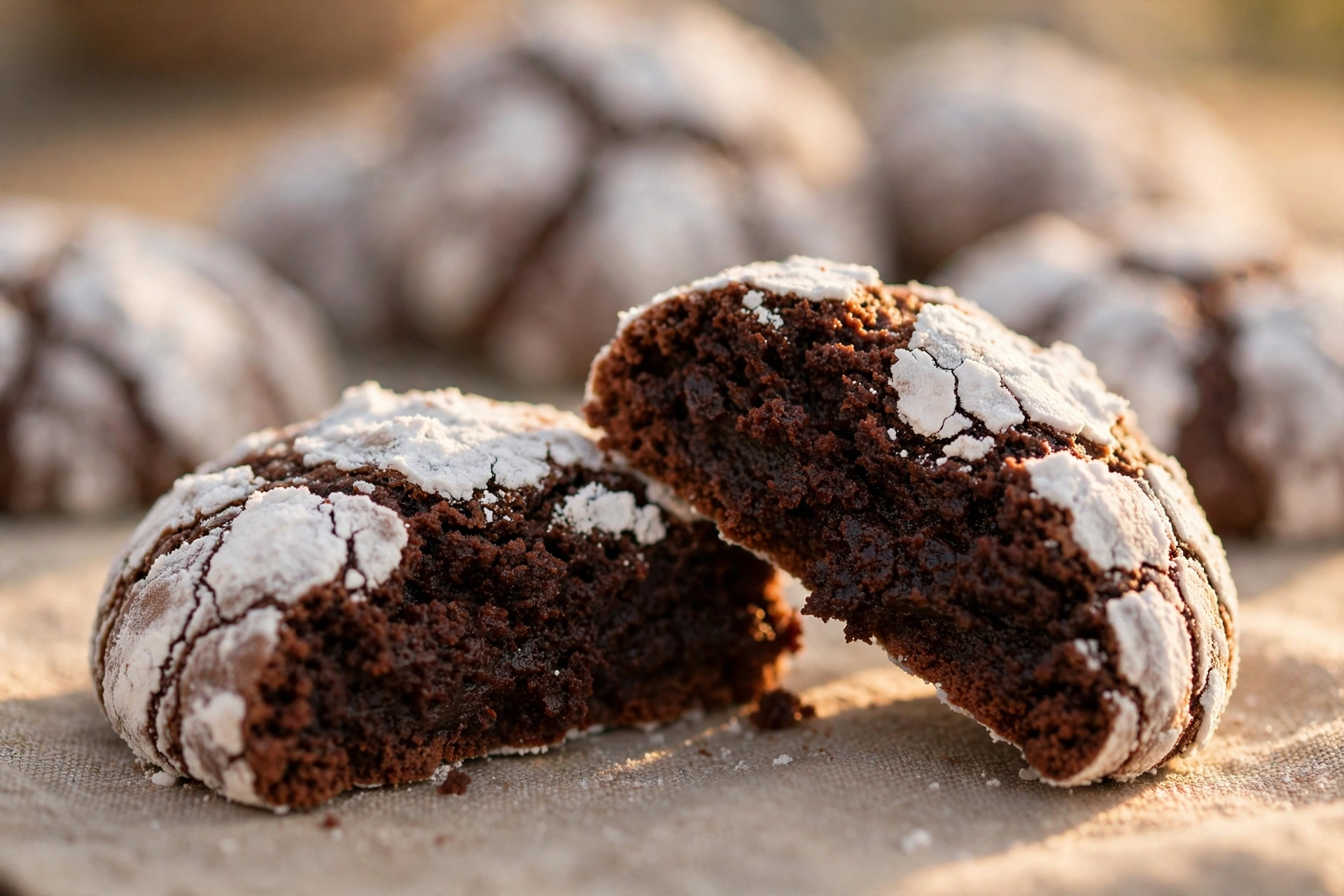
The first bite is all contrast. Your teeth meet a delicate sugary crust that shatters softly, then the center folds in, chewy and dark, closer to the middle of a pan of brownies than to an ordinary cookie. Natural cocoa keeps the flavor bright and assertive, while the melted chocolate rounds it out with something deeper and almost truffle-like. A small pinch of espresso powder does not make the cookies taste like coffee; it simply turns the chocolate volume up. Temperature matters here too. Eaten slightly warm, the centers are at their most molten and the cracks at their whitest. At room temperature they settle into a chewy, truffle-dense crumb that pairs beautifully with coffee or a glass of cold milk. The look is part of the pleasure. Piled on a plate next to paler shortbreads and snowball cookies, the black and white pattern reads unmistakably as Christmas, no decorating skills required. Serve them where the contrast stays visible, on a pale plate or a wooden board, never lost against a dark tablecloth. A short stack tied with twine also makes a handsome small gift, especially tucked into a tin beside something frosted and pale for balance.Chocolate Crinkle Cookies Ingredients
The list is short and pantry friendly. Use a dark chocolate bar you would happily eat on its own, around 60 to 70 percent, since its flavor carries the whole cookie. Both natural and Dutch-process cocoa work; Dutch gives a darker color and a smoother, deeper taste.- 4 ounces dark chocolate (60 to 70 percent), chopped
- 4 tablespoons unsalted butter
- 3/4 cup unsweetened cocoa powder (75 grams)
- 1 1/2 cups granulated sugar (300 grams)
- 1/3 cup neutral oil, such as avocado or light olive oil
- 3 large eggs, at room temperature
- 2 teaspoons vanilla extract
- 1 teaspoon instant espresso powder (optional, for depth)
- 1 3/4 cups all-purpose flour (220 grams)
- 2 teaspoons baking powder
- 1/2 teaspoon fine sea salt
- 1/3 cup granulated sugar, for the first roll
- 3/4 cup powdered sugar, sifted, for the snowy roll
How to Make Chocolate Crinkle Cookies, From Batter to Snowy Tops
The dough mixes in one bowl and behaves more like a thick brownie batter than a stiff cookie dough. Do not panic at its softness; the long chill is what turns it into something you can roll.- Melt the chopped chocolate and butter together in a heatproof bowl set over barely simmering water, stirring until glossy. Set aside to cool for 10 minutes; it should feel warm, not hot.
- Whisk the cocoa, granulated sugar and oil in a large bowl until the mixture looks like wet sand. Beat in the melted chocolate until the base is smooth and shiny.
- Add the eggs one at a time, beating well after each, then mix in the vanilla and espresso powder. The batter will loosen, then thicken again into a glossy ribbon.
- Sprinkle the flour, baking powder and salt over the bowl and fold gently with a spatula until no dry streaks remain. Stop as soon as it comes together; overmixing makes the cookies tough.
- Cover the bowl and chill the dough for at least 4 hours, or overnight. It should be firm enough to scoop cleanly, like cold fudge. This rest is not optional; it is the crackle insurance.
- Heat the oven to 350°F (175°C) and line two baking sheets with parchment. Put the granulated sugar in one shallow bowl and the sifted powdered sugar in another.
- Scoop 1 1/2 tablespoon portions and roll them into balls between your palms. Roll each ball first in granulated sugar, then very generously in powdered sugar, coating it thickly on all sides.
- Arrange the balls 2 inches apart on the prepared sheets. Bake 10 to 12 minutes, until the tops have cracked wide and the edges look set, while the centers still look slightly soft and puffy.
- Cool the cookies on the sheet for 5 minutes, where they will finish setting with fudgy centers, then move them to a rack. If any cracks look pale, a final light dusting of powdered sugar fixes them.
The Double Sugar Roll and Other Tricks for Bold Cracks
Most crinkle disappointments trace back to the sugar, not the dough. Powdered sugar applied directly to a moist ball melts into the surface as the cookie warms, leaving gray patches instead of bold white cracks. The granulated sugar undercoat solves this. It forms a dry, gritty barrier between the dough and the powdered layer, so the white coat stays on the surface where it belongs and dries into those striking fissures. Be generous to the point of excess with the second roll. The ball should look like a snowball, with no dark dough peeking through anywhere. Any thin spot becomes a dark smear in the finished pattern. Two more habits help. Keep the shaped balls cold while the first tray bakes, returning them to the fridge between batches, and never flatten the balls before baking. The dome is what stretches and splits as it rises. Size consistency is the quiet fourth trick. A cookie scoop makes every ball the same weight, so a whole tray finishes at the same moment and no small cookie overbakes while a large one catches up. If you work by hand, weigh the first few balls; about 30 grams each is the sweet spot.A Calmer December: Chill, Roll and Freeze the Dough Ahead
These are quietly among the best make-ahead cookies of the season, because the mandatory chill stretches happily from 4 hours to a full 2 days in the refrigerator. For a longer runway, scoop and roll the balls, freeze them solid on a tray, then store them in a bag for up to 3 months. Wait to do the sugar rolls until baking day, so the coating stays dry and bright. Frozen balls bake from solid at the same temperature, with 1 to 2 extra minutes. That means a tray of warm crinkles can appear for unexpected guests with almost no notice, which is a genuinely useful December superpower. On a full holiday baking day, this dough also plays well with others. It chills patiently while the oven handles a yule log cake or a batch of cut-outs, then bakes off in minutes at the end.Mocha, Peppermint and Orange: Crinkle Variations to Try
The espresso powder in the base recipe is already a quiet mocha variation; raise it to 2 teaspoons and add a pinch of cinnamon for a warmer, more pronounced coffee edge that adults tend to love. For peppermint crinkles, add 1/2 teaspoon of peppermint extract with the vanilla and press a few crushed candy cane pieces onto the hot cookies the moment they leave the oven. Adding the candy before baking melts it into puddles, so timing is everything. Orange zest, one finely grated orange’s worth folded into the sugar, gives a bright, almost marmalade note that flatters dark chocolate. A handful of mini chocolate chips folded in at the end doubles down for true chocolate devotees. For dietary tweaks, a good 1 to 1 gluten-free flour blend swaps in cleanly thanks to the dough’s fudgy structure, and dairy-free butter substitutes for the butter without changing the method. The centers stay soft either way. One more direction worth knowing: a Mexican chocolate crinkle, with 1 teaspoon of cinnamon and a pinch of cayenne folded into the flour. The heat arrives late and low, and the crackled tops look exactly the same while tasting like a different cookie entirely.Keeping Crinkle Cookies Soft for Days
Stored in an airtight tin at room temperature, these cookies keep their chewy centers for about 5 days. Layer them with parchment so the sugary tops do not rub against each other and lose their pattern. A slice of sandwich bread tucked into the tin keeps the moisture balance kind, the oldest trick in the cookie jar and still the most reliable. Replace it when it goes stale and hard. Baked cookies also freeze well for up to 2 months. Thaw them at room temperature in their container so condensation lands on the tin, not on the sugar, and refresh the tops with a whisper of fresh powdered sugar before serving. If a batch ever does dry out, ten seconds in the microwave under a barely damp paper towel brings the centers back to softness. Serve them right away after this rescue; it works once, and it works well. Chocolate crinkle cookies earn their place in the tin honestly: five minutes of mixing, a patient chill, and a double roll of sugar, in exchange for the most dramatic looking cookie of the season. They are the cookies people photograph first and reach for second, and the recipe doubles cleanly if your exchange list is long. Bake one tray exactly as written, learn how your oven treats the cracks, and the rest of December is yours.FAQ
Why did the powdered sugar on my crinkle cookies disappear or turn gray?
The dough was probably too warm or the coating too thin, so the sugar absorbed moisture and melted into the surface. Chill the dough the full 4 hours, roll the balls first in granulated sugar as a dry barrier, then coat them very thickly in powdered sugar so no dark dough shows through.
Can I use Dutch-process cocoa instead of natural cocoa in crinkle cookies?
Yes, and many bakers prefer it here. Dutch-process cocoa gives a darker, almost black cookie with a smoother, deeper chocolate flavor. This recipe uses baking powder rather than soda, so the leavening works the same with either cocoa.
How long does crinkle cookie dough really need to chill?
Four hours is the minimum for a dough that scoops cleanly and cracks boldly, and overnight is even better. In a hurry, spread the dough in a shallow pan so it chills faster, or freeze the scooped balls for 30 minutes before rolling them in sugar.
Can I freeze the dough balls and bake them later?
Yes, they freeze beautifully for up to 3 months. Freeze the scooped balls solid on a tray, bag them, and do the two sugar rolls on baking day for the brightest coating. Bake from frozen at 350°F, adding 1 to 2 minutes to the time.
Why did my crinkle cookies spread flat instead of cracking?
Flat crinkles almost always mean warm dough, a too-cool oven, or balls that were flattened before baking. Chill the shaped balls for 15 minutes while the oven heats, verify the oven reaches 350°F, and leave the balls as tall domes so the surface can split as they rise.
Chocolate Crinkle Cookies
Dark chocolate crinkle cookies built on cocoa and melted dark chocolate for a true brownie center, double rolled in sugar so the snowy cracks stay bold. A December cookie tin essential that chills, freezes and makes ahead beautifully.
- Total Time: 4 hours 45 minutes
- Yield: 24 cookies 1x
Ingredients
- 4 ounces dark chocolate (60 to 70 percent), chopped
- 4 tablespoons unsalted butter
- 3/4 cup unsweetened cocoa powder (75 grams)
- 1 1/2 cups granulated sugar (300 grams)
- 1/3 cup neutral oil, such as avocado or light olive oil
- 3 large eggs, at room temperature
- 2 teaspoons vanilla extract
- 1 teaspoon instant espresso powder (optional, for depth)
- 1 3/4 cups all-purpose flour (220 grams)
- 2 teaspoons baking powder
- 1/2 teaspoon fine sea salt
- 1/3 cup granulated sugar, for the first roll
- 3/4 cup powdered sugar, sifted, for the snowy roll
Instructions
- Melt the chopped chocolate and butter in a heatproof bowl over barely simmering water until glossy. Cool 10 minutes.
- Whisk the cocoa, granulated sugar and oil until like wet sand. Beat in the melted chocolate until smooth and shiny.
- Beat in the eggs one at a time, then the vanilla and espresso powder, until the batter ribbons off the whisk.
- Fold in the flour, baking powder and salt until no dry streaks remain. Do not overmix.
- Cover and chill the dough at least 4 hours or overnight, until firm like cold fudge.
- Heat the oven to 350°F (175°C). Line two baking sheets with parchment. Put the granulated sugar and the powdered sugar in two shallow bowls.
- Scoop 1 1/2 tablespoon balls. Roll each first in granulated sugar, then very generously in powdered sugar.
- Place 2 inches apart and bake 10 to 12 minutes, until the tops crack wide and the edges set while centers stay soft.
- Cool 5 minutes on the sheet, then move to a rack. Dust with extra powdered sugar if any cracks look pale.
- Prep Time: 20 minutes
- Cook Time: 11 minutes