
In this article:
- A Silky Pumpkin Pie Filling That Never Turns Grainy
- The Homemade Spice Blend Behind the Flavor
- Classic Pumpkin Pie Ingredients
- How to Make Pumpkin Pie, Crust First
- The Never-Cracked Rule: Reading the Jiggle
- A Crust That Stays Crisp to the Last Slice
- Fresh Roasted Pumpkin or Canned: An Honest Answer
- The Calm Thanksgiving Timeline
- FAQ
A Silky Pumpkin Pie Filling That Never Turns Grainy
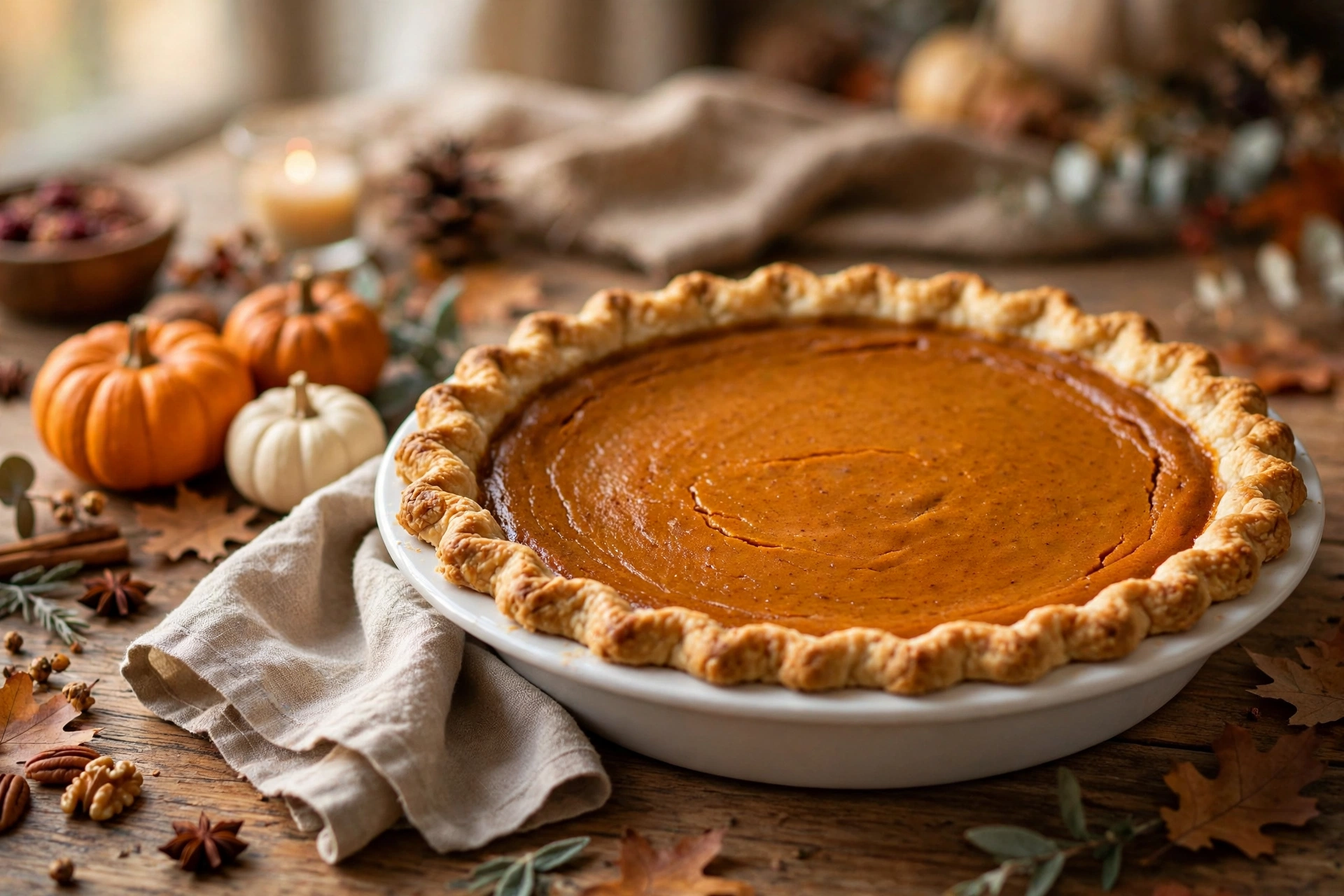
A great pumpkin pie filling is a custard, and custards reward gentleness. The eggs must be whisked until just unified with the pumpkin, never beaten to foam, because trapped air expands in the oven and leaves the surface pocked and the texture coarse. Brown sugar does more than sweeten here. Its moisture keeps the filling supple as it sets, and its caramel notes deepen the pumpkin in a way white sugar cannot. The tablespoon of molasses is the quiet amplifier, adding the dark, almost spiced-rum warmth that makes people ask what is different this year. There is no alcohol in it, only depth. Cornstarch, one tablespoon, is the structural secret borrowed from the best Southern bakers. It does not make the pie gummy; it simply guarantees that the custard sets into clean, glossy slices instead of weeping liquid onto the plate. Heavy cream, rather than evaporated milk, gives the filling its silk. The fat carries the spices evenly and softens the slight grain that pumpkin puree can bring, so the finished slice eats like a firm, spiced cream. Temperature plays a supporting role that most recipes never mention. Room-temperature eggs and pumpkin whisk into a uniform custard that bakes evenly edge to center. Cold ingredients from the refrigerator can leave the middle lagging behind the rim, which tempts the cook into the extra ten minutes that crack the top.The Homemade Spice Blend Behind the Flavor
Jars of pumpkin pie spice are convenient, but they fade, and they lean so hard on cinnamon that the other spices disappear. Blending your own takes one minute and lets you tune the pie to your table. This blend uses one and a half teaspoons of cinnamon for warmth, half a teaspoon of ginger for a slow heat, a quarter teaspoon of freshly grated nutmeg for its woodsy sweetness, and an eighth of a teaspoon of cloves, which is plenty; cloves bully a custard when given more room. The final pinch is black pepper, finely ground, and it surprises everyone. At an eighth of a teaspoon it never reads as pepper; it simply makes the other spices taste more like themselves, the way salt makes chocolate taste more like chocolate. If you keep a house blend, mix a small jar for the season: three tablespoons cinnamon, two teaspoons ginger, one teaspoon nutmeg, half a teaspoon cloves. It will carry you through every pie, loaf and latte of the fall. Freshly grated nutmeg is worth the thirty seconds. The pre-ground spice loses its perfume within months, while a whole nutmeg, grated on a microplane over the bowl, perfumes the whole filling from a quarter teaspoon.Classic Pumpkin Pie Ingredients
The list divides into a simple all-butter crust and the filling. Everything should be measured before the oven heats; Thanksgiving is no day for searching for the molasses mid-recipe.- 1 1/4 cups all-purpose flour (160 grams), for the crust
- 1 tablespoon granulated sugar
- 1/2 teaspoon fine sea salt, for the crust
- 8 tablespoons cold unsalted butter, cut into small cubes
- 3 to 4 tablespoons ice water
- 1 (15 ounce) can pumpkin puree (not pumpkin pie filling)
- 3/4 cup dark brown sugar (165 grams), packed
- 1 tablespoon molasses
- 2 large eggs plus 1 egg yolk, at room temperature
- 1 tablespoon cornstarch
- 1 1/2 teaspoons ground cinnamon
- 1/2 teaspoon ground ginger
- 1/4 teaspoon freshly grated nutmeg
- 1/8 teaspoon ground cloves
- 1/8 teaspoon finely ground black pepper
- 1/2 teaspoon fine sea salt, for the filling
- 1 cup heavy cream
- 1 teaspoon vanilla extract
How to Make Pumpkin Pie, Crust First
Work in the order below and the pie assembles calmly: crust made and chilled, crust blind baked, filling whisked while it bakes, then one pour into a hot crust. That hot crust meeting room-temperature filling is the first defense against a soggy bottom.- Make the crust. Rub the cold butter into the flour, granulated sugar and 1/2 teaspoon salt until the pieces are pea sized with a few larger flakes. Sprinkle in the ice water, toss until the dough holds when squeezed, then press into a disk, wrap, and chill 1 hour.
- Roll the dough into a 12 inch circle on a floured surface, fit it into a 9 inch pie plate, trim, and crimp the edge tall. Freeze 15 minutes while the oven heats.
- Heat the oven to 375°F (190°C). Line the frozen crust with parchment, fill with pie weights or dried beans, and blind bake 18 minutes. Remove the weights and bake 5 minutes more, until the bottom looks dry and pale golden.
- While the crust bakes, whisk the pumpkin, brown sugar and molasses until smooth. Whisk in the eggs and yolk just until combined, then the cornstarch, cinnamon, ginger, nutmeg, cloves, pepper and salt.
- Whisk in the heavy cream and vanilla until the filling pours like a thick, glossy ribbon. Do not whip air into it.
- Pour the filling into the hot crust, right from the oven, and shield the crimped edge with foil or a pie shield.
- Bake 45 to 50 minutes, until the edges are set and puffed slightly and the center jiggles in a circle about 2 inches wide when the plate is nudged.
- Turn off the oven, crack the door, and let the pie cool inside for 1 hour. Move to a rack to finish cooling, then refrigerate at least 4 hours or overnight.
- Slice with a hot, dry knife, wiping the blade between cuts, and serve with cinnamon whipped cream.
The Never-Cracked Rule: Reading the Jiggle
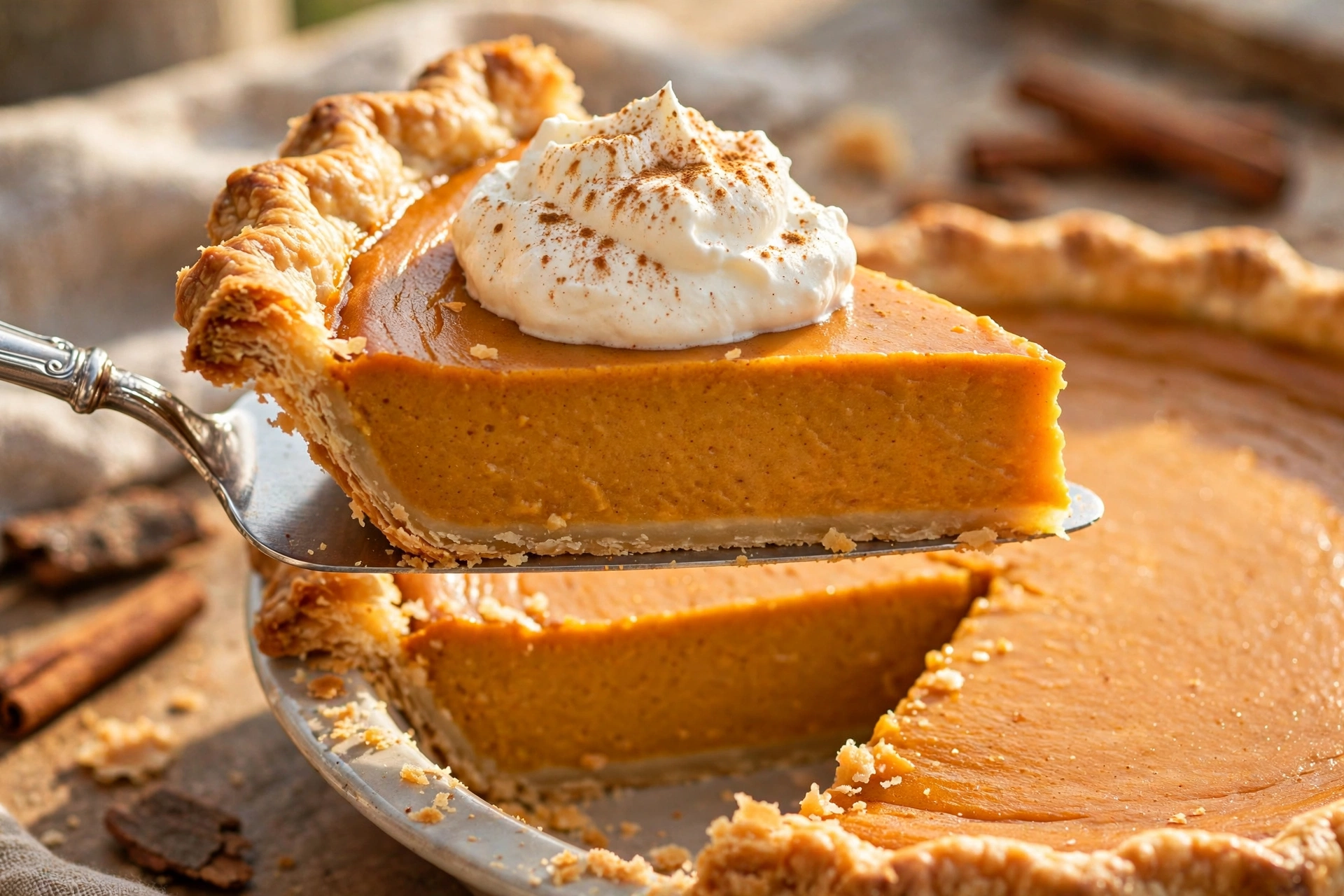
A cracked pumpkin pie is an overbaked pumpkin pie, and it is the most common disappointment in the whole Thanksgiving canon. The crack forms because the custard keeps cooking after the surface has set, expands, and tears itself apart. The defense is a single skill: reading the jiggle. The pie is done when the outer two thirds look set and matte, while the center, a circle roughly two inches across, still trembles like set gelatin when the rack is nudged. That trembling center finishes cooking from residual heat as the pie cools. Cooling slowly is the second half of the rule. A pie moved straight from a hot oven to a cold countertop contracts too fast and can crack in protest; an hour in the cooling oven, door cracked, lets it settle gradually and stay mirror-smooth. If a hairline crack ever does appear, it is purely cosmetic. A blanket of whipped cream, applied with confidence, has hidden a thousand of them, and the flavor underneath is entirely unharmed. An oven thermometer earns its keep on this recipe more than on any other of the season. Custards live in a narrow band of doneness, and an oven running 25 degrees hot, which is common, quietly steals the jiggle window and bakes the pie past tenderness before the timer ever sounds.A Crust That Stays Crisp to the Last Slice
Three habits protect the bottom crust. The first is the blind bake itself, done until the base looks dry, not merely pale; a timid blind bake steams later under the wet filling. The second habit is the hot marriage: filling poured into the crust while the crust is still hot from blind baking begins setting the base on contact, sealing it against the liquid. The third is position. Bake the pie on the lowest oven rack, ideally on a preheated baking sheet, so the bottom receives direct, assertive heat from the moment it goes in. For a final insurance, brush the hot blind-baked crust with a whisper of beaten egg white and return it to the oven for one minute. The protein film is invisible in the finished pie and quietly waterproof.Fresh Roasted Pumpkin or Canned: An Honest Answer
Every fall, someone at the table asks whether the pie would be better with a real pumpkin. The honest answer is that it can be wonderful, but canned puree wins on the day it matters most, because its texture and moisture are identical from can to can. Fresh sugar pumpkin, roasted until its flesh collapses and then drained in a sieve for a full hour, gives a slightly earthier, less uniform filling that many bakers love. Skip the draining, though, and the excess water will loosen the custard and lengthen the bake unpredictably. For Thanksgiving itself, when the oven is shared with green bean casserole and the sweet potato casserole, choose the can without apology. Save the fresh pumpkin experiment for a quiet October Sunday, when failure costs nothing. Either way, never buy the can labeled pie filling by mistake. It is the single substitution that no technique in this article can rescue.The Calm Thanksgiving Timeline
This pie is a gift to the cook because it wants to be made ahead. Each slice has about 340 calories, 42 grams of carbohydrate, 18 grams of fat and 5 grams of protein, honest numbers for the centerpiece dessert of the year. Three days out, make the crust disk and keep it wrapped in the refrigerator. Two days out, roll, crimp and freeze the shaped crust in its plate. One day out, bake the pie completely and refrigerate it overnight. The rest deepens the spice and firms the custard, and slices cut the next day are the cleanest of all. On the day itself, the pie needs nothing but whipped cream and a place of honor, which is exactly how a holiday should treat its cook. For the full day’s plan, our Thanksgiving dinner menu lays out the whole table, course by course. Serve this pie at room temperature or lightly chilled, never warm from the oven, and it will reward you with perfect slices. The whipped cream can be made ahead too. Whip it to soft peaks with a spoonful of powdered sugar and a pinch of the house spice blend, then hold it covered in the refrigerator for up to a day. A brief whisk by hand before serving brings back its billow, and the spiced cream ties the whole dessert course together. A classic pumpkin pie asks for so little: a cold crust, a gentle whisk, and the discipline to pull it from the oven while the center still trembles. Give it those three things and it gives you back the smoothest, most confidently spiced slice on the table. Bake it the day before, sleep well, and let Thanksgiving morning belong to the savory dishes. The dessert, for once, is already done.FAQ
Why did my pumpkin pie crack on top?
Cracking means overbaking or cooling too fast. Pull the pie when the center still jiggles in a 2 inch circle; it finishes setting as it cools. Then let it cool slowly for an hour in the oven with the door cracked instead of moving it straight to a cold counter.
Can I make pumpkin pie two days before Thanksgiving?
Yes, and it improves. Bake it fully, cool it slowly, then refrigerate covered for up to 2 days. The spice deepens and the custard slices at its cleanest. Keep the whipped cream separate and add it at serving time.
Can I freeze a whole baked pumpkin pie?
Yes, for up to 1 month. Cool it completely, wrap the whole pie tightly in plastic and then foil, and freeze. Thaw overnight in the refrigerator, still wrapped, so condensation forms on the wrapping and not on the surface of the pie.
Can I use evaporated milk instead of heavy cream in pumpkin pie?
You can, and the pie will set a little firmer with a slightly lighter body. The cream version in this recipe is silkier and richer. If you swap, keep everything else identical and expect the same bake time and the same 2 inch jiggle test.
My pumpkin pie is still liquid in the middle the next day. What went wrong?
Either the center was pulled before the edges truly set, or fresh puree was used without draining. The pie should leave the oven with set, matte edges and only a small trembling center. If it sloshes rather than jiggles, give it 5 more minutes and check again.
Classic Pumpkin Pie
Classic pumpkin pie with a silky brown sugar and molasses custard, a homemade spice blend with a whisper of black pepper, and an all-butter crust blind baked so it stays crisp. Built to never crack: pulled from the oven while the center still jiggles, then cooled slowly.
- Total Time: 6 hours 40 minutes
- Yield: 8 slices 1x
Ingredients
- 1 1/4 cups all-purpose flour (160 grams), for the crust
- 1 tablespoon granulated sugar
- 1/2 teaspoon fine sea salt, for the crust
- 8 tablespoons cold unsalted butter, cut into small cubes
- 3 to 4 tablespoons ice water
- 1 (15 ounce) can pumpkin puree (not pumpkin pie filling)
- 3/4 cup dark brown sugar (165 grams), packed
- 1 tablespoon molasses
- 2 large eggs plus 1 egg yolk, at room temperature
- 1 tablespoon cornstarch
- 1 1/2 teaspoons ground cinnamon
- 1/2 teaspoon ground ginger
- 1/4 teaspoon freshly grated nutmeg
- 1/8 teaspoon ground cloves
- 1/8 teaspoon finely ground black pepper
- 1/2 teaspoon fine sea salt, for the filling
- 1 cup heavy cream
- 1 teaspoon vanilla extract
Instructions
- Make the crust: rub the cold butter into the flour, sugar and salt until pea sized. Add the ice water, toss until the dough holds when squeezed, press into a disk, wrap and chill 1 hour.
- Roll the dough into a 12 inch circle, fit into a 9 inch pie plate, trim and crimp the edge tall. Freeze 15 minutes.
- Heat the oven to 375°F (190°C). Line the frozen crust with parchment, fill with pie weights, and blind bake 18 minutes. Remove the weights and bake 5 minutes more, until dry and pale golden.
- Whisk the pumpkin, brown sugar and molasses until smooth. Whisk in the eggs and yolk just until combined, then the cornstarch, spices, pepper and salt.
- Whisk in the heavy cream and vanilla until the filling pours like a thick, glossy ribbon. Do not whip in air.
- Pour the filling into the hot crust and shield the crimped edge with foil or a pie shield.
- Bake 45 to 50 minutes, until the edges are set and the center jiggles in a circle about 2 inches wide.
- Turn off the oven, crack the door, and cool the pie inside for 1 hour. Finish cooling on a rack, then refrigerate at least 4 hours or overnight.
- Slice with a hot, dry knife, wiping between cuts. Serve with cinnamon whipped cream.
- Prep Time: 30 minutes
- Cook Time: 1 hour 10 minutes