
In this article:
- It starts on Christmas Eve
- A dry cube drinks better
- Nutmeg on top, custard underneath
- The soak window, eight to twenty-four hours
- What you need for the casserole
- Assembling on Christmas Eve, baking on Christmas morning
- Reading the center: three signs it is done
- Dairy-light, gluten-free and small-batch versions
- Panettone, challah and croissant twists
- Freeze it assembled, freeze it baked
- The dish that smells like Christmas morning
- Questions about eggnog french toast casserole
Eggnog French toast casserole is my answer to the oldest Christmas morning problem: everyone is hungry, nobody wants the cook in the kitchen. It goes into the fridge on Christmas Eve as a quiet, custard soaked pan, and comes out of the oven golden while the gifts are still being opened.
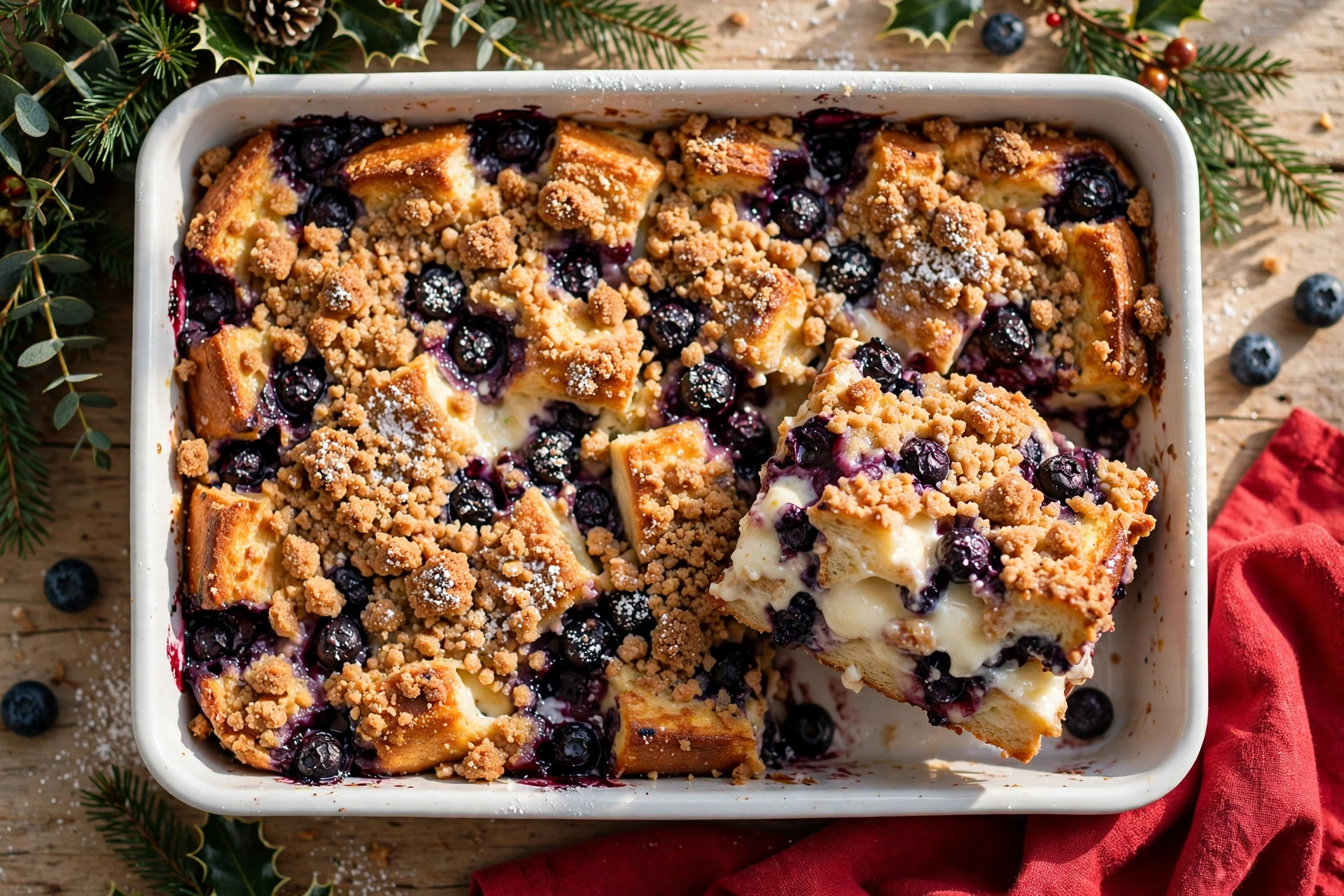
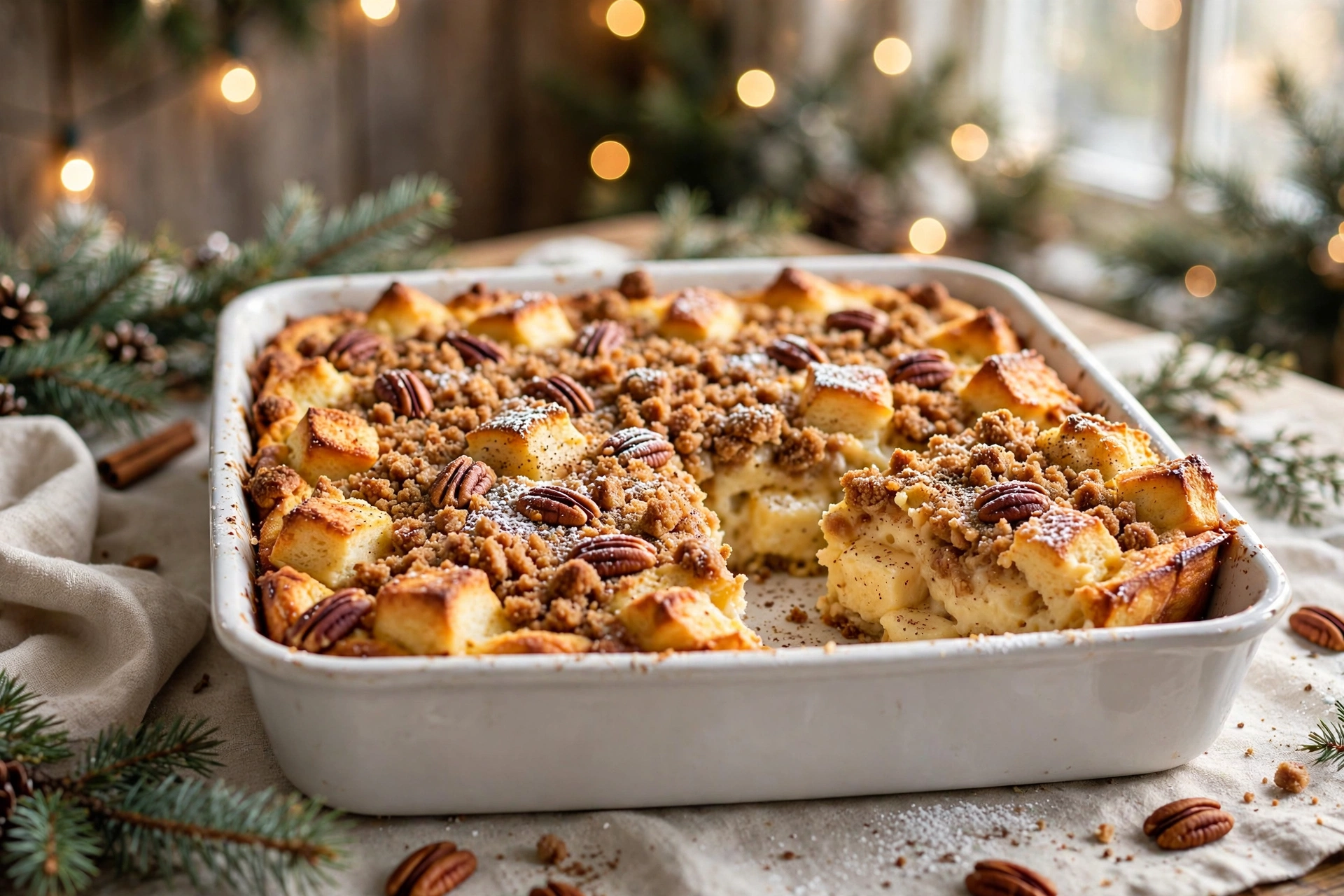
What comes to the table is a casserole with manners. The top is crisp with brown sugar streusel and pecans, the middle is soft and custardy without a trace of sogginess, and the whole dish smells of nutmeg before the first square is cut.
Why This Eggnog French Toast Casserole Starts on Christmas Eve
Eggnog French toast casserole belongs to Christmas Eve because bread and custard need a long, unhurried meeting. Given a full night together, the cubes drink the spiced eggnog all the way to their centers, and the casserole bakes up set and sliceable instead of layered and wet.
The timing is also a gift to the cook. Fifteen minutes of assembly after dinner on the 24th replaces the whole morning performance of dipping, frying and serving French toast in batches while the room moves on without you.
Eggnog does heavy lifting here that plain milk cannot. It arrives already sweetened, already spiced, already rich with yolks, so the custard needs little more than eggs, vanilla and a confident grating of fresh nutmeg to taste like the holidays.
The streusel is part of the night before plan, not a morning chore. Rubbed together in two minutes and bagged in the fridge, it waits cold and crumbly, ready to be scattered over the soaked bread the moment the oven is lit.
A Dry Cube Drinks Better: the Anti-Soggy Rule
The single most useful thing I can tell you about any French toast casserole is this: dry the bread cubes first. Ten minutes in a low oven drives off surface moisture, and a dry cube absorbs custard the way a sponge should, evenly and completely.
Fresh, soft bread does the opposite. Its crumb is already full of water, so the custard coats the outside and pools at the bottom of the dish, which is exactly where the dreaded soggy layer is born.
Drying is not toasting. The cubes should look pale and feel papery at the edges, not golden; color comes later, during the real bake, along with the flavor that makes the top worth eating.
The custard ratio matters as much as the bread. Two cups of eggnog and a half cup of milk to six eggs is the balance I trust: rich enough to set into a true custard, liquid enough to saturate a full loaf of cubes without leaving a puddle.
Press the top layer down gently once the custard is poured. The top cubes sit proud and dry out in the fridge otherwise, and a firm press with clean hands or a spatula settles every piece into the soak.
Nutmeg on Top, Custard Underneath: Flavor and Texture
Cut a square and look at the contrast: a rubble of brown sugar streusel, crisp pecans, then the golden shoulders of the top cubes, then a pale, trembling custard that holds the whole square together on the fork.
Nutmeg is the flavor that announces this dish across the room. Half a teaspoon goes into the custard, and a second, fresher grating goes over the baked top, so the spice reads twice: warm and deep inside, bright and aromatic on the surface.
Cinnamon supports rather than leads, and vanilla lengthens the eggnog’s own flavor. This is not a heavily spiced casserole; it tastes like the drink it came from, warmed and set into bread.
The edges are the cook’s reward. Against the hot ceramic, the custard caramelizes faintly and the bread turns almost toffee crisp at the corners, a texture the soft center cannot offer and should not have to.
Served warm, with maple syrup that has been warmed too, the casserole lands somewhere between breakfast and dessert, which is precisely where Christmas morning food ought to live.
Cut the squares large and serve them on warm plates if you can manage it; a cold plate steals heat from custard faster than any cook expects. A small pitcher of extra eggnog, warmed and poured at the table like a sauce, is a quiet luxury nobody refuses.
The Soak Window, From Eight Hours to Twenty-Four
Eight hours is the honest minimum. By then the centers of the cubes are saturated and the casserole bakes evenly; at four hours the middle pieces are still dry hearted and the texture comes out patchy.
Twenty four hours is the maximum, and it is worth saying plainly because few recipes do. Past a day in the custard, the bread begins to disintegrate, the crumb turns to porridge, and no baking schedule can bring the structure back.
Between those two marks, the casserole is flexible and forgiving. Assemble it after lunch on the 24th or after dinner; both pans bake the same on Christmas morning, which is the entire point of a brunch dish built for a real family schedule.
The same planning runs through my whole Christmas morning table. The Christmas morning casserole waits overnight in the same spirit, the overnight cinnamon roll casserole rises while everyone sleeps, and this eggnog version takes the sweet seat at the table.
What You Need for the Casserole
Brioche is the bread I reach for, rich and sturdy in the crumb, but the method forgives other loaves as the variations below explain. The eggnog should be the full fat kind you would happily drink:
- 1 loaf brioche (16 ounces), cut into 1 inch cubes, about 10 cups, plus butter for the dish
- 6 large eggs
- 2 cups full fat eggnog
- 1/2 cup whole milk
- 1/4 cup granulated sugar (see the note in the method about sweeter eggnogs)
- 2 teaspoons vanilla extract
- 1 teaspoon ground cinnamon
- 1/2 teaspoon freshly grated nutmeg, plus more for serving
- 1/4 teaspoon fine salt
- 1/2 cup light brown sugar, packed, for the streusel
- 1/3 cup all-purpose flour, for the streusel
- 1 teaspoon ground cinnamon and 1/4 teaspoon fine salt, for the streusel
- 6 tablespoons cold unsalted butter, cut into small cubes, for the streusel
- 3/4 cup chopped pecans, for the streusel
- Confectioners’ sugar and warm maple syrup, to serve
Assembling on Christmas Eve, Baking on Christmas Morning
The assembly takes about twenty five minutes including the drying step, and the bake is entirely hands off. Read the sugar note before you whisk: very sweet bottled eggnogs need only two tablespoons of added sugar, lighter ones can take the full quarter cup:
- Heat the oven to 300°F. Spread the brioche cubes on a large rimmed sheet pan and dry them for 10 minutes, until they feel papery at the edges but have taken no color. Cool for 10 minutes.
- Butter a 9×13 inch baking dish generously. Tip in the dried cubes and spread them into an even layer, tucking any very small crumbs between the big pieces.
- Whisk the eggs in a large bowl until the yolks and whites are fully combined. Whisk in the eggnog, milk, granulated sugar, vanilla, cinnamon, nutmeg and salt until smooth.
- Pour the custard slowly and evenly over the bread. Press the top layer down gently with a spatula so every cube is kissed by custard, then rest the pan for 10 minutes and press once more.
- Make the streusel: rub the brown sugar, flour, cinnamon and salt together, then work in the cold butter with your fingers until the mixture forms coarse crumbs. Stir in the pecans, tip the streusel into a bag or small container and refrigerate.
- Cover the casserole tightly and refrigerate for at least 8 hours and up to 24 hours.
- On Christmas morning, set the casserole on the counter for 30 minutes while the oven heats to 350°F. Uncover, scatter the cold streusel evenly over the top, and bake for 45 to 50 minutes, until puffed, deeply golden and set at the center.
- Rest the casserole for 10 minutes so the custard finishes setting. Dust with confectioners’ sugar and a fresh grating of nutmeg, cut into squares and serve warm with maple syrup.
Reading the Center: Three Signs It Is Done
The clock alone cannot tell you this casserole is done; ovens and breads vary too much. The center tells you, in three ways, and learning to read it ends the era of the soggy middle for good.
First, the surface: the center cubes should look set and matte, with streusel that has melted into a crisp crust. A wet sheen in the middle means liquid custard is still moving underneath.
Second, the spring: press the center lightly with the back of a spoon. It should push back gently, like a set custard, not ripple or sag. That small rebound is the eggs finishing their work.
Third, the number, for anyone who wants certainty: an instant read thermometer in the center should read 160°F, the temperature the USDA gives for egg dishes to be served safely. Five extra minutes is the fix when any sign falls short; the streusel can take it, and a loose tent of foil protects it if your oven runs hot.
Dairy-Light, Gluten-Free and Small-Batch Versions
For a lighter pan, use a light eggnog and replace the milk with the same measure of skim milk, then cut the streusel butter to four tablespoons. The casserole leans a little less rich and still sets beautifully, because the eggs do the structural work.
Gluten free bread works if you choose a sturdy loaf and dry the cubes a few minutes longer; delicate sandwich loaves collapse in the soak regardless of their flour. Keep the cubes large, a full inch, so they hold their shape.
For a small household, halve everything into an 8×8 inch dish and bake for 35 to 40 minutes. The soak window does not change, and a small pan is honestly the right size for most weekday December brunches.
Nut free is simple: leave the pecans out of the streusel and add a pinch of flaky salt to the crumbs instead. The salty sweet crust keeps its interest, and nobody at a mixed table has to ask questions.
Panettone, Challah and a Croissant Twist: Variations
Panettone makes the most festive version of all: its candied peel and raisins are already Christmas, so skip the streusel cinnamon and let the bread lead. A gingerbread french toast casserole plays a spicier variation on the same overnight theme, and the two pans side by side make a brunch table feel abundant without extra work.
Challah is the classic stand in, nearly as rich as brioche with a sturdier chew, and it tolerates the full twenty four hour soak better than any other loaf. Day old croissants, torn rather than cubed, give a shattering, buttery top and a very soft center; dry them only 6 minutes.
A cranberry version is lovely and tart: scatter a cup of halved fresh cranberries through the cubes before the custard goes on. Their sharpness against the sweet eggnog is the same balance that makes the holiday table work, much like the quick cinnamon rolls rely on a bright icing against a rich dough.
For a grown up brunch twist without any alcohol, add the zest of an orange to the custard and serve the squares with macerated oranges. The citrus lifts the nutmeg and makes the casserole taste new again on the second morning.
Freeze It Assembled, Freeze It Baked: Storage That Works
The unbaked casserole freezes well, which moves the whole job to the weekend before Christmas. Assemble it in a freezer safe dish, streusel bagged separately on top, wrap tightly and freeze for up to one month; thaw for a full 24 hours in the fridge before baking.
Baked leftovers keep for three days in the fridge and reheat best in a 325°F oven, covered, for about fifteen minutes, which revives the streusel somewhat. The microwave is faster and softer; choose based on whether crunch matters to you that morning.
Individual baked squares also freeze, wrapped one by one, for up to two months. Reheated from thawed in a hot oven, they make a small, private Christmas breakfast in the middle of January, which is its own kind of gift.
One caution: never refreeze a casserole that was frozen unbaked and then baked. The texture survives one freeze gracefully, not two, and the custard will tell on you at the table.
The Dish That Smells Like Christmas Morning
Eggnog French toast casserole is, in the end, a scheduling kindness that tastes like a celebration: nutmeg and brown sugar in the air before anyone is fully awake, a golden pan that cuts into clean squares, and a cook who was present for the morning instead of performing it.
Assemble it on Christmas Eve, sleep through the soak, and let the oven do the hosting. That is the whole promise of this casserole, and it keeps it every year.
Questions About Eggnog French Toast Casserole
My casserole came out soggy in the middle. What went wrong?
Usually one of two things: the bread went in fresh and soft, so it could not absorb the custard evenly, or the center was pulled early. Dry the cubes for 10 minutes at 300°F, and bake until the center springs back lightly and reads 160°F.
Can I make eggnog french toast casserole without eggnog?
Yes. Whisk 1 1/2 cups whole milk with 1/2 cup heavy cream, 3 tablespoons of sugar, an extra egg yolk, a teaspoon of cinnamon and a half teaspoon of nutmeg. It reads as a spiced custard French toast, very close in spirit to the original.
How long can the assembled casserole wait before baking?
Between 8 and 24 hours in the fridge. Less than 8 and the centers stay dry hearted; more than 24 and the bread begins to fall apart in the custard, which no amount of baking can repair.
Can I assemble it two days before Christmas?
Assemble and freeze it instead: the unbaked casserole keeps for a month in the freezer, streusel bagged on top. Move it to the fridge a full 24 hours before baking and it behaves exactly like a freshly assembled pan.
Why do you dry the bread if the recipe calls for stale bread anyway?
Because most kitchens do not have a loaf that is stale in the right way on December 24th. Ten minutes in a low oven gives any loaf, fresh or day old, the same dry, thirsty crumb, so the recipe works the same every time.
Eggnog French Toast Casserole
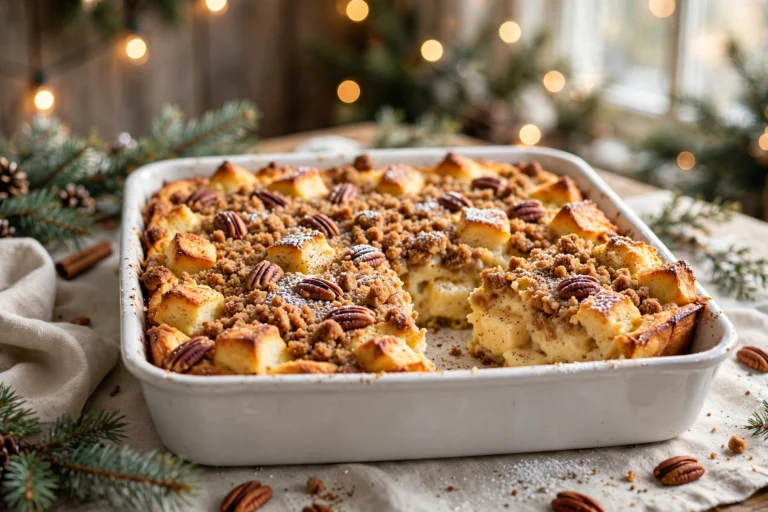
Eggnog French toast casserole assembled entirely on Christmas Eve: dried brioche cubes soak overnight in a nutmeg spiced eggnog custard, the brown sugar pecan streusel waits cold in its own bag, and the pan bakes golden on Christmas morning while the gifts are opened. Crisp on top, custardy at the center, never soggy.
- Total Time: About 1 hour 15 minutes of work and baking, plus overnight soaking
- Yield: 8 servings 1x
Ingredients
- 1 loaf brioche (16 ounces), cut into 1 inch cubes, about 10 cups, plus butter for the dish
- 6 large eggs
- 2 cups full fat eggnog
- 1/2 cup whole milk
- 1/4 cup granulated sugar
- 2 teaspoons vanilla extract
- 1 teaspoon ground cinnamon
- 1/2 teaspoon freshly grated nutmeg, plus more for serving
- 1/4 teaspoon fine salt
- 1/2 cup light brown sugar, packed, for the streusel
- 1/3 cup all-purpose flour, for the streusel
- 1 teaspoon ground cinnamon and 1/4 teaspoon fine salt, for the streusel
- 6 tablespoons cold unsalted butter, cut into small cubes, for the streusel
- 3/4 cup chopped pecans, for the streusel
- Confectioners’ sugar and warm maple syrup, to serve
Instructions
- Heat the oven to 300°F. Spread the brioche cubes on a large rimmed sheet pan and dry for 10 minutes, until papery at the edges but not colored. Cool for 10 minutes.
- Butter a 9×13 inch baking dish generously. Tip in the dried cubes and spread into an even layer.
- Whisk the eggs until fully combined. Whisk in the eggnog, milk, granulated sugar, vanilla, cinnamon, nutmeg and salt until smooth.
- Pour the custard slowly and evenly over the bread. Press the top layer down gently with a spatula, rest 10 minutes, and press once more.
- Rub the brown sugar, flour, cinnamon and salt together, work in the cold butter to coarse crumbs, stir in the pecans. Bag the streusel and refrigerate.
- Cover the casserole tightly and refrigerate for at least 8 hours and up to 24 hours.
- Set the casserole on the counter for 30 minutes while the oven heats to 350°F. Scatter the cold streusel over the top and bake for 45 to 50 minutes, until puffed, golden and set at the center (160°F).
- Rest 10 minutes. Dust with confectioners’ sugar and fresh nutmeg, cut into squares and serve warm with maple syrup.
- Prep Time: 25 minutes, plus 8 to 24 hours soaking
- Cook Time: 45 to 50 minutes
Nutrition
- Serving Size: 1
- Calories: 530
- Sugar: 34
- Sodium: 265
- Fat: 28
- Saturated Fat: 10
- Unsaturated Fat: 17
- Trans Fat: 0
- Carbohydrates: 58
- Fiber: 2
- Protein: 13
- Cholesterol: 190