
In this article:
- The cornstarch secret
- Pale is done
- When the dough stays crumbly
- How much peppermint is too much
- What you need for the meltaways
- Mixing, chilling and baking
- Dip, do not drizzle
- Freezing for the cookie box
- Pink without the dye bottle
- Why meltaways spread
- A week in the tin
- The first tin to empty
- Questions about the meltaways
Peppermint meltaway cookies are the ones that disappear from my cookie tin before the tin even reaches the table. Pale, round and impossibly tender, they hold together just until the first bite, then dissolve into butter and cool mint.
They are also the most forgiving Christmas cookie I bake. The dough freezes beautifully, the bake is twelve quiet minutes, and the pink glaze with its rubble of candy cane makes them look like far more work than they are.

The Cornstarch Secret Inside Peppermint Meltaway Cookies
Peppermint meltaway cookies melt because of one quiet ingredient: cornstarch. A full half cup of it stands in for part of the flour, and since cornstarch carries no gluten at all, every bite stays short and tender.
Flour alone would give these cookies structure, and structure is exactly what a meltaway refuses. The crumb is meant to collapse on the tongue, not resist it, and the cornstarch is what removes the chew.
The ratio is the recipe’s real instruction. More cornstarch than this and the cookies turn chalky and fragile; much less and they bake up like ordinary shortbread, pleasant but no longer meltaways in any honest sense.
Powdered sugar does similar quiet work. Its fine grains dissolve into the butter without any grit, and the small amount of cornstarch it carries adds one more nudge toward that vanishing texture.
The tray matters here more than bakers expect. A dark pan throws extra heat into the bottoms and can take a meltaway from blond to browned in the final minute, so a light colored sheet, or a doubled sheet on a dark pan, buys the gentle bake this cookie wants.
Pale Is Done: Reading the Bake
Nearly every failed batch of meltaways fails at the same moment: the baker waits for golden edges. A meltaway that browns at the edges has already given up the soft center that defines it.
The correct signal is duller and braver. The tops lose their shine and turn matte, the surface looks set and dry, and the bottom, checked with a spatula, is the palest blond you can imagine.
They will feel too soft when the timer rings, almost raw in the middle. That softness is carryover doing its work: five minutes resting on the hot sheet firms them into something that can be moved, barely.
Move them too soon and they crumble; move them too late and they weld to the pan. Five minutes on the sheet, then a wide spatula and a gentle hand onto the rack, is the whole technique.
The same patience applies at the other end of the mixing. Once the dough gathers, stop. Beating past that point warms the butter with friction, and warm butter is tomorrow’s spreading problem wearing a disguise. Gather, cover, chill: the dough rewards a baker who quits at the right moment.
When the Dough Refuses to Come Together
There is a moment in every meltaway batch where the bowl holds nothing but sweet rubble. The flour and cornstarch go in, the mixer churns, and the mixture looks like dry sand that will never become dough.
Keep beating. Somewhere between thirty and sixty seconds later, the butter pulls the crumbs together all at once, and the dough climbs into a soft, smooth mass. Stopping early is the only real mistake available here.
If a full minute passes and the dough still refuses, the butter was too cold. Rest the bowl at room temperature for ten minutes and beat again; the dough will surrender without any added liquid.
Never fix the crumbs with milk or water. Liquid wakes up what little gluten the flour has, and the cookies trade their melt for a faint toughness that no amount of glaze can hide.
There is a second place mint hides: the candy itself. Old candy canes, the ones from last December’s clearance bin, lose their perfume and taste mostly of sugar. Fresh candy for the topping is not a luxury here; it is half the peppermint in every bite, and the cookie knows the difference.
How Much Peppermint Is Too Much
Peppermint extract has a narrow honest range. Half a teaspoon in the dough and a quarter teaspoon in the glaze reads as Christmas; double it and the cookies cross into toothpaste, a word no baker wants at the table.
Extracts vary by brand, some gentle and some fierce. The safeguard is the first sheet: bake a single test cookie, glaze it, taste it, and only then commit the whole batch to the oven.
If the test cookie lands hot with mint, the rescue is dilution, not drama. Beat two more tablespoons of butter and a quarter cup of powdered sugar into the remaining dough and the balance comes back.
One quiet note on the butter: this cookie is mostly butter, so it tastes like the butter you choose. A good everyday butter is fine; a fancy cultured one is better. What matters more than the label is the temperature, cool and pliable, holding a fingerprint without sinking into a puddle.
What You Need for the Meltaways
The list is short and entirely ordinary, which is part of the cookie’s charm. The only specialty item is the candy canes, and December puts those within reach of every checkout line:
- 1 cup unsalted butter, softened
- 1/2 cup powdered sugar
- 1/2 teaspoon peppermint extract
- 1/4 teaspoon vanilla extract
- 1 1/4 cups all-purpose flour
- 1/2 cup cornstarch
- 1/4 teaspoon fine salt
- 1 1/2 cups powdered sugar, for the glaze
- 2 tablespoons unsalted butter, softened, for the glaze
- 1/4 teaspoon peppermint extract, for the glaze
- 2 to 3 tablespoons milk
- 1 to 2 drops red food coloring, or 1 teaspoon freeze-dried raspberry powder
- 1/2 cup crushed candy canes or hard peppermint candies (about 6 candy canes)
Mixing, Chilling and Baking the Meltaways
The dough asks for one real rest, and it is not negotiable. Warm meltaway dough spreads into lace; cold dough holds its round shape and bakes into the tender dome the cookie is known for:
- Beat the butter and powdered sugar in a large bowl on medium speed until pale and creamy, 1 to 2 minutes. Beat in the peppermint extract and the vanilla.
- Add the flour, cornstarch and salt. Beat on low speed; the mixture will look like dry crumbs for a while, so keep beating for 30 to 60 seconds until it gathers into a soft dough.
- Cover the bowl and refrigerate for 45 to 60 minutes, until the dough is firm enough to roll without sticking to your palms.
- Heat the oven to 350°F. Line two baking sheets with parchment paper.
- Roll the dough into 1 inch balls, about 2 teaspoons each, and set them 2 inches apart on the sheets. Leave them as balls; they settle into domes as they bake.
- Bake for 12 to 14 minutes, until the tops look matte and set and the bottoms are barely blond. Do not wait for golden edges.
- Rest the cookies on the sheet for 5 full minutes, then move them gently with a wide spatula to a rack and cool completely.
- Whisk the glaze ingredients into a thick, dippable glaze, tint it pink, dip each cookie top, press lightly into the crushed candy, and let the glaze set for 30 minutes.
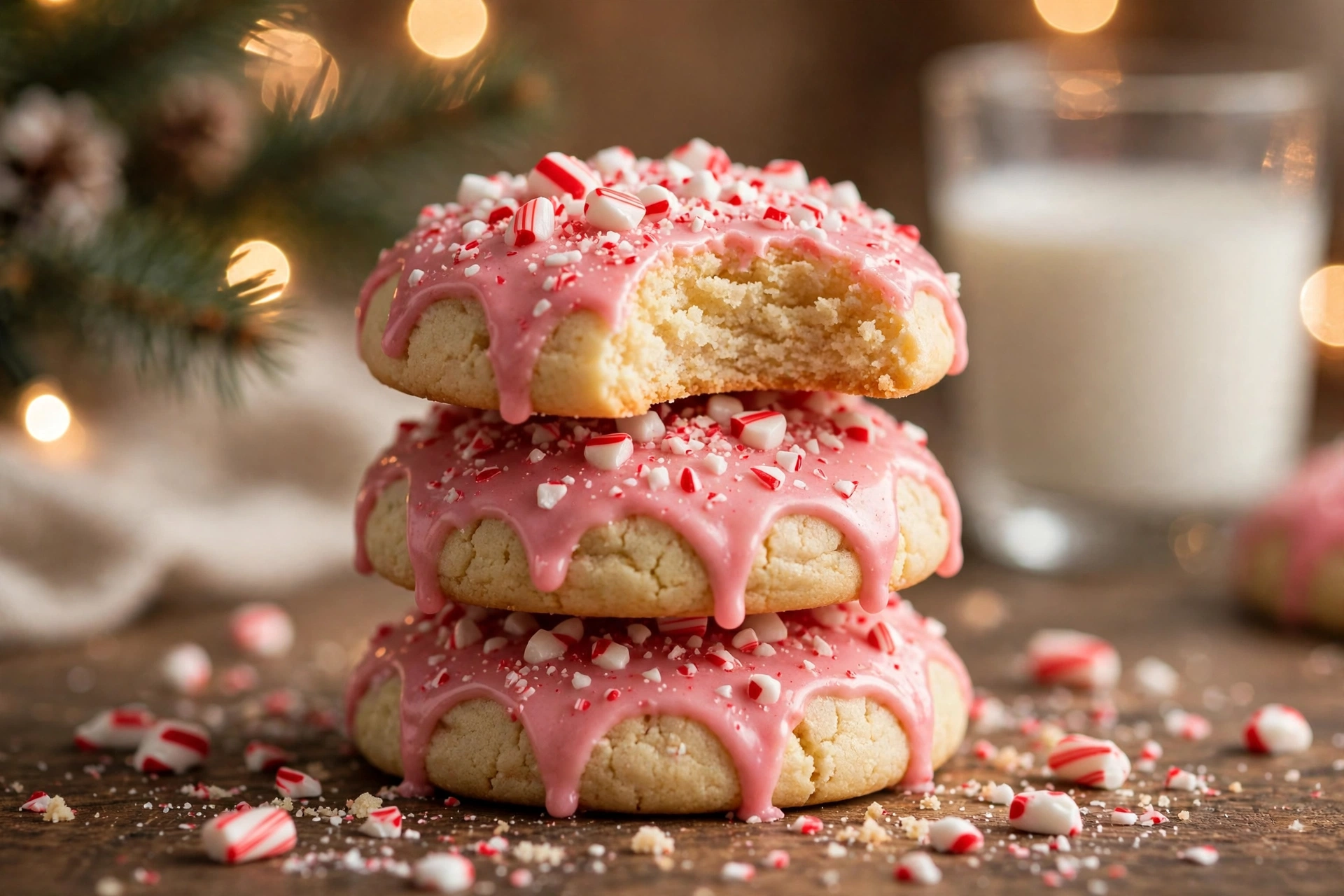
Work in small runs when you dip. Glaze thickens as it stands and as crumbs fall into it, so eight or ten cookies at a time, then a quick whisk and, if needed, a teaspoon of milk to bring it back. The last cookie should wear the same even cap as the first.
Dip, Do Not Drizzle: the Glaze Finish
Three finishes circulate for this cookie: a drizzle from a spoon, a spread with a knife, and the dip. The drizzle looks charming and tastes thin; the knife spread is tidy but slow across three dozen cookies.
The dip wins on both counts. Turned upside down into a thick glaze, each cookie takes an even cap in one motion, and the crushed candy pressed on immediately afterward holds in a complete, sparkling layer.
Thickness is the whole skill. The glaze should fall off the whisk in a slow ribbon and hold a peak for two seconds; too thin and it slides off, too thick and it sits in a lump.
Freezing Peppermint Meltaway Cookies for the Cookie Box
A cookie box lives or dies on its schedule, and peppermint meltaway cookies are built for the long game. The dough balls freeze raw for up to three months, ready to bake in any quiet December hour.
Freeze the rolled balls on a tray until solid, then bag them with the air pressed out. Bake them straight from frozen at the same temperature, adding one to two minutes, and they lose nothing at all.
Baked cookies freeze well too, but only unglazed, for up to two months. Glaze them after thawing, the day they go into the box, next to the gingerbread cookies, and they will taste like the morning’s work.
What never survives the freezer is the crushed candy. It drinks humidity as it thaws and turns tacky, so the sparkle is always a last day job, a rule the whole box follows, from the snowball cookies to the christmas pinwheel cookies.
The raspberry powder brings one more gift the dye never could: it perfumes the glaze faintly of fruit, which sits beautifully against the peppermint and makes tasters ask what the secret is. Ground freeze-dried strawberries work the same way, in a slightly warmer pink, and either keeps the ingredient list clean enough to read aloud.
Pink Without the Dye Bottle
The pink on a meltaway is half its identity, but it does not need a dye bottle. A teaspoon of freeze-dried raspberry powder, whisked into the glaze, gives a soft, natural pink with a whisper of berry.
The powder route asks for one adjustment: it thickens the glaze slightly, so add the milk a teaspoon at a time and stop at the slow ribbon stage described above.
Candy choice matters to the color story too. Classic red and white canes on pink glaze is the picture everyone knows; crushed green and white mints on a white glaze make a quieter, very pretty second tin.
Ball size quietly joins the same story. A ball rolled much bigger than an inch bakes with a raw center long after its edges have run, while a smaller one sets before it can spread at all. Two level teaspoons, rolled quickly with cool hands, is the size the whole recipe is tuned to.
Why Meltaways Spread, and the Fixes
A meltaway that puddles flat is telling you one of three things. The butter was melted rather than softened, the dough skipped its chill, or the balls went onto a sheet still warm from the previous batch.
The fixes are equally plain: butter that holds a fingerprint but not a dent, a full chill, and a cool sheet every time. A warm kitchen in December is the usual culprit behind all three.
If a batch is already rolled and the kitchen is hot, give the tray itself fifteen minutes in the fridge before it goes in the oven. Cold dough meeting a hot oven is what sets the dome before the butter can run.
If the tin will ride in a car to its destination, pack it like the fragile cargo it is: a snug tin, parchment between layers, and no empty headspace for the cookies to rattle in. Meltaways survive a week on the counter beautifully, but they do not survive a loose box and a bumpy road.
A Week in the Tin
Kept in a tin at room temperature, parchment between the layers, meltaways hold their texture for about a week. The candy topping softens first, so day five cookies are tender everywhere, which nobody has ever complained about.
The tin matters more than the calendar. These cookies trade flavors with their neighbors eagerly, so they keep best in their own container, away from anything spiced that might colonize the mint, a separation the candy cane cookies in the next tin will also appreciate.
For longer storage, the Virginia Tech Extension food storage guidelines are the reference I trust: frozen cookie dough keeps its quality for months, and this dough is one of the best freezers in my whole Christmas rotation.
That hidden handful is also the baker’s proof. A cookie good enough to hide from your own family is a cookie worth its place in the box, and this one, pale and plain as it looks, earns the hiding every single December without arguing with anybody.
The First Tin to Empty
Peppermint meltaway cookies are not the loudest cookie on the table. They are pale, quiet and small, and they are gone first anyway, because a cookie that dissolves asks to be followed by another.
Bake them once with the dip finish and the freezer plan, and the December scramble loses one of its battles. The tin fills early, the glaze waits for its morning, and the cook keeps a few back, hidden, for the quiet hour after the wrapping is done.
Questions About Peppermint Meltaway Cookies
Why did my peppermint meltaways spread into flat puddles?
Almost always warm dough: butter that was melted instead of softened, a skipped chill, or a baking sheet still warm from the last batch. Chill the rolled balls on their tray for 15 minutes before baking and they will hold their domes.
Can I freeze the cookies after they are glazed?
It is the one version that fails. The crushed candy drinks humidity in the freezer and turns tacky as it thaws. Freeze the cookies unglazed for up to two months, or the raw dough balls for up to three, and glaze on boxing day.
Is peppermint oil the same as peppermint extract in this recipe?
No, and the difference is large. Peppermint oil is several times stronger than extract; if oil is what you have, use a quarter of the amount, measured in drops, and taste the dough before adding more.
Why did the crushed candy cane on top turn sticky by day two?
Crushed candy is thirsty: it pulls moisture from the glaze and the air and slowly melts into a tacky layer. Store the cookies cool and dry with parchment between layers, and for gifts, add the candy the same day the box goes out.
Can these meltaways be made gluten free?
Yes, and they adapt better than most cookies because the cornstarch already does much of the textural work. Use a one to one gluten free flour blend, chill the dough a full hour, and bake exactly as written.

Peppermint Meltaway Cookies
Peppermint meltaway cookies with the cornstarch secret for a true melt: a butter and powdered sugar dough with flour and cornstarch, chilled firm, baked pale until just set, then dipped in pink peppermint glaze and pressed into crushed candy cane. Freezer friendly for cookie box season.
- Total Time: About 1 hour 50 minutes, most of it chilling and cooling
- Yield: 36 cookies 1x
Ingredients
- 1 cup unsalted butter, softened
- 1/2 cup powdered sugar
- 1/2 teaspoon peppermint extract
- 1/4 teaspoon vanilla extract
- 1 1/4 cups all-purpose flour
- 1/2 cup cornstarch
- 1/4 teaspoon fine salt
- 1 1/2 cups powdered sugar, for the glaze
- 2 tablespoons unsalted butter, softened, for the glaze
- 1/4 teaspoon peppermint extract, for the glaze
- 2 to 3 tablespoons milk
- 1 to 2 drops red food coloring, or 1 teaspoon freeze-dried raspberry powder
- 1/2 cup crushed candy canes or hard peppermint candies (about 6 candy canes)
Instructions
- Beat the butter and powdered sugar in a large bowl on medium speed until pale and creamy, 1 to 2 minutes. Beat in the peppermint extract and the vanilla.
- Add the flour, cornstarch and salt. Beat on low speed; the mixture will look like dry crumbs at first, so keep beating for 30 to 60 seconds until it gathers into a soft dough.
- Cover the bowl and refrigerate for 45 to 60 minutes, until the dough is firm enough to roll without sticking to your palms.
- Heat the oven to 350°F. Line two baking sheets with parchment paper.
- Roll the dough into 1 inch balls, about 2 teaspoons each, and set them 2 inches apart on the sheets. Leave them as balls; they settle into domes as they bake.
- Bake for 12 to 14 minutes, until the tops look matte and set and the bottoms are barely blond. Do not wait for golden edges.
- Rest the cookies on the sheet for 5 full minutes, then move them gently with a wide spatula to a rack and cool completely.
- Whisk the powdered sugar, softened butter, peppermint extract and milk into a thick, dippable glaze and tint it pink.
- Dip each cookie top into the glaze, press lightly into the crushed candy, and let the glaze set for 30 minutes before storing or boxing.
- Prep Time: 20 minutes, plus 45 to 60 minutes chilling
- Cook Time: 12 to 14 minutes per sheet
Nutrition
- Serving Size: 1
- Calories: 105
- Sugar: 8
- Sodium: 45
- Fat: 6
- Saturated Fat: 4
- Unsaturated Fat: 2
- Trans Fat: 0
- Carbohydrates: 13
- Fiber: 0
- Protein: 1
- Cholesterol: 15