
In this article:
- Why Roasting Makes This Sweet Potato Casserole Taste Deeper
- Roasted, Boiled or Canned: An Honest Comparison
- Sweet Potato Casserole Ingredients
- How to Make the Silky Filling
- A Pecan Streusel That Stays Crunchy
- The Marshmallow Compromise
- Sweeten to Your Potatoes, Not the Label
- The Thanksgiving Timeline
- FAQ
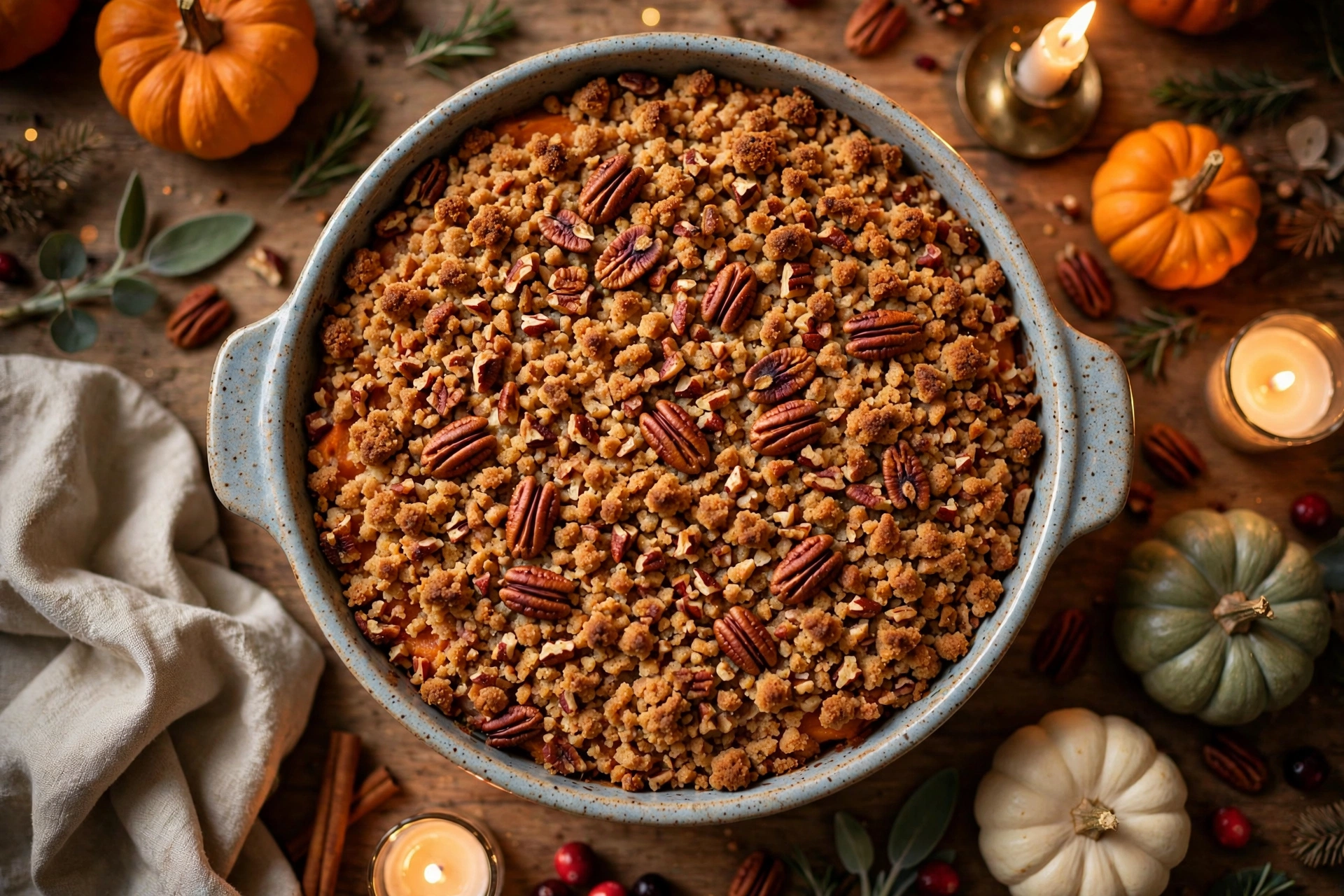
Every Thanksgiving table has one dish that pretends to be a vegetable and behaves like dessert. This sweet potato casserole is proudly that dish: a silky, deep orange filling under a rubble of brown sugar pecan streusel that shatters when the spoon goes in.
The casserole fails in two familiar ways. The filling turns watery and pale, or the streusel steams into a soft, sad blanket. Both failures are decided long before the dish reaches the oven: the first by how the potatoes are cooked, the second by when the topping goes on. This version roasts the potatoes until they slump, sweetens with restraint, and keeps the streusel off the dish until baking day.
It also makes peace in the oldest argument at the table. Streusel covers the whole casserole, and a modest drift of mini marshmallows lands on one half only, in the final minutes, for the people who insist. Everybody eats. Nobody relitigates.
Why Roasting Makes This Sweet Potato Casserole Taste Deeper
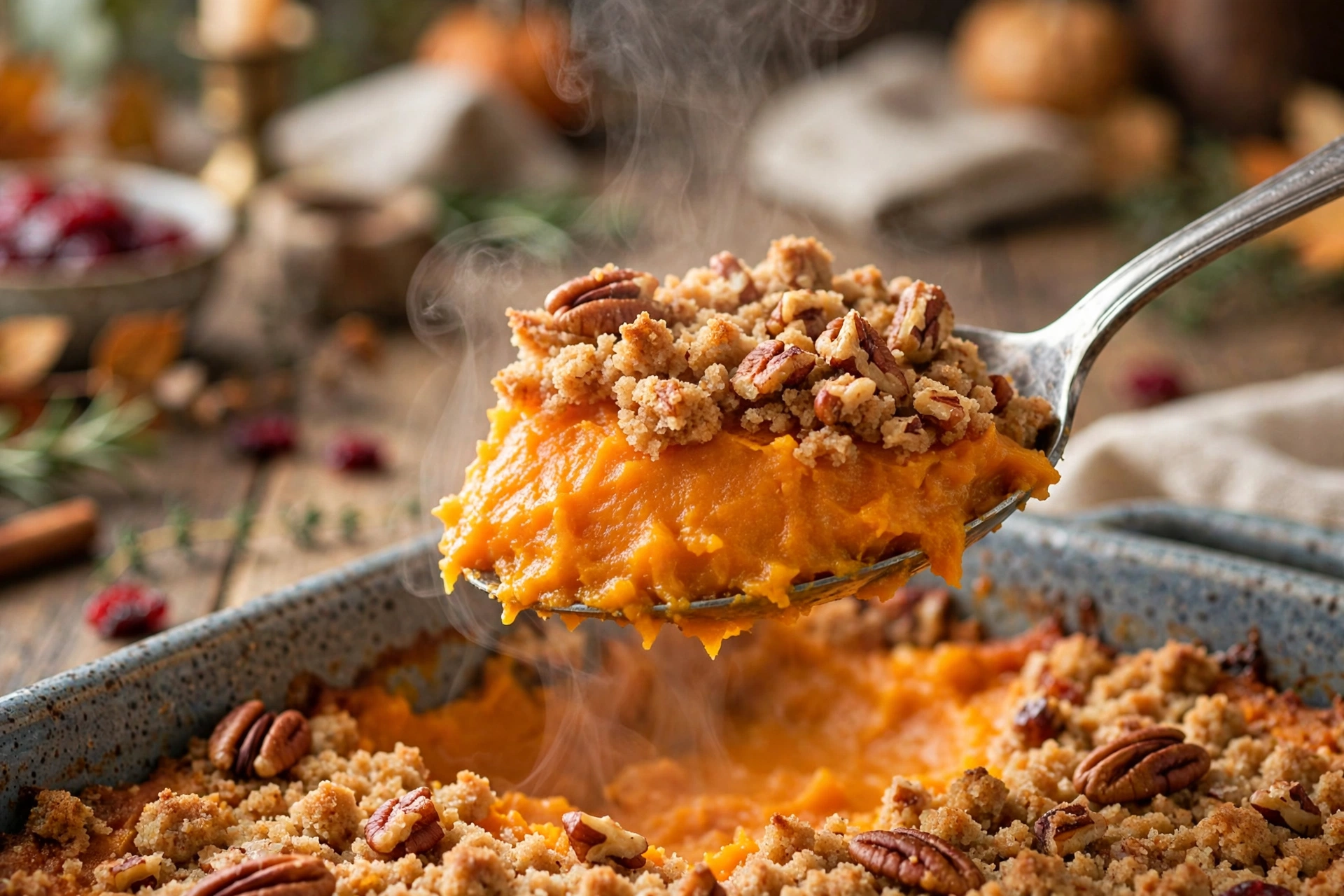
A sweet potato roasted whole, in its skin, does something boiling water cannot do for it: it concentrates. As the flesh slowly collapses over an hour of dry heat, its own sugars deepen toward caramel and the texture turns dense and almost custardy. The puree that comes out of a roasted potato needs less added sugar and holds its shape in the dish.
Boiling works against both goals. Cubed potatoes drink water as they cook, and that water rides into the casserole, where it loosens the filling and dulls the flavor so the cook compensates with more sugar. If you must boil, drain aggressively and return the cubes to the hot pot for two minutes to steam dry; it helps, but it never quite catches up to roasting.
Roasting has one more gift: timing. Whole potatoes roast unattended at 400°F (200°C) for fifty to sixty minutes, pierced with a fork and set on a foil lined tray, any day in the week before Thanksgiving. The flesh scoops out in seconds once cool, with no peeling, no dicing and no pot to wash. On the busiest cooking week of the year, the method that asks least is the method that wins.
Beat the roasted flesh while it is warm and it goes silky with a hand mixer in under a minute. Add cool ingredients to a steaming puree, though, and the eggs can catch and cook in fine threads. Warm, not hot, is the window where this sweet potato casserole becomes genuinely smooth.
Choosing the potatoes sets the ceiling for all of it. Garnet and jewel varieties, the ones with copper skins and deep orange flesh, roast up sweetest and give the casserole its saturated color. Pick potatoes of similar size so they finish together, and favor the heavy, firm ones without soft spots or sprouting eyes. A pale fleshed variety still makes a good casserole, but expect to land at the top of the sugar range and to miss the sunset color in the photos.
The dish itself matters a little too. A two quart ceramic or glass dish, about 9 by 13 inches or an oval of similar volume, bakes the filling at the depth where the center sets just as the streusel finishes. A much deeper dish needs five to ten more minutes and risks a loose middle; a wider, shallower one sets faster and gives you more streusel per serving, which nobody has ever complained about.
Roasted, Boiled or Canned: An Honest Comparison
Canned sweet potatoes are the shortcut nobody should be shamed for. They are consistent, already soft, and a well drained can makes a perfectly respectable casserole on a year when the oven schedule is a war zone. The flavor runs milder and the color paler, and the syrup they pack in means you should cut the added sugar by a third and taste before adding more.
Boiled fresh potatoes sit in the middle: better flavor than the can, more water to manage than the roast. If boiling is your habit, weigh the drained cubes and expect to add a tablespoon of flour to the filling for insurance, or bake the assembled filling ten minutes longer.
Roasting stays the recommendation for the holiday itself, when this dish is a centerpiece side and the table includes a green bean casserole and a bird that rested properly. The depth it gives is the difference between a casserole people take politely and one they ask about.
Whichever route you choose, decide once and write it on your plan. Casserole day is no day for method experiments, and the filling here is calibrated for roasted potatoes, with the adjustments above if you swap.
Sweet Potato Casserole Ingredients
For the filling: four large sweet potatoes, about three and a half pounds, roasted and scooped. A half cup of unsalted butter, melted. Two large eggs at room temperature. A third of a cup of brown sugar to start, with more only if your potatoes ask for it. A third of a cup of heavy cream, two teaspoons of vanilla extract, three quarters of a teaspoon of fine salt, a half teaspoon of cinnamon and a pinch of nutmeg.
For the streusel: one cup of chopped pecans, toasted. A half cup of all-purpose flour, a half cup of packed brown sugar, a quarter teaspoon of cinnamon, a pinch of salt, and five tablespoons of cold butter cut into small cubes. Cold is the operative word; the rubble texture lives or dies there.
Optional but encouraged: one cup of mini marshmallows, reserved for the final five minutes and for one half of the dish only.
How to Make the Silky Filling
Heat the oven to 400°F (200°C). Pierce each sweet potato several times, set them on a foil lined tray, and roast fifty to sixty minutes, until they slump and a knife slides through like warm butter. Cool until you can handle them, halve them, and scoop the flesh into a large bowl. You should have about four cups.
Lower the oven to 350°F (175°C). Beat the flesh smooth with a hand mixer. Add the melted butter, brown sugar, cream, vanilla, salt, cinnamon and nutmeg, and beat until unified and glossy. Let the mixture stand five minutes so it is warm rather than hot, then beat in the eggs one at a time, just until incorporated. Overbeating after the eggs adds air, and air makes a filling that puffs and falls.
Spread the filling into a buttered two quart baking dish and smooth the top. At this point the dish can be covered and refrigerated for up to forty eight hours, which is exactly where it should wait while Thanksgiving gathers around it. The streusel, pointedly, does not go on yet.
A Pecan Streusel That Stays Crunchy
Toast the chopped pecans first, in a dry skillet over medium heat or on a tray at 350°F for six to eight minutes, until they smell like warm pie. Toasting is the difference between nuts that merely sit in a topping and nuts that flavor it. Cool them completely before mixing; warm nuts melt the butter and the rubble becomes paste.
Rub the cold butter cubes into the flour, brown sugar, cinnamon and salt with your fingertips until the mixture is all coarse crumbs and pea sized pieces. Fold in the cooled pecans. This bowl can wait in the refrigerator, covered, for two days, or in the freezer for a month.
The rule that protects the crunch is simple: streusel goes on the day of baking, onto a filling that is at room temperature or better, never onto a casserole destined to sit dressed in the refrigerator. Moisture climbs from the filling overnight and the topping steams instead of crisping. Scatter it generously on baking day, bake thirty to thirty five minutes at 350°F until the edges bubble and the top is deeply golden, and the crust will still crackle at the table.
Make a double batch of streusel while your hands are in it. The extra bag freezes for a month and turns a plain baked sweet potato, a bowl of roasted apples or a tray of muffins into something planned. Brown sugar, flour, cinnamon and cold butter keep their ratios in any quantity, and future you, standing in front of an ordinary Tuesday dinner, will be grateful.
One more texture secret hides in the pecans themselves: chop them coarse, not fine. Pieces around the size of a pea stay distinct in the rubble and crunch individually; pecan dust disappears into the crumbs and the topping reads as sweet sand. The contrast this casserole is loved for lives in those distinct, buttery pieces.
The Marshmallow Compromise
Families divide on marshmallows with a seriousness usually reserved for politics. The compromise that ends the argument in this house: the pecan streusel covers everything, because it is structurally part of the dish, and mini marshmallows scatter over one half in the last five minutes of baking, pulled as soon as they puff and bronze at the tips.
Marshmallows added too early dissolve into the filling and vanish into sweetness with no identity. Added at the five minute mark, they blister, toast and stay themselves. Watch them closely; the distance between golden and scorched is about ninety seconds, and the cook who walks away to carve anything will learn that personally.
Serve the dish with the marshmallow half turned toward the marshmallow people. Diplomacy, plated.
There is a practical bonus to the split finish: leftovers reheat more honestly. The streusel half revives in a hot oven exactly as it was, while the marshmallow half, reheated gently, turns gooey again rather than tough. Scoop across the border in a single serving and you get crunch, silk and one toasted marshmallow in the same bite, which may be the best argument that the compromise was never really a compromise.
If your household is firmly one camp, bake two smaller dishes instead of arguing ratios: one classic streusel in an 8 inch dish, one marshmallow topped for the traditionalists. The recipe divides cleanly in half, the bake time drops by about five minutes, and Thanksgiving gains a side dish and loses a debate.
Sweeten to Your Potatoes, Not the Label
Recipes print one sugar quantity as if all sweet potatoes were identical. They are not. A roasted garnet can be nearly dessert sweet on its own; a paler variety may genuinely need the full measure. Taste the warm puree before the sugar bowl comes out. Start with a third of a cup of brown sugar, stir, and taste again with the salt and vanilla in, because both make sweetness read louder without adding any.
If your table likes this casserole firmly in side dish territory, hold at the third of a cup and let the streusel carry the dessert note. If yours treats it as a pre-dessert, a half cup is the ceiling; beyond that the potato disappears behind the sugar and the dish loses its identity.
A maple variation replaces the brown sugar in the filling with a quarter cup of maple syrup and adds a pinch of black pepper, which sounds like a dare and tastes like the filling simply became more itself. It is the version to make once the classic is muscle memory.
The Thanksgiving Timeline
Each serving carries about 385 calories, 46 grams of carbohydrate, 20 grams of fat and 4 grams of protein, which is the honest price of a side dish wearing a streusel hat.
Three days out, roast the potatoes and make the filling; refrigerate it in its dish. Two days out, mix the streusel and refrigerate it separately. This sweet potato casserole now waits, fully calm, for its one job.
On the day, take the filling out of the refrigerator an hour before baking so it loses its chill. When the turkey comes out to rest, scatter the streusel and slide the casserole into the freed oven at 350°F for thirty to thirty five minutes; it bakes in exactly the window the bird needs to rest, a scheduling gift pointed out by generations of cooks. Marshmallows, if your house votes yes, go on at minute thirty for the final five.
For the whole table planned course by course, our Thanksgiving dinner menu lays it out, and a classic pumpkin pie made the day before closes the meal without touching the oven at all. Leftovers keep four days refrigerated and revive at 375°F for ten minutes to bring the streusel back to a crackle.
Roast the potatoes, season to their sweetness, keep the topping dry until its moment, and this is the casserole that converts the people who claim not to like sweet potatoes. It has happened at this table more than once.
Serve it warm, never piping hot, with the spoon standing in the dish so the first scoop shows off the layers. Ten minutes of rest after the oven lets the filling settle into slices that hold, and the streusel stays loud enough to hear across the table.
FAQ
Why is my sweet potato casserole watery?
Almost always the potatoes were boiled and under drained, or canned potatoes went in with their syrup. Roast the potatoes whole so the flesh stays dense, and if you boil or use canned, drain aggressively and steam the cubes dry in the hot pot for 2 minutes before mashing.
Why did the pecan streusel on my sweet potato casserole go soft?
The topping sat on the filling too long before baking, usually overnight in the refrigerator, and absorbed its moisture. Keep the streusel in a separate bowl and scatter it over the sweet potato casserole on baking day only. To revive leftovers, bake at 375°F for 10 minutes.
Can I make sweet potato casserole ahead of time?
Yes, and it improves the holiday. Make the sweet potato casserole filling up to 48 hours ahead and refrigerate it in its dish. Mix the streusel separately and keep it cold. Assemble the topping the day of baking, let the filling lose its chill for an hour, and bake as directed.
Can I freeze sweet potato casserole?
Freeze the sweet potato casserole filling, without streusel, for up to 3 months, wrapped tightly in its dish. Thaw overnight in the refrigerator, add fresh streusel, and bake. Freezing the assembled dish with the topping on softens the streusel, so keep them apart.
Why did the marshmallows burn on my sweet potato casserole?
They went in too early or the dish sat too close to the top element. Add mini marshmallows only in the last 5 minutes of baking, on the middle rack, and watch them continuously: they move from golden to scorched in about 90 seconds.
Sweet Potato Casserole with Pecan Streusel
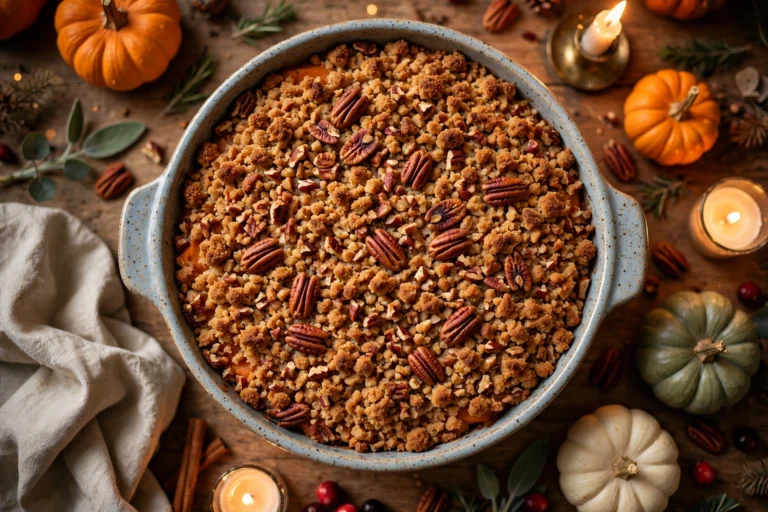
A silky sweet potato casserole built on whole roasted potatoes for deep, concentrated flavor, sweetened to taste and finished with a crunchy toasted pecan streusel that goes on the day of baking so it stays crisp. Mini marshmallows on one half keep the whole table happy.
- Total Time: 2 hours 5 minutes
- Yield: 10 servings 1x
Ingredients
- 4 large sweet potatoes (about 3 1/2 pounds), for about 4 cups roasted flesh
- 1/2 cup unsalted butter, melted
- 1/3 cup packed brown sugar, plus more to taste
- 1/3 cup heavy cream
- 2 large eggs, at room temperature
- 2 teaspoons vanilla extract
- 3/4 teaspoon fine sea salt
- 1/2 teaspoon ground cinnamon
- Pinch of ground nutmeg
- 1 cup pecans, toasted and coarsely chopped
- 1/2 cup all-purpose flour
- 1/2 cup packed brown sugar (for the streusel)
- 1/4 teaspoon ground cinnamon (for the streusel)
- Pinch of salt (for the streusel)
- 5 tablespoons cold unsalted butter, cut into small cubes
- 1 cup mini marshmallows (optional, for half the dish)
Instructions
- Heat the oven to 400°F (200°C). Pierce the sweet potatoes, set them on a foil lined tray, and roast 50 to 60 minutes, until they slump and feel very soft.
- Cool slightly, halve, and scoop the flesh into a large bowl. Lower the oven to 350°F (175°C).
- Beat the flesh smooth with a hand mixer. Beat in the melted butter, brown sugar, cream, vanilla, salt, cinnamon and nutmeg until glossy.
- Let the mixture stand 5 minutes so it is warm, not hot, then beat in the eggs one at a time, just until incorporated.
- Spread the filling into a buttered 2 quart baking dish and smooth the top. (The dish can rest, covered, in the refrigerator for up to 48 hours at this point.)
- Rub the cold butter cubes into the flour, streusel brown sugar, streusel cinnamon and salt until coarse crumbs form. Fold in the cooled toasted pecans.
- Scatter the streusel generously over the filling on baking day.
- Bake 30 to 35 minutes, until the edges bubble and the streusel is deeply golden.
- If using, scatter the mini marshmallows over one half and bake 5 minutes more, watching closely, until puffed and golden at the tips.
- Rest 10 minutes before serving so the filling sets into clean scoops.
- Prep Time: 25 minutes
- Cook Time: 35 minutes