
In this article:
This baked mac and cheese is the Thanksgiving side I stopped making on Thanksgiving. It goes into its dish on Wednesday, sauce and all, sleeps in the fridge, and bakes on Thursday while the turkey rests, with a top that still comes out deep gold and crisp.
The trick is not a secret ingredient. It is a sauce built to wait: a proper roux, warm milk, one quiet block of cream cheese for stability, and the buttered crumbs held back until bake day, so nothing in the pan turns soft overnight.
Why This Baked Mac and Cheese Survives the Night in the Fridge
This baked mac and cheese works the day after assembly because the sauce is engineered for the wait. A roux of butter and flour gives the milk a structure that reheating cannot easily break, so the sauce stays glossy instead of splitting into grease and curds.
Cream cheese is the quiet stabilizer. Four ounces melt invisibly into the sauce and do the job that processed cheese does in old recipes: they keep the emulsion calm through chilling, baking and even the second warm-up of leftovers.
The pasta is deliberately undercooked, two full minutes shy of the package time. Overnight, the elbows keep drinking sauce in the cold dish, and they finish at exactly tender in the oven instead of sliding past it into mush.
Cheese choice matters more than cheese quantity. Sharp cheddar brings the voice, Gruyère brings the pull and a faint nuttiness, and a little Parmesan sharpens the edges. All three melt cleanly when they go in off the heat, one handful at a time.
Finally, the crumbs never meet the sauce until Thursday. Panko mixed with butter and Parmesan waits in a jar on the counter, so the top bakes up as a real crust instead of a steamed, soggy blanket.
Silky in the Middle, Shattering on Top
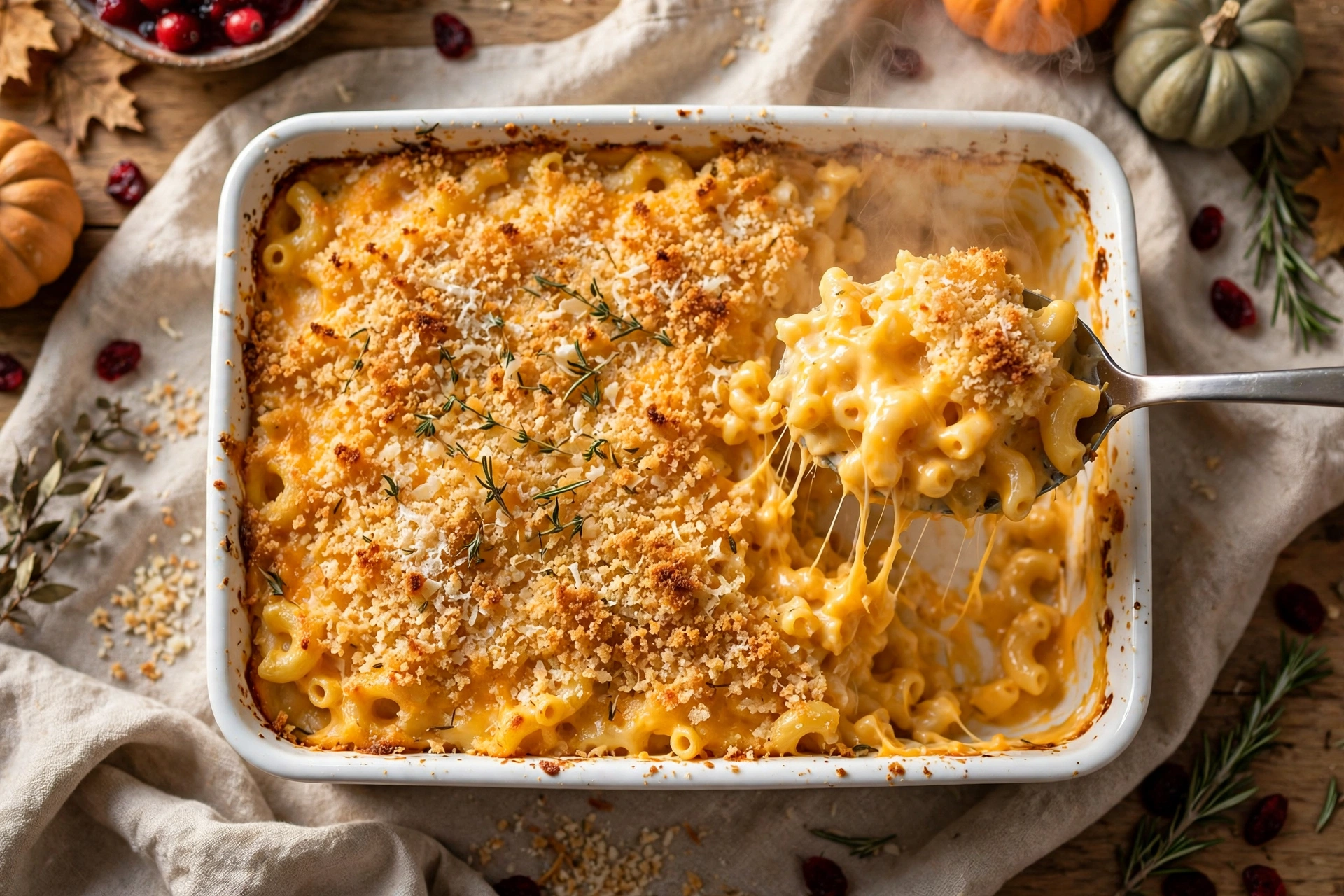
The first spoonful should move slowly. The sauce coats each elbow in a continuous sheen, thick enough to cling, loose enough to pool slightly in the corners of the dish where the serving spoon goes last.
Cheddar leads, unmistakably, but the Gruyère stretches the flavor longer across the palate. A thread of mustard powder and a whisper of nutmeg sit underneath, never named by anyone at the table, simply making the cheese taste more like itself.
On top, the panko bakes into separate, buttery shards that crackle against the spoon. That contrast, crisp crumbs over a flowing center, is the whole architecture of the dish, and it survives because the crumbs went on at the last possible minute.
The edges deserve their own sentence. Where the sauce meets the buttered dish it fries gently into lacy, deep gold cheese, and those corner servings carry a toasted flavor the middle cannot offer. In my house the corners are spoken for before the dish leaves the kitchen.
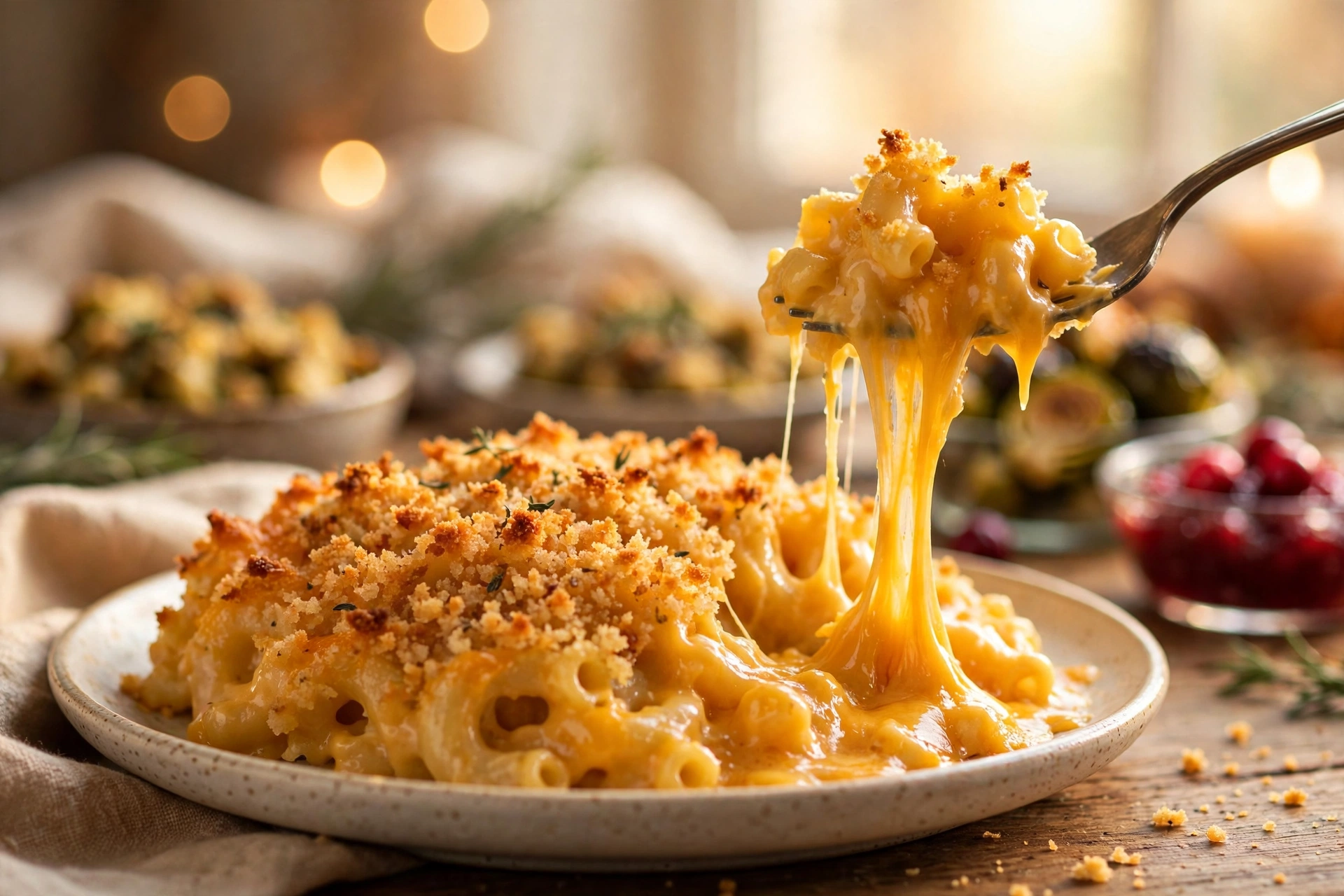
Served at the right moment, the mac steams, stretches and settles into its serving in one motion. Ten minutes of rest after the oven is the difference between a sauce that runs off the spoon and one that drapes over it.
The cheese pull is real but disciplined, a few inches of Gruyère stretch rather than a mozzarella rope. That restraint is a compliment to the dish: the sauce stays where the spoon puts it, on the plate, next to the turkey, instead of sliding toward the cranberry sauce.
Wednesday Assembly, Thursday Bake
Wednesday is a twenty five minute job with one pot and one dish. Boil the pasta, build the sauce in the same pot, fold, scrape, cover. Nothing about it competes with the pies and the brining happening around it.
The dish then waits in the coldest part of the fridge for up to twenty four hours. This is not a compromise version of the recipe; the overnight rest is the recipe, and the flavors settle into each other in a way a same day pan does not match.
Thursday asks for almost nothing. The dish stands on the counter while the oven heats, takes a drizzle of milk and its crumbs, and bakes in the exact window when the turkey comes out and needs its rest anyway.
Everything else on the table is planned around that same logic this year. The Thanksgiving dinner menu runs on dishes that wait patiently, from the gravy to the potatoes, so the cook sits down with everyone else.
If your table needs the oven free on Thursday instead, bake the mac fully on Wednesday and reheat it covered at 325°F. The top loses a little of its crackle, and a handful of fresh crumbs scattered before serving brings most of it back.
The dish also travels better than most Thanksgiving sides, which makes it a strong Friendsgiving assignment. Assemble it in a disposable pan, keep the crumb jar in your coat pocket, and give it its bake in the host’s oven while everyone is still finding their seats.
One honest limit: this baked mac and cheese is built for a full table. Halving it in an 8 inch square dish works, with five minutes off the bake, but a double pan for a crowd is better split across two dishes so the centers set at the same pace as the edges.
What You Need for the Mac
For the pasta and the sauce, everything weighed and within reach before the water boils, because once the roux starts there is no pausing to hunt for the mustard:
- 1 pound elbow macaroni (about 4 cups dry)
- 6 tablespoons unsalted butter, plus more for the dish
- 6 tablespoons all-purpose flour
- 3 1/2 cups whole milk, warmed
- 1 cup heavy cream (or half and half)
- 4 ounces cream cheese, cut in cubes and softened
- 1 teaspoon dry mustard
- 1/2 teaspoon sweet paprika
- 1/4 teaspoon garlic powder
- 1 teaspoon fine salt, plus more for the pasta water
- 1/2 teaspoon black pepper
- 1 pinch ground nutmeg
- 3 cups shredded sharp cheddar (about 12 ounces), shredded from a block
- 2 cups shredded Gruyère (about 8 ounces)
- 1/2 cup finely grated Parmesan
For the topping, which is mixed in the same Wednesday session but kept apart in its jar, plus the small bottle of milk that wakes the sauce up on Thursday:
- 1 cup panko breadcrumbs
- 2 tablespoons unsalted butter, melted
- 1/3 cup finely grated Parmesan
- 1 tablespoon chopped fresh parsley, to serve (optional)
- 1/4 cup whole milk, for bake day
Building the Mac, Pot to Dish
- Bring a large pot of well salted water to a boil. Cook the macaroni 2 minutes less than the package directs for al dente, then drain it without rinsing and tip it back into the warm pot.
- Melt the 6 tablespoons of butter in the same pot over medium heat. Whisk in the flour and cook, whisking steadily, for 2 minutes, until the roux turns pale gold and smells faintly toasty.
- Pour in the warm milk and the cream in a slow stream, whisking without stopping. Simmer 4 to 5 minutes, still whisking, until the sauce thickens enough to coat the back of a spoon and hold a line drawn through it.
- Take the pot off the heat. Whisk in the mustard, paprika, garlic powder, salt, pepper and nutmeg, then drop in the cream cheese and stir until it disappears completely into the sauce.
- Add the cheeses a handful at a time, cheddar first, then Gruyère, then the Parmesan, stirring each handful until melted before the next. Never let the sauce boil once the cheese is in.
- Fold the drained macaroni through the sauce until every elbow is glossy and coated. Scrape everything into a buttered 9×13 inch dish and level the top with the back of the spoon.
- To make ahead, cool the dish 30 minutes, cover it tightly and refrigerate for up to 24 hours. Stir the panko with the melted butter and the topping Parmesan and keep it in a sealed jar at room temperature.
- On bake day, let the dish stand 30 minutes at room temperature. Drizzle the 1/4 cup of milk over the surface, scatter the panko mixture evenly, and bake at 375°F for 25 to 30 minutes, until the edges bubble and the top is deep golden. Baking the same day instead: top it right away and give it 20 to 25 minutes.
- Rest the dish 10 minutes so the sauce settles into its drape. Scatter the parsley, if using, and carry it straight to the table.
The Panko Goes On Last, and Other Insurance
Grate your own cheese, at least for the cheddar. Bagged shreds carry anti caking starches that melt into a slightly grainy sauce, and the difference is impossible to hide in a dish this simple. Ten minutes with a box grater buys a silkier pan.
Warm milk is not a fussy detail. Cold milk hitting a hot roux seizes into lumps that no whisk fully rescues, while warm milk folds in smoothly and thickens evenly. A minute in the microwave or a small pan is all it takes.
Judge the sauce before the pasta goes in, not after. Off the heat it should pour like a thick ribbon and taste a shade too salty and a shade too loose. The pasta will drink, the salt will spread, and the bake will tighten everything to exactly right.
If the sauce ever breaks, heat is almost always the cause. Pull the pot off the burner, whisk in a splash of warm milk, and let the temperature fall before the cheese goes in. Cheese melted gently stays melted; cheese boiled once never quite forgives.
Readers who love this style of pan should know it sits comfortably beside our other versions: the Chick-fil-A style mac and cheese for weeknights, and the creamy slow cooker mac and cheese when the oven is spoken for entirely.
Cheese Swaps That Still Melt Right
The formula to protect is not the exact trio, it is the balance: one sharp voice, one smooth melter, one salty accent. Keep those three roles and the sauce behaves, whatever the cheese drawer offers in late November.
Gruyère swaps cleanly with fontina, young Gouda or a mild Swiss, all of which melt into the same stretch. Cheddar can go white and extra sharp for a paler, tangier pan, or meet a cup of pepper Jack if your table likes a low warmth under the richness.
What does not work is a pan built on mozzarella alone, which bakes up stringy and bland, or on aged, crumbly cheeses alone, which melt into oil. A younger, moister cheese must always carry at least half the total weight.
For a lighter pan, trade the cream for more milk and cut the cheddar to two cups, then lean harder on mustard and nutmeg. The result reads as a weeknight mac rather than a holiday one, but the make ahead structure survives intact.
One swap deserves a warning label: smoked cheeses. A little smoked Gouda reads as depth; a lot reads as a campfire that wandered into the wrong holiday. Keep smoked cheese under a quarter of the total, and let the cheddar keep the microphone.
Holding It Warm While the Turkey Rests
The bake is timed for the turkey’s rest, and the mac tolerates company well. Covered loosely with foil, it holds its texture for a good 30 to 45 minutes in a 200°F oven while the bird is carved and the gravy is finished.
At the table it shares its row with the other Wednesday workers: the make-ahead mashed potatoes on one side and the green bean casserole on the other, none of them asking the cook for anything at the last minute.
Leftovers keep 3 to 4 days in the fridge in a covered container, in line with the USDA guidance on leftover safety. Reheat single portions with a spoonful of milk stirred in, covered, until steaming, and the sauce returns to nearly its first day gloss.
The assembled, unbaked dish also freezes well for up to 2 months, wrapped twice. Thaw it overnight in the fridge, then treat it exactly like the Wednesday pan: counter rest, milk drizzle, fresh crumbs, same bake.
The Side That Empties First
This baked mac and cheese earns its Thanksgiving place by subtraction: one pot on Wednesday, one calm bake on Thursday, and nothing at all asked of the cook in between. What arrives at the table tastes like it was made to order minutes before.
Make it once by the plan, with block cheese, warm milk and the crumbs held back. Next year the only question at your table will be whether one pan is honestly going to be enough.
Double the recipe only if your table truly eats like it. Two pans bake side by side, rotate once at the halfway mark, and hold even better than one, because the second pan becomes the built in second helping nobody has to ask for.
Questions About This Mac and Cheese
FAQ
Can I assemble this baked mac and cheese two days ahead instead of one?
One night is the sweet spot. At two nights the pasta keeps drinking sauce in the fridge and bakes up softer, even with the milk drizzle. If you need two days, assemble and freeze the dish instead, then thaw it overnight before baking.
Why did my cheese sauce turn grainy when I reheated it?
Two usual causes: the sauce boiled after the cheese went in, or the cheese came from a bag of pre shredded cheese with anti caking starch. Reheat leftovers gently with a spoonful of milk and steady whisking, and grate block cheese for the next pan.
Does the panko really have to stay off the dish overnight?
Yes. Crumbs sitting on a wet sauce for 24 hours hydrate fully and steam soft in the oven instead of crisping. Kept dry in a jar and scattered on at bake time, the same panko bakes into a genuinely crisp crust.
Which pasta can stand in for elbows in this recipe?
Short, ridged shapes with a hollow or a twist hold the sauce best: cavatappi, medium shells or penne all work in the same weight. Long pasta breaks and slices badly in a baked pan, so save it for stovetop versions.
Can I bake this mac and cheese in a slow cooker instead?
The assembled dish can hold and reheat in a slow cooker on low, but it will not build the crisp panko crust that defines this version. For a fully slow cooked pan, use our creamy slow cooker mac and cheese, which is written for that appliance from the start.