
In this article:
Cauliflower gratin is the Thanksgiving side that quietly outshines the bird: tender florets under a Gruyere and cheddar sauce, a panko and parmesan top that crackles, and not a drop of watery sauce pooling at the bottom of the dish.
That last part is where most gratins fail, and it is not the cheese’s fault. Cauliflower carries a surprising amount of water inside its florets, and it gives that water up in the oven, right into your sauce. This recipe deals with the water before the dish ever goes in.
The other design decision is the calendar. The gratin assembles completely on Wednesday, topping left off, and bakes on Thursday with exact times from the refrigerator. One less dish fighting for attention while the turkey rests.
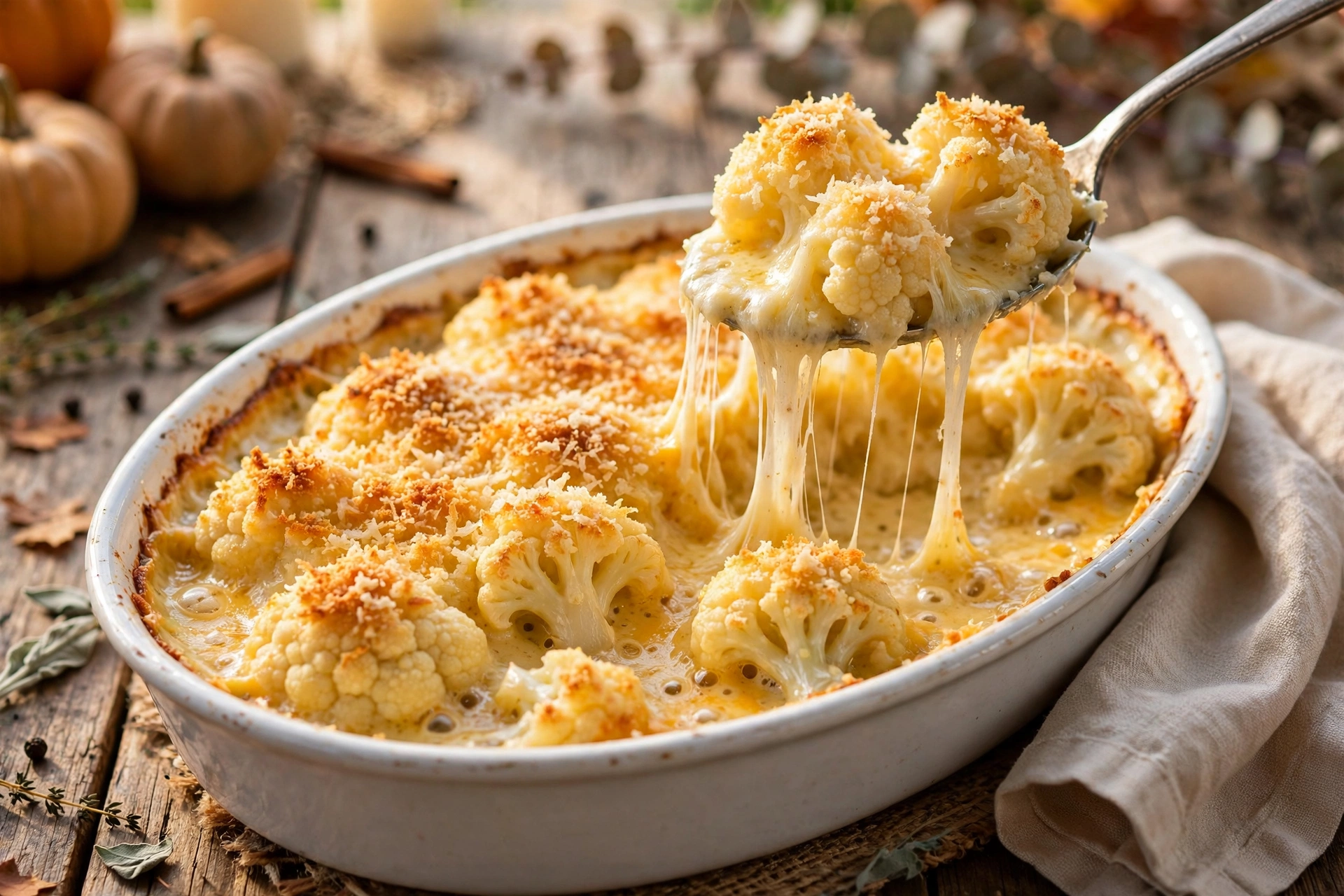
A Cheese Sauce That Stays a Sauce
Cauliflower gratin depends on a bechamel that can hold its body, so this one is built slightly thicker than a sauce meant for pasta. Three tablespoons of flour against three cups of dairy gives a coating that clings to the florets instead of sliding off them.
The cheese goes in off the heat, a handful at a time. A bechamel that is still bubbling when the cheese lands will seize and turn grainy, and no amount of whisking brings it fully back. Off the heat, the residual warmth melts Gruyere and cheddar into silk.
Dijon mustard and a small grating of nutmeg are doing quiet work in the background. Neither one is identifiable in the finished dish, but together they sharpen the cheese flavor the way salt sharpens everything else. Skip them and the gratin tastes flat in a way people notice without naming.
The sauce also waits well, which is what makes the whole make ahead structure possible. Built Wednesday, it reheats gently and folds over the florets without breaking, because a properly made bechamel is stable by design.
One proportion to respect: roughly three cups of finished sauce for two heads of cauliflower. Less and the top florets bake dry; more and the dish swims. The quantities below hit that balance in a shallow dish, where the sauce layer stays thin enough to set.
Golden Top, Tender Middle, No Mush
The first spoonful should crackle. Panko and parmesan, tossed with olive oil, toast into a crust that holds its crunch against the creamy sauce underneath, and it goes on only at baking time so it never steams soft in the refrigerator.
Under the crust, the florets keep their shape. Blanching for exactly four minutes takes the raw edge off the stems while leaving the florets firm, and the bake finishes them to tender without collapse. A floret you can cut with the side of a spoon, but that still reads as a vegetable, is the target.
Gruyere brings the nutty, almost sweet depth that makes people ask what is in it. Sharp cheddar brings the familiar comfort and most of the color in the sauce. The split is deliberate: all Gruyere tastes elegant but distant, all cheddar tastes like mac and cheese in a costume.
Rest the gratin ten minutes before it goes to the table. The sauce, which bubbles loose at the edges in the oven, sets just enough to coat each spoonful instead of running across the plate. Serve it in the dish it baked in, still warm enough that the top audibly settles.
The Steam Dry Step That Saves the Gratin
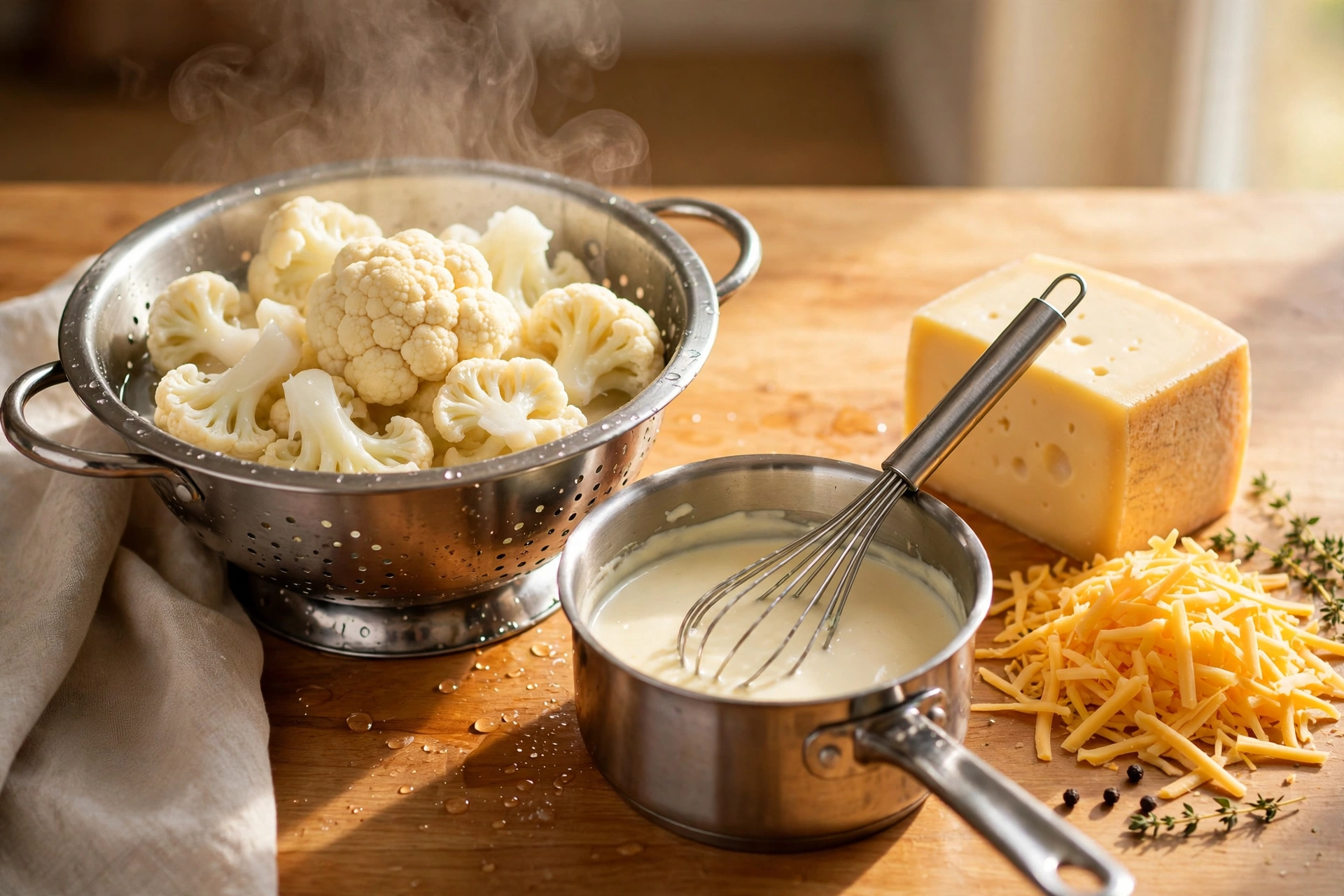
Here is the step no first page recipe quantifies, and it is the difference between this cauliflower gratin and a soupy one. After the four minute blanch, the florets sit in the colander, steaming, for a full ten minutes before they meet the sauce.
Blanched cauliflower holds water in two places: on the surface of every floret, and inside the little branches where the florets divide. A quick shake removes almost none of it. Ten minutes of steam drying, with one or two tosses, lets the surface water evaporate while the florets are still hot, and that water is exactly the amount that would have thinned your sauce.
You can watch it work. The colander steams hard for the first few minutes, then slows, and the florets go from glossy and wet to matte and just damp. Matte is the signal. That is when they are ready for the sauce.
If you are short on time, spread the florets on a clean towel lined sheet pan instead. The towel wicks what the colander misses, and five minutes on the pan beats skipping the drying altogether.
The same step protects the make ahead version. Florets that go into the refrigerator wet keep weeping overnight, and the sauce thins before the dish ever bakes. Florets that go in dry hold their sauce from Wednesday to Thursday without change.
What Goes Into the Gratin
Two large heads of cauliflower sound like a lot until they are cut down; florets shrink as they blanch, and a shallow dish fills fast. Shred the cheeses yourself if you can. Pre-shredded cheese carries anti-caking starch that dulls a sauce, the same caution that applies to the cheese in our butternut squash gratin. Cauliflower nutrition figures are easy to confirm at USDA FoodData Central.
- 2 large heads cauliflower (about 4 1/2 pounds), cut into bite size florets
- 3 tablespoons unsalted butter
- 2 cloves garlic, grated
- 3 tablespoons all-purpose flour
- 2 1/2 cups whole milk
- 1/2 cup heavy cream
- 1 teaspoon Dijon mustard
- 1/4 teaspoon ground nutmeg
- 1 teaspoon fine salt
- 1/2 teaspoon black pepper
- 1 1/2 cups shredded Gruyere cheese
- 1 cup shredded sharp cheddar cheese
- 3/4 cup panko breadcrumbs
- 1/3 cup grated parmesan cheese
- 1 tablespoon olive oil
- 1 teaspoon fresh thyme leaves
The dish itself matters more than it should. A shallow 2 1/2 quart dish, or a 9 by 13, gives the topping maximum surface and keeps the sauce layer thin enough to set. A deep, narrow dish traps steam and undoes the drying step.
Blanch, Dry, Sauce, Bake
- Heat the oven to 375 degrees F. Butter a 2 1/2 quart baking dish, or a shallow 9 by 13 inch dish.
- Bring a large pot of well salted water to a rolling boil. Add the cauliflower and blanch 4 minutes, until the thickest stems are just tender at the tip of a knife.
- Drain in a colander and leave the florets steaming in the colander for a full 10 minutes, tossing once or twice, until the surfaces look dry. This step keeps the sauce thick.
- Melt the butter in a medium saucepan over medium heat. Add the garlic and cook 30 seconds. Whisk in the flour and cook 1 minute, until it smells faintly nutty.
- Slowly whisk in the milk and cream. Simmer, whisking, 3 to 4 minutes, until the sauce coats the back of a spoon. Remove from the heat.
- Whisk in the mustard, nutmeg, salt and pepper. Add the Gruyere and cheddar a handful at a time, stirring until melted and smooth.
- Tip the dried cauliflower into the dish and pour the sauce over. Fold gently until every floret is coated. At this point the gratin can be covered and refrigerated up to 24 hours, without the topping.
- Toss the panko with the parmesan and olive oil. Scatter over the gratin just before baking.
- Bake 25 to 30 minutes from a room temperature assembly, or 40 to 45 minutes from the refrigerator with the first 25 minutes covered in foil, until the sauce bubbles at the edges and the top is deep gold.
- For a darker top, broil 1 to 2 minutes. Rest 10 minutes, scatter the thyme and serve hot.
Assembled Wednesday, Baked Thursday
The full holiday schedule looks like this. Wednesday, at whatever hour the kitchen is calm: blanch, steam dry, build the sauce, assemble, cover, refrigerate. Twenty active minutes, and the dish joins the rest of the advance work, the way the staples in our Thanksgiving dinner menu are staggered across the week.
Thursday, the topping is mixed while the oven heats, scattered over the cold gratin, and the dish goes in covered for 25 minutes, then uncovered for 15 to 20 more. From the refrigerator it needs those times; from a same day assembly it bakes faster, 25 to 30 minutes total.
Keep the assembled dish at 40 degrees or below until it bakes; holiday dishes do not sit out on the counter, per the standard FoodSafety.gov guidance. The foil cover during the cold bake is what lets the center heat through before the top races ahead.
For a buffet, the baked gratin holds beautifully. Keep it in a 200 degree oven, uncovered, up to 45 minutes and the top stays crisp. A lid or a tight foil tent traps steam and softens the crust you timed so carefully.
Leftovers keep four days in the refrigerator and reheat at 325 degrees until the center is hot, about 20 minutes. The gratin sits naturally beside the other make ahead sides on the table, from scalloped potatoes to the make-ahead mashed potatoes that anchor the end of the table.
If the Sauce Splits or Thins
Sauces misbehave in predictable ways, and each one has a specific rescue. If the cheese goes grainy, the sauce was too hot when the cheese went in. Take it off the heat, whisk in a spoonful of cold milk, and stir until it relaxes; it will not be perfect, but it will be smooth enough to serve.
If the sauce looks thin before the cheese, it simply needs another minute at a simmer. A bechamel thickens at the boil and not before, so give it the full minute of bubbling before judging it. One extra teaspoon of flour, whisked with a little cold milk into a slurry, fixes a persistently thin batch.
If the baked gratin weeps at the table, the florets were wet. Serve it anyway; it will taste right. Next time, hold the steam dry for the full ten minutes, and salt the blanching water well so the florets season from the inside instead of leaching into the dish.
If the sauce broke in the refrigerator overnight, do not panic. A broken looking cold sauce almost always comes back together in the bake, because the starch re-gels as it heats. Fold the florets once more before the topping goes on and bake as written.
Cheese Swaps and a Broccoli Variation
Fontina melts even silkier than Gruyere and gives a milder, milkier gratin that suits a table with kids. Smoked Gouda, used for half the cheddar, moves the dish toward the fire and pairs well with a ham free holiday spread. A spoonful of cream cheese whisked into the sauce adds body when your milk is low fat.
The broccoli variation swaps half the cauliflower for broccoli florets, blanched for only 2 minutes and dried the same way. The color alone earns it a place on the table, next to the green bean casserole from scratch, and the method does not change in any other respect.
For a smaller Thanksgiving, halve every quantity and bake in an 8 by 8 inch dish for 22 to 25 minutes. For twenty people, double the recipe across two shallow dishes rather than one deep roasting pan, so the tops brown evenly.
However you scale it, protect the two moves that make this cauliflower gratin what it is: dry the florets until they steam no more, and let Wednesday do the work so Thursday stays calm.
Cauliflower Gratin Questions, Answered
Why is my cauliflower gratin watery?
The florets went into the sauce wet. Blanched cauliflower holds water on its surface and inside its branches, and it releases that water in the oven. Drain the florets and let them steam dry in the colander for a full 10 minutes, until the surfaces look matte, and the sauce stays thick.
Can I use frozen cauliflower for gratin?
Yes, with an adjustment. Thaw it completely, spread it on towels and press it dry, then skip the blanch and extend the steam dry time. Frozen florets hold more water than fresh, so the drying step matters even more. Expect a slightly softer texture.
How far ahead can I assemble cauliflower gratin?
Assemble it completely, without the panko topping, up to 24 hours ahead and refrigerate covered. Add the topping just before baking. From the refrigerator it bakes 40 to 45 minutes at 375 degrees, the first 25 minutes covered with foil.
How do I fix a cheese sauce that split?
Take it off the heat and whisk in a spoonful of cold milk, stirring until it smooths out. Splitting happens when cheese meets a boiling sauce, so add the cheese off the heat, a handful at a time. A sauce that looks broken when cold usually comes back together during the bake.
Why did the panko topping go soft?
The topping was added too early or the dish was covered after baking. Panko goes on just before the gratin enters the oven, never before refrigeration, and the baked dish rests uncovered. A lid or foil tent traps steam and softens the crust within minutes.