
In this article:
- Christmas Eve assembly, Christmas morning glory
- Sticky, spiced and made for pulling apart
- A real dough, not a can
- What goes into the bundt pan
- Mix, roll, coat, layer
- The overnight rise, hour by hour
- Ten minutes, then the confident flip
- Serving the ring while the coffee brews
- What to do with the leftovers on the 26th
- Gingerbread monkey bread questions, answered
Gingerbread monkey bread is the Christmas morning bake that asks everything of you the night before and almost nothing of you at seven in the morning: a homemade spiced dough, rolled in gingerbread sugar, layered with molasses caramel, and left to rise slowly in the refrigerator while everyone sleeps.
By the time the coffee is on, the bundt pan is full of puffed, sugar crusted balls waiting for the oven. Thirty five minutes later the whole house smells like a gingerbread bakery, and breakfast is a warm ring everyone pulls apart with their fingers.
It is built from scratch on purpose. No cans to pop, no tubes to unroll, just a soft enriched dough that takes twenty minutes of real work on Christmas Eve and rewards you with a texture no shortcut dough has ever produced.
Christmas Eve Assembly, Christmas Morning Glory
Gingerbread monkey bread works because the refrigerator does the hardest shift. A slow, cold rise develops flavor in the dough all night, deepening the yeast character the way a bakery’s overnight ferment does, while the cook is nowhere near the kitchen.
The timing is the design, not a storage footnote. The pan is assembled between eight and ten in the evening, when the kitchen is already in use and the day is winding down, and it bakes the next morning with zero dough work left.
Molasses is the second reason the recipe lands. In the caramel it brings a dark, almost smoky sweetness that brown sugar alone cannot reach, and against the ginger and cloves in the coating it tastes unmistakably like gingerbread rather than cinnamon bread with ambitions.
There is also the matter of the table itself. A pull apart ring needs no slicing, no serving utensils and no plates for the first round, which makes it the rare holiday breakfast that works around a tree, a couch and a floor full of wrapping paper.
Sticky, Spiced and Made for Pulling Apart
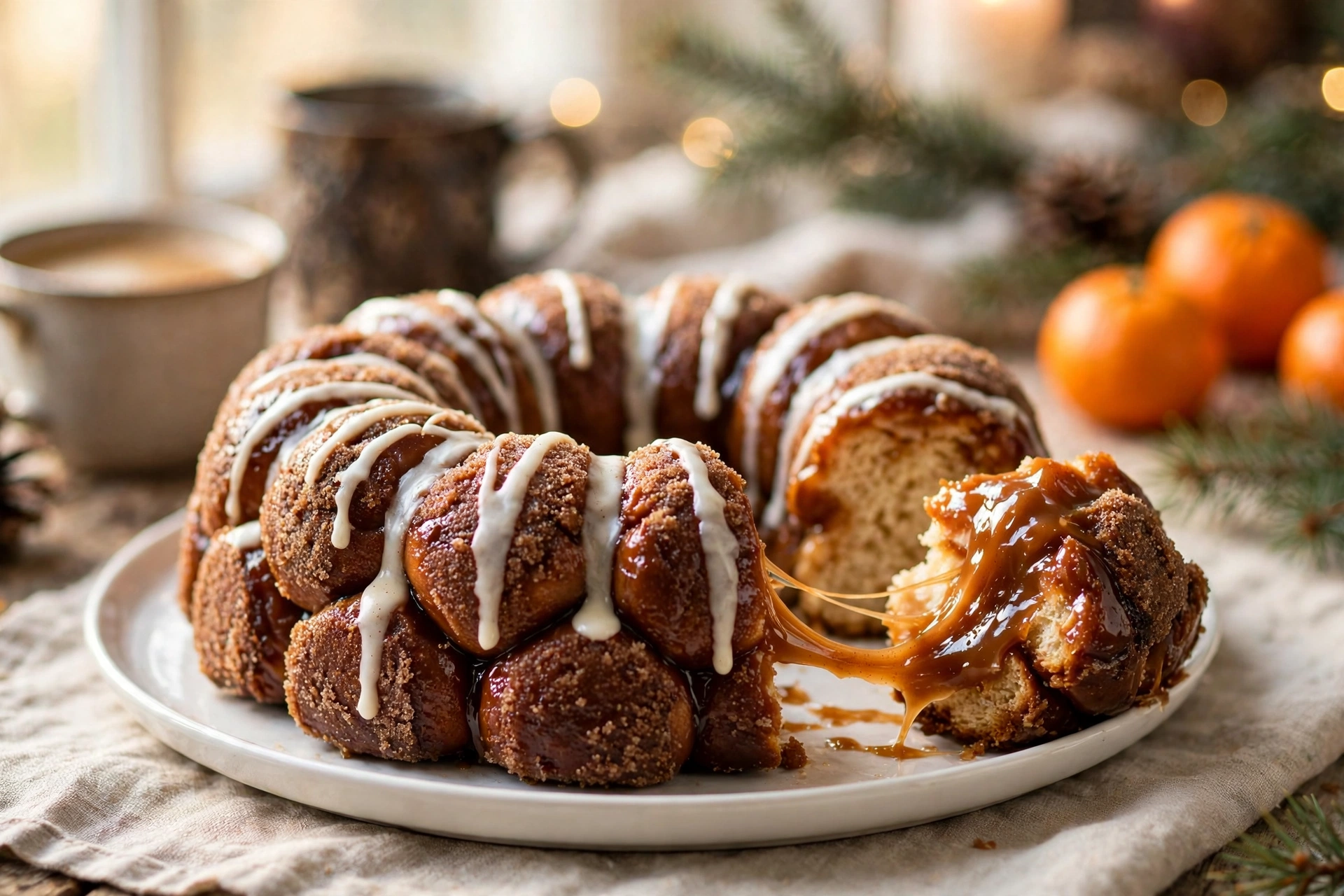
Each ball bakes up tender and pale gold inside, wearing a crackled coat of spiced sugar that shatters slightly when you pull it free. The pieces at the top of the ring are the crisp ones; the pieces at the bottom have been bathing in caramel.
That gradient is the pleasure of the dish. Nobody fights over a uniform slice, because there are no slices: you choose your texture, sticky bottom piece or crisp top piece, and the ring keeps offering both until it is gone.
The spice blend leans on ginger first, the way gingerbread should. Cinnamon supports, nutmeg rounds, and a quarter teaspoon of cloves sits in the background where it belongs, present in the finish without ever announcing itself.
The glaze is optional and deliberately thin. The caramel already glosses the ring when it flips out of the pan, so the white drizzle is decoration as much as flavor, a little vanilla sweetness drawn over the dark mahogany top.
Serve it warm, always. Monkey bread at room temperature is a fine snack, but warm it eats like a bakery case: the caramel loosens, the sugar crust stays crisp, and each piece stretches a thread of sauce as it pulls away.
A Real Dough, Not a Can
Nearly every recipe for this bread reaches for refrigerated biscuit or cinnamon roll dough, and the shortcut shows. Canned dough bakes up bready and uniform, with a faint tinny tang, and it cannot rise slowly overnight in the pan the way a yeasted dough can.
This dough is a simple enriched formula: warm milk, an egg and a yolk, a little butter, and flour, with half a teaspoon of ginger kneaded in so the crumb itself carries spice, not just the coating.
It is a forgiving dough for a busy evening. Six to eight minutes of kneading brings it smooth and elastic, and it doubles in about an hour in a warm kitchen, less time than a Christmas movie playing in the next room.
The balls should be walnut sized and roughly even, about forty eight from this batch. Perfect uniformity is not the goal; a slight variation gives the ring its craggy, hand built look, and the sugar finds more edges to crisp.
If your Christmas Eve is genuinely full, the dough alone can be made a day earlier and refrigerated after its first rise. Punch it down cold the next evening and roll the balls straight from the refrigerator.
What Goes Into the Bundt Pan
Everything here is a baking cupboard staple, with one shopping note: buy unsulphured molasses, the mild, sweet kind sold for baking, rather than blackstrap, which turns bitter in the oven.
Spice quantities below are written for the coating in a second group, because the dough and the coating season separately. Spice freshness guidance is easy to verify through the USDA resources on storing ground spices.
- 3/4 cup warm whole milk
- 1/4 cup warm water
- 2 1/4 teaspoons active dry yeast
- 1/4 cup granulated sugar, plus 1 teaspoon for the yeast
- 1 large egg plus 1 egg yolk, at room temperature
- 4 tablespoons unsalted butter, melted
- 3 1/2 cups all-purpose flour, plus more for dusting
- 1 teaspoon fine salt
- 1/2 teaspoon ground ginger
- 3/4 cup granulated sugar (for the coating)
- 2 teaspoons ground ginger (for the coating)
- 2 teaspoons ground cinnamon
- 1/2 teaspoon ground nutmeg
- 1/4 teaspoon ground cloves
- 1/2 cup unsalted butter, melted (for dipping)
- 3/4 cup packed dark brown sugar
- 1/2 cup unsalted butter (for the caramel)
- 1/3 cup unsulphured molasses
- 2 tablespoons whole milk (for the caramel)
- 1 pinch fine salt (for the caramel)
- 1 cup powdered sugar (for the glaze)
- 2 to 3 tablespoons whole milk (for the glaze)
- 1/2 teaspoon vanilla extract (for the glaze)
Dark brown sugar in the caramel is a small choice with a real effect: its extra molasses echoes the sauce’s own, so the finished ring tastes deeper and darker than a light sugar version ever does.
Mix, Roll, Coat, Layer
- Stir the warm milk, warm water, yeast and 1 teaspoon of sugar together in a large bowl. Rest 5 to 10 minutes, until foamy.
- Whisk in the 1/4 cup sugar, the egg, the yolk and the melted butter. Add the flour, salt and 1/2 teaspoon ginger and mix to a shaggy dough.
- Knead on a lightly floured counter for 6 to 8 minutes, until smooth and elastic. Place in a greased bowl, cover and rise in a warm spot for 1 hour, until doubled.
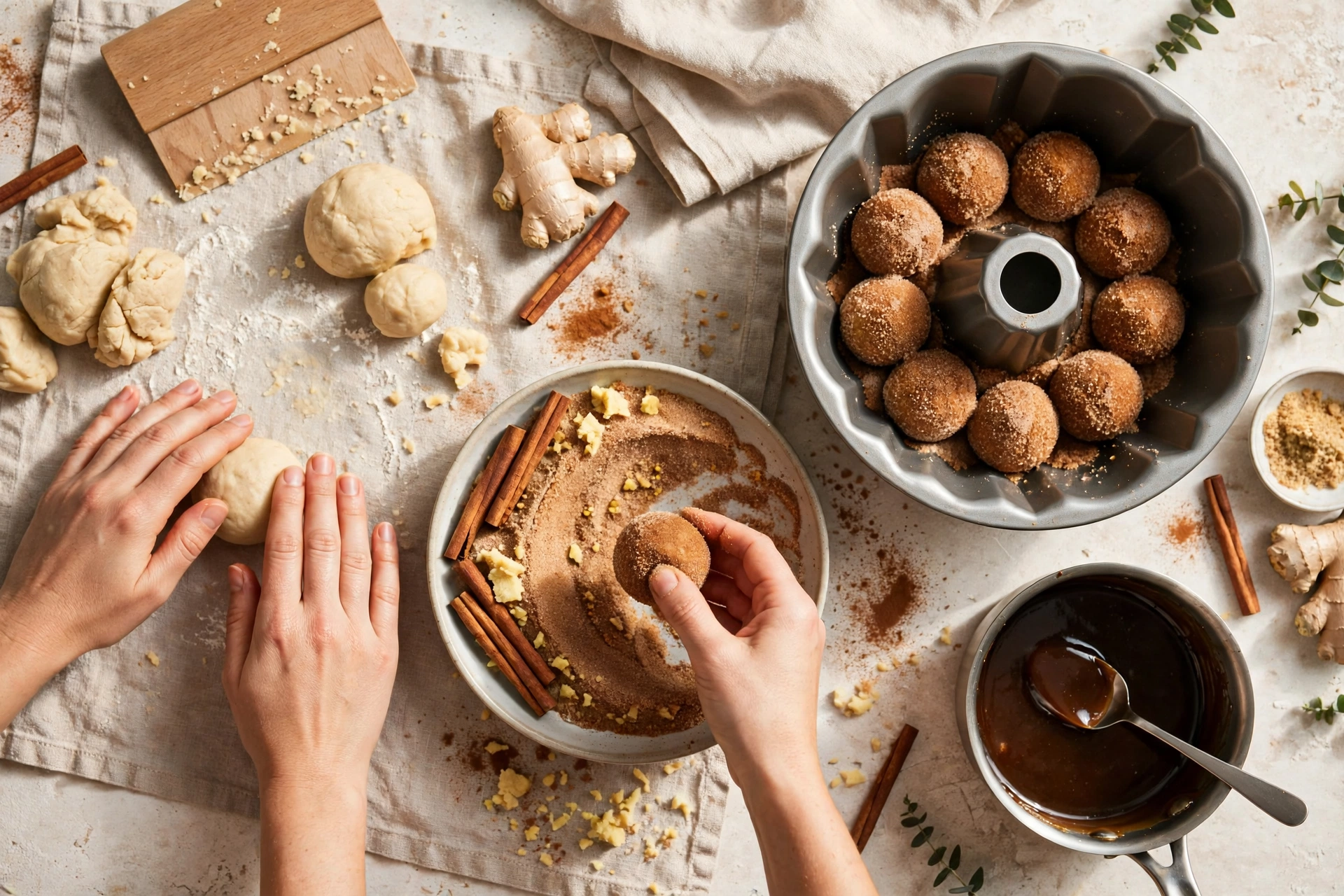
- Stir the coating sugar, ginger, cinnamon, nutmeg and cloves together in a shallow bowl. Have the 1/2 cup melted butter in a second bowl.
- Make the caramel: melt the brown sugar, butter, molasses, milk and salt in a small saucepan over medium heat, whisking until just combined and glossy, about 2 minutes. Do not boil. Cool 5 minutes.
- Grease a 10 to 12 cup bundt pan generously. Pinch the dough into roughly 48 walnut sized balls. Dip each ball in melted butter, roll in the spiced sugar and place in the pan.
- When the pan is half full, drizzle over half the caramel. Finish layering the balls, then pour the remaining caramel evenly over the top.
- Cover the pan tightly and refrigerate overnight, 8 to 12 hours. The balls will puff and fill the pan.
- In the morning, set the pan on the counter while the oven heats to 350 degrees F, about 30 minutes. Bake 35 minutes, until deep mahogany and bubbling at the edges, tenting loosely with foil at 20 minutes if the top colors fast.
- Rest the pan exactly 10 minutes. Place a serving plate over the pan, invert in one confident motion, wait 2 minutes, then lift the pan away.
- Whisk the powdered sugar, milk and vanilla into a pourable glaze, drizzle over the warm bread and serve immediately, pulling pieces apart at the table.
The Overnight Rise, Hour by Hour
Here is the schedule the recipe is built around. Balls rolled and layered by ten in the evening, pan covered and into the refrigerator, where the cold slows the yeast to a gentle, all night climb.
Eight to twelve hours is the window. Shorter and the ring bakes up tight; longer than twelve and the dough over proofs, turning slack and sour edged, so a very late Christmas morning argues for baking first and reheating.
Take the pan out while the oven heats, about thirty minutes. It will not come to room temperature and does not need to; the small head start simply keeps the glass or metal of the pan from shocking in the heat.
Keep cold food safety in mind on a crowded holiday counter: the pan goes from refrigerator to a brief counter rest to the oven, never an hours long sit, in line with the usual FoodSafety.gov guidance for egg rich doughs.
Set the pan on a rimmed baking sheet for the bake. Molasses caramel is enthusiastic, and a sheet pan catching one bubble over is a great deal easier to wash than an oven floor on Christmas morning.
Ten Minutes, Then the Confident Flip
The rest before unmolding is the step every recipe rushes and the one that decides how the ring looks. Ten minutes is the exact window, and it is worth setting a timer.
Flip sooner and the structure is still setting; the ring slumps, the caramel runs off in a sheet, and the tall pull apart shape you built collapses into a delicious puddle. Nobody is sad, but nobody photographs it either.
Wait much longer and the cooling caramel turns to glue against the pan. The bread tears on its way out and leaves its best, stickiest layer behind in the flutes of the bundt.
At ten minutes the caramel is still fluid and the crumb has just set. Plate on top, both hands committed, one flip, then two minutes of patience before lifting the pan so the sauce settles over the ring instead of the plate.
If a ball or two stays in the pan, lift it out with a spoon and press it back into place while everything is warm. The glaze covers a multitude of small repairs.
Serving the Ring While the Coffee Brews
Christmas morning has its own menu logic, and this bread anchors the sweet side of it. Set the ring down with coffee, a bowl of clementines for brightness, and something savory beside it; our eggnog French toast casserole can bake in the same oven for a table that wants both.
The bread also shares its flavor family with yesterday’s gingerbread waffles, which is a feature for a house divided between waffle loyalists and pull apart people: one spice blend, two mornings, no argument about the theme.
For drinks, keep it simple and warm. A pot of coffee, hot chocolate for the small people, and a pitcher of the cranberry orange Christmas punch for anyone who wants something cold and red in the glass.
If the ring needs to wait while presents happen, hold it unflipped in its pan, covered with a towel, for up to thirty minutes. Flip it at serving time and the caramel will still pour; its cousin the blueberry monkey bread waits the same way in the summer.
What to Do With the Leftovers on the 26th
Leftovers, if your house produces them, keep two days at room temperature under a dome and four in the refrigerator. The sugar crust softens either way, which the microwave fixes in fifteen second bursts per piece.
For a crisper revival, warm pieces on a sheet pan at 325 degrees for six to eight minutes. The edges re crisp, the caramel loosens again, and the pieces eat closer to fresh than any microwave manages.
Day old pieces also make a remarkable bread pudding base. Cube what remains, fold through a simple egg and milk custard, bake until set, and yesterday’s breakfast becomes the 26th’s dessert with no apology attached.
Gingerbread monkey bread, in the end, asks for one honest evening of work and gives back the calmest Christmas morning a baker can buy. Roll the balls on the 24th, and let the refrigerator keep the promise.
Gingerbread Monkey Bread Questions, Answered
How long can the assembled pan sit in the refrigerator before baking?
Eight to twelve hours is the tested window. The balls puff slowly and fill the pan, and the flavor deepens. Past twelve hours the dough over proofs and turns slack, so if your morning runs later, bake the bread the night before and reheat it instead.
How do I know the center of the monkey bread is not raw?
Look for three signs together: a deep mahogany top, caramel bubbling at the edges of the pan, and a center ball that pulls away with tender strands rather than wet, shiny dough. If the top colors early, tent the pan loosely with foil at 20 minutes and finish the full 35.
Why did my monkey bread stick in the bundt pan?
It rested too long before flipping. Past about 15 minutes the caramel cools into glue against the pan. Rest exactly 10 minutes, flip in one motion, then wait 2 minutes before lifting the pan so the sauce settles over the ring.
Can I make gingerbread monkey bread in a tube pan or a 9 by 13 instead?
A tube pan works with the same timing. A 9 by 13 dish works too, but the pieces bake flatter with more crisp edges and less caramel pooling; start checking at 28 minutes. The bundt shape gives the best mix of sticky bottom pieces and crisp top pieces.
Can I freeze the dough balls for later?
Yes. Roll and coat the balls, freeze them in a single layer on a tray, then bag them for up to a month. Layer them frozen in the greased pan with the caramel, refrigerate overnight to thaw and rise, and bake as directed in the morning.