
In this article:
- The church cookbook classic on every Thanksgiving table
- Cold, creamy and bright against a heavy table
- Real whipped cream, with a yogurt backbone
- What goes into the bowl
- Drain, whip, fold and chill
- The two stage marshmallow trick
- Assemble it Wednesday, serve it Thursday
- For a crowded table, double it in the trifle bowl
- Swaps for the bowl you grew up with
- Ambrosia salad questions, answered
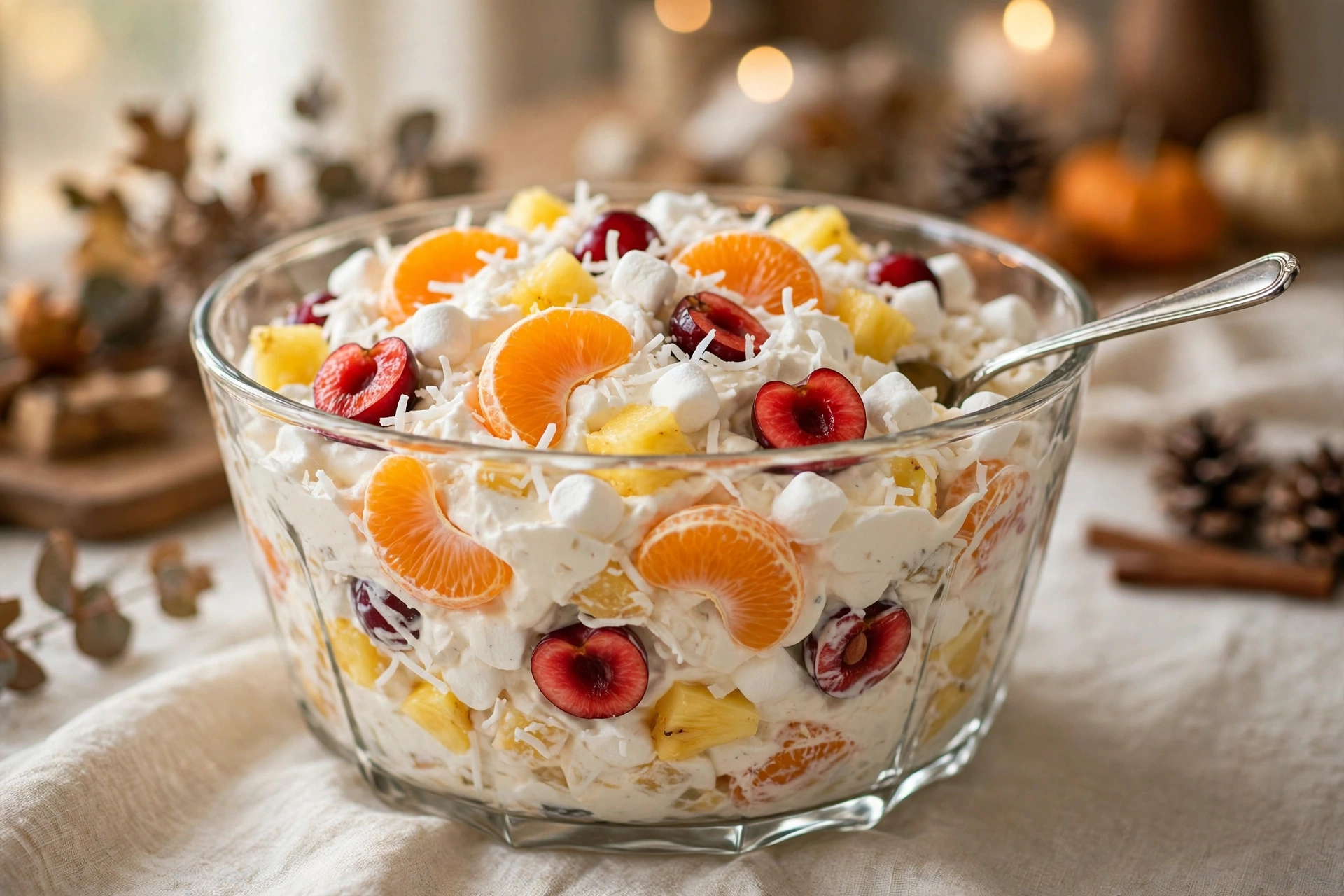
Ambrosia salad is the cold, cloud soft bowl that shows up at Thanksgiving wearing its Sunday best: mandarin oranges, pineapple, cherries and coconut folded into real whipped cream, with mini marshmallows tucked through like little pillows.
It is also the easiest assignment on the whole holiday list. There is no oven time, no gravy timing, no last minute carving drama. One bowl, twenty minutes of work, and the refrigerator does the rest until Thursday.
The difference between a great ambrosia and a soupy one lives in two habits the old cookbook cards rarely wrote down. Drain the fruit longer than feels reasonable, and split the marshmallows between the night before and the moment of serving.
The Church Cookbook Classic on Every Thanksgiving Table
Ambrosia began in the late 1800s as a simple luxury of oranges, coconut and sugar, back when citrus in November was a genuine event. Coconut arrived by ship, oranges by train, and the combination was precious enough to be named for the food of the gods.
The twentieth century moved it firmly into the Southern church cookbook canon. Canned pineapple and mandarin oranges made it possible anywhere, marshmallows joined during their mid century moment, and the dish became a fixture of suppers, funerals and holiday tables.
Every family edits the formula. Some cooks defend cherries as nonnegotiable, others ban them for turning the bowl pink. Some hold that nuts are an intrusion, others that a Thanksgiving table without pecans is not finished. The arguments are part of the inheritance.
What nobody argues about is the bowl it travels in. Ambrosia still arrives in the same cut glass or trifle bowl it has always arrived in, carried with both hands, and it still empties faster than dishes that took ten times the work.
Its role at Thanksgiving is specific and underrated. Between the turkey, the gravies and the row of golden casseroles, ambrosia is the one cold, bright, refreshing spoonful, and plates come back for it precisely because everything else is rich and hot.
Cold, Creamy and Bright Against a Heavy Table
The first spoonful is cool before it is anything else, a clean break from a plate of warm food. Then the cream lands, soft and barely sweet, carrying little bursts of mandarin and pineapple that pop against its calm background.
Texture does quiet work here. The coconut gives a gentle chew, the cherries a firmer bite, and the marshmallows two different textures at once: the ones that rested overnight turn almost meringue soft, while the ones folded in at serving stay bouncy.
The flavor is brighter than the ingredient list suggests. Citrus does the lifting, a pinch of salt sharpens everything, and the yogurt in the dressing keeps the sweetness from tipping into candy territory. It tastes like fruit first and dessert second.
Served very cold, straight from the refrigerator, the salad holds soft folds on the spoon instead of slumping. Temperature is an ingredient in this dish, which is why it waits in the fridge until the moment the rest of dinner is carved and ready.
Real Whipped Cream, With a Yogurt Backbone
This dressing starts with real heavy cream, whipped to soft peaks with a little powdered sugar and vanilla. Tub whipped topping is the shortcut most versions take, and it works, but it brings a flat, oily sweetness that real cream never has.
Plain Greek yogurt is folded through the whipped cream, and it does three jobs at once. It steadies the cream so the dressing holds for a full day in the refrigerator, it adds a gentle tang, and it keeps the whole bowl from tasting like frosting.
The ratio matters. Too much yogurt and the salad reads as a health food remix; too little and you lose the structure. Three quarters of a cup against a cup of cream is the balance that tastes like the classic and behaves like a make ahead dish.
Whip the cream cold, in a cold bowl if your kitchen is warm. Stop at soft, billowy peaks rather than stiff ones: an overwhipped dressing turns grainy as it sits overnight, and the fold of yogurt and fruit will firm it further on its own.
What Goes Into the Bowl
Everything is a supermarket staple, and the short list rewards small choices: pineapple packed in juice rather than syrup, cherries you halve by hand, and coconut you can toast for the top if you want one warm note in a cold dish. Nutrition figures for the fruit are easy to check against USDA FoodData Central if you track them.
- 1 can (20 ounces) pineapple tidbits in juice, drained
- 1 can (15 ounces) mandarin oranges in juice, drained
- 1 cup maraschino cherries, drained, halved and patted dry
- 1 1/2 cups miniature marshmallows, divided
- 1 cup sweetened shredded coconut, plus more for the top
- 1/2 cup chopped pecans (optional)
- 1 cup cold heavy cream
- 2 tablespoons powdered sugar
- 1 teaspoon vanilla extract
- 3/4 cup plain Greek yogurt (2 percent or whole milk)
- 1 pinch fine salt
Fresh fruit has its place in this salad, and the swaps section below covers it honestly. The classic Thanksgiving version, though, is built on canned fruit for a reason: its texture is tender, its sweetness is predictable, and nobody is segmenting oranges on Wednesday night.
Drain, Whip, Fold and Chill
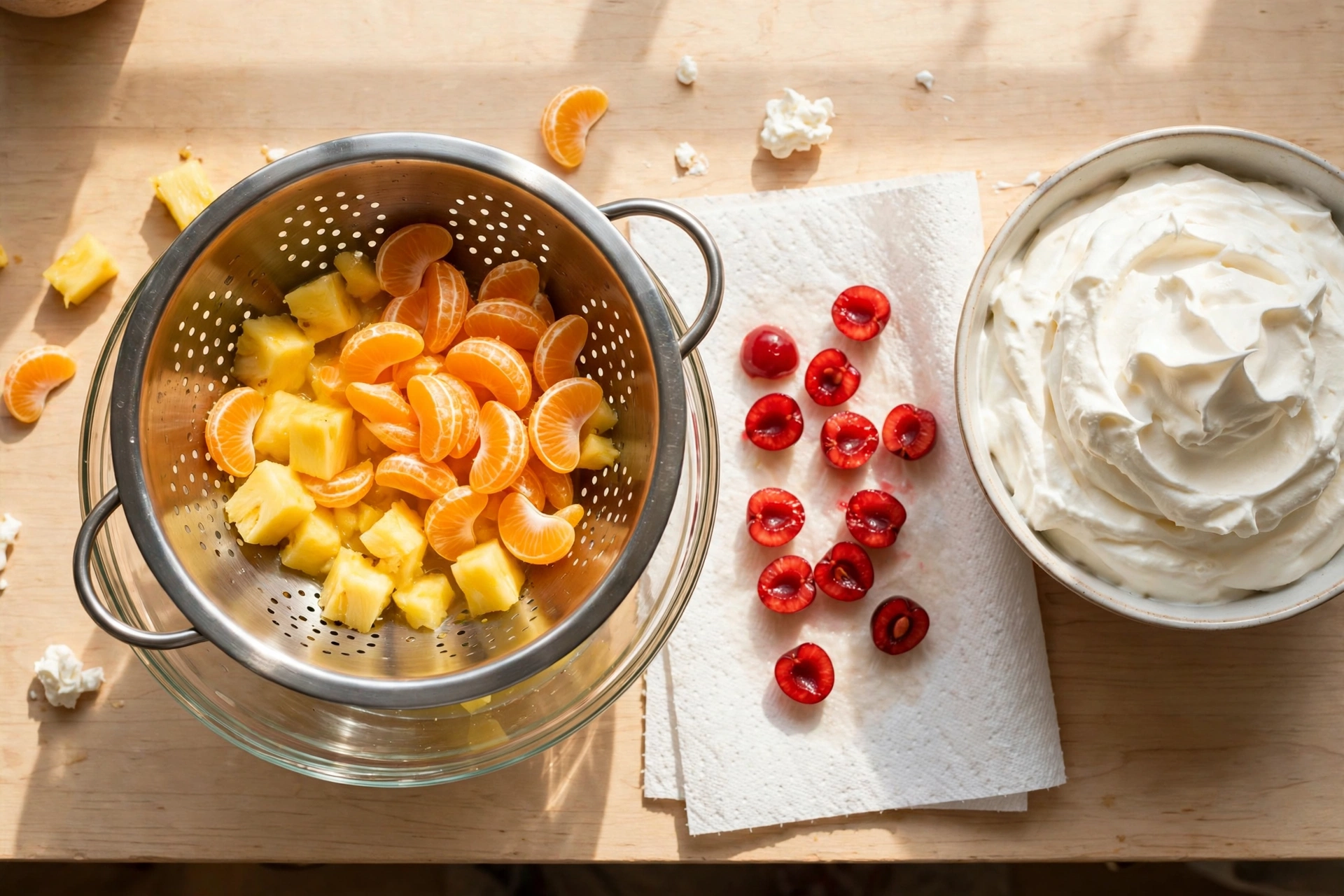
- Pour the pineapple and mandarin oranges into a colander set over a bowl and let them drain for a full 20 minutes, shaking the colander once or twice. Discard the juice or save it for another use.
- While the fruit drains, halve the cherries and spread them on a plate lined with paper towels. Press another towel gently over the top and set them aside; this is what keeps the finished salad white instead of pink.
- Pour the cold heavy cream into a large, chilled mixing bowl. Beat with a hand mixer on medium high until soft peaks form, about 2 to 3 minutes.
- Sprinkle in the powdered sugar, vanilla and salt and beat a few seconds more, just until the peaks hold softly.
- Fold the Greek yogurt through the whipped cream with a spatula until no streaks remain. This is the finished dressing.
- Add the drained fruit, the cherries, the coconut, the pecans if using, and 1 cup of the marshmallows. Fold gently with the spatula, turning the bowl as you go, until everything is evenly coated and no fruit is crushed.
- Scrape the salad into its serving bowl, cover tightly and refrigerate for at least 2 hours, and up to 24 hours.
- Just before serving, fold in the remaining 1/2 cup of marshmallows, give the top a gentle stir, and finish with a pinch of extra coconut.
The Two Stage Marshmallow Trick
Marshmallows change character in a creamy dressing, and the change is the whole opportunity. Left in overnight, they drink in moisture and flavor until they soften into something close to meringue, sweet little clouds that dissolve as you eat them.
That transformation is lovely, but a bowl where every marshmallow has gone soft loses its bounce. The salad turns uniform, more like a pudding, and the contrast that makes people take a second spoonful disappears somewhere in the refrigerator.
The fix costs nothing: hold back half a cup of marshmallows when you assemble the salad. They wait in their bag, untouched, while the rest of the bowl does its overnight melding on Wednesday.
Fold the reserved marshmallows in at the table, or just before carrying the bowl out. They stay springy against the softened ones, the dressing stays glossy, and the salad eats like it was made twice, once for depth and once for texture.
Assemble It Wednesday, Serve It Thursday
Ambrosia salad might be the best scheduled dish on the entire Thanksgiving menu. It does not merely tolerate being made ahead; it improves, because the fruit perfumes the dressing and the dressing relaxes into every corner of the bowl.
Wednesday looks like this. Drain the fruit after lunch, whip the dressing in the evening, fold everything together except the reserved marshmallows, and refrigerate the covered bowl. Total active work is about twenty minutes, none of it near a hot stove.
It keeps good company on that schedule. The make-ahead mashed potatoes and the pineapple casserole are built on the same Wednesday assembly, so the three dishes go into the refrigerator together and free the cook almost completely on Thursday.
Thursday asks for two minutes: a gentle stir, the fresh marshmallows folded in, a pinch of coconut over the top. Keep the bowl refrigerated until the turkey is carved, since the salad should stay at 40 degrees or below while it waits, the standard FoodSafety.gov guidance for cold dishes.
At the table, set the bowl out for the meal itself rather than a long buffet afternoon. Leftovers go back into the refrigerator within two hours and keep, covered, for up to 3 days, though the fruit softens a little more each day.
For a Crowded Table, Double It in the Trifle Bowl
The recipe as written serves ten as a side, at about three quarters of a cup a person. For the full extended family, it doubles without a single adjustment to the dressing ratio, the draining time or the marshmallow split.
A straight sided trifle bowl is the right vessel for the doubled batch. The layers of orange, gold, red and white show through the glass, and the deep shape keeps the salad colder at the table than a wide, shallow bowl would.
Double the cherries without worry, but halve and dry them with extra patience, since twice the cherries means twice the juice waiting to tint the cream. It is the one step in the doubled recipe that deserves an extra paper towel.
Set out a long handled spoon and small bowls rather than letting guests serve onto dinner plates. Ambrosia eaten from its own little bowl stays cold, and the plate stays free for the hot food it was meant to hold. Its cousin, the cranberry fluff salad, works the same way, and the two bowls side by side make the cold corner of the buffet look planned.
If the bowl comes back with a cup or two left, that is tomorrow’s portion, not a failure. Folded onto a slice of leftover pound cake or eaten straight from the refrigerator door, the last of the ambrosia is the cook’s reward.
Swaps for the Bowl You Grew Up With
If your family’s version used sour cream instead of yogurt, the swap runs cleanly in reverse. Use three quarters of a cup of sour cream and expect a slightly looser dressing with a sharper tang; it is the older formula and it still works.
Fresh clementine segments can replace the canned mandarins in years when the fruit is sweet and cheap. They bring a brighter bite and a firmer texture, but they weep more juice, so add them at serving time rather than the night before.
Banana is the contested classic. A sliced banana folded in at the last minute is traditional in many households and very good, but it browns by the second day, which is why it never belongs in the Wednesday assembly.
For a nut free table, drop the pecans entirely and lean on the coconut for texture, or toast the coconut for the top until it is deep gold and scatter it over at serving. Toasted coconut reads as crunch without putting a single nut in the bowl.
Ambrosia salad, in the end, is a forgiving bowl. Keep the fruit drained, the dressing cold and the marshmallows in two stages, and it will taste like the version somebody at your table has been missing since childhood.
Ambrosia Salad Questions, Answered
How far ahead can I make ambrosia salad?
Up to 24 hours ahead is the sweet spot. The fruit perfumes the dressing and the first cup of marshmallows softens into it, while the salad still looks fresh. Fold in the reserved marshmallows just before serving so some of them stay springy.
Why did my ambrosia salad turn out watery?
The fruit did not drain long enough. Canned pineapple and mandarins carry a surprising amount of juice, and it all ends up in the dressing. Drain for a full 20 minutes in a colander, and pat the cherries dry on paper towels before they go in.
How do I keep the cherries from turning the salad pink?
Halve them, then press them between paper towels and let them sit while the other fruit drains. Dry cherries folded in last bleed very little. Adding them at serving time instead of the night before keeps the bowl whitest of all.
Can I freeze ambrosia salad?
No, and this is one recipe where the answer does not soften. The whipped cream dressing separates as it thaws, the fruit goes limp, and the marshmallows turn spongy. Make it fresh, refrigerate it, and plan on leftovers within 3 days.
Can I use fresh pineapple instead of canned?
Yes, with one adjustment. Use about 3 cups of chopped fresh pineapple and drain it the same 20 minutes, since fresh fruit releases juice too. The flavor is brighter and a little less sweet, so taste the dressing and add an extra teaspoon of powdered sugar if it needs it.