
In this article:
- Rub the Zest Into the Sugar First
- Buttery Crumb, Ruby Bursts, a Glaze That Sets
- Cranberry Orange Bundt Cake Ingredients
- Making the Cranberry Orange Bundt Cake
- The Bundt Pan Protocol: Butter, Flour, Ten Minutes
- Chop the Cranberries Coarse So They Hang in the Crumb
- Bake It in Early December, Glaze It on Christmas Eve
- Lemon, Blood Orange, and a Cream Cheese Glaze
- One Cake for the Whole Christmas Week
- Cranberry Orange Bundt Cake Questions
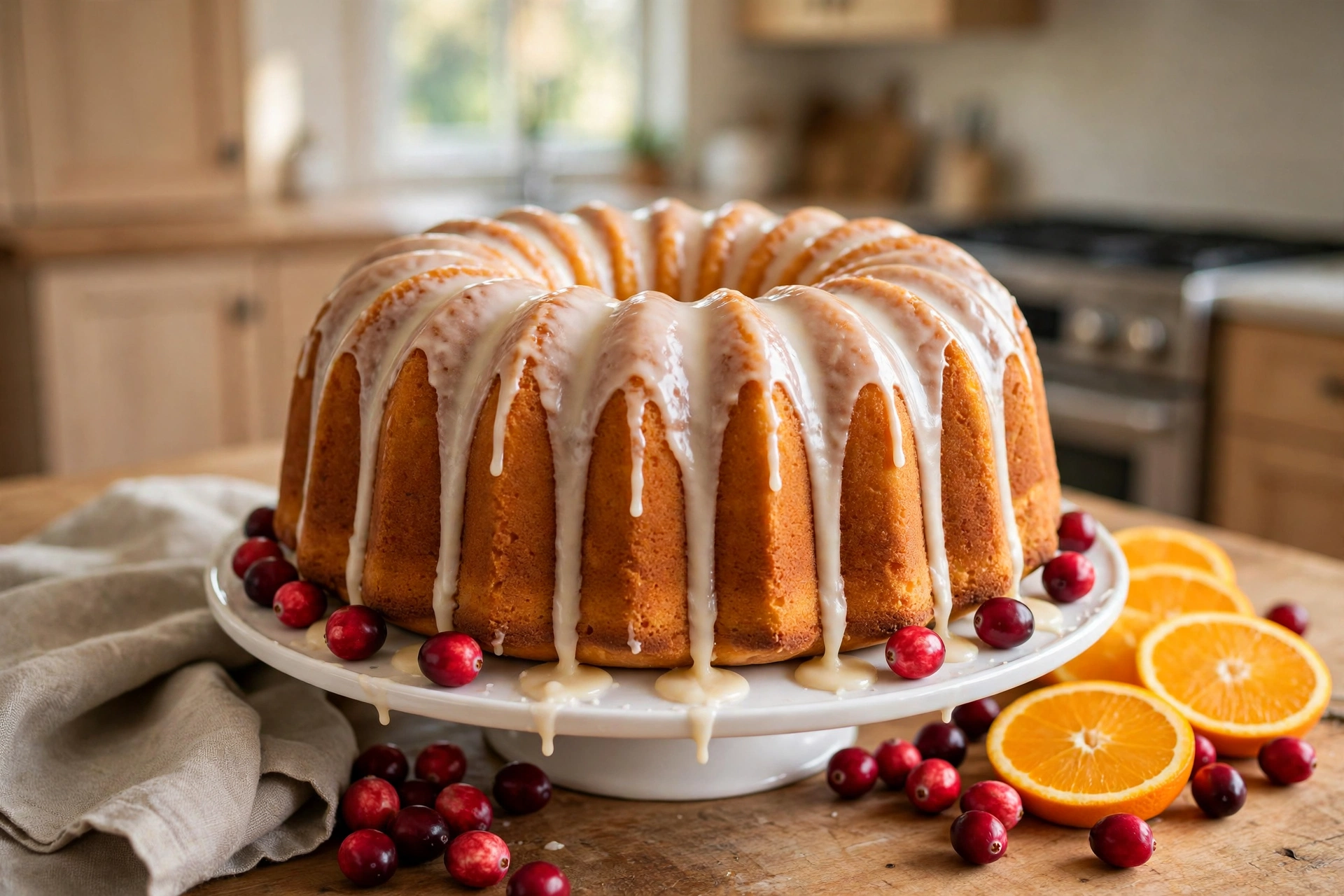
Cranberry orange bundt cake is the Christmas cake that behaves like a centerpiece: a tall, fluted ring with a buttery crumb, studded with ruby cranberries and poured over with a white orange glaze that sets into a thin shell. It looks like it took all day, and it takes about 25 minutes of real work.
The flavor is built before the mixer even starts. Orange zest gets rubbed into the granulated sugar with your fingertips until the sugar turns damp and fragrant, which pulls the aromatic oils out of the zest and distributes them through every crumb of the cake instead of leaving them in a few bitter flecks.
It is also a cake with a plan. Baked in the first week of December, it freezes unglazed for the whole month, thaws overnight, and takes its glaze on Christmas Eve like it was made that morning. One bake in a quiet week buys you the showpiece of the busiest one.
Rub the Zest Into the Sugar First
Cranberry orange bundt cake gets its perfume from a step most recipes skip entirely. Zest holds its flavor in tiny oil glands on the orange peel, and those oils are fat soluble and fragile. Rubbing the zest into the sugar bursts the glands and coats every crystal, so the orange spreads evenly through the batter instead of concentrating in bitter shreds.
You can feel the moment it works: the sugar turns the texture of damp sand, picks up a pale orange tint, and the bowl suddenly smells like the whole fruit, not just the peel. Two minutes of rubbing does more for this cake than an extra tablespoon of zest added the lazy way.
The crumb is built for keeping. Butter beaten with that orange sugar gives the flavor base, sour cream gives the tenderness and a gentle tang, and the batter is mixed thick on purpose. A thick batter is not a flaw in a bundt cake; it is what holds the fruit in suspension and gives the fine, even crumb that slices without shedding.
Cranberries bring the contrast the cake needs. Raw, they are too tart to eat, but baked inside a sweet, buttery crumb they soften into bright, jammy bursts that cut the richness. Coarsely chopped, each piece is big enough to taste and small enough to stay where the batter put it.
The glaze is the final piece of engineering. Powdered sugar and fresh orange juice, whisked thick and spooned over a completely cold cake in two passes, sets into a matte white shell that cracks faintly under the knife. On a warm cake it would melt and vanish into the crumb, which is why the cooling hour is written into the method, not suggested.
Nothing in the cake is exotic, and that is deliberate. Flour, butter, eggs, sour cream and a bag of cranberries are already in most December kitchens, usually bought for three other recipes. The bundt pan is the only special equipment, and the method is built so that a pan you use twice a year still gives you a clean release and an even crumb on the day it matters.
Buttery Crumb, Ruby Bursts, a Glaze That Sets
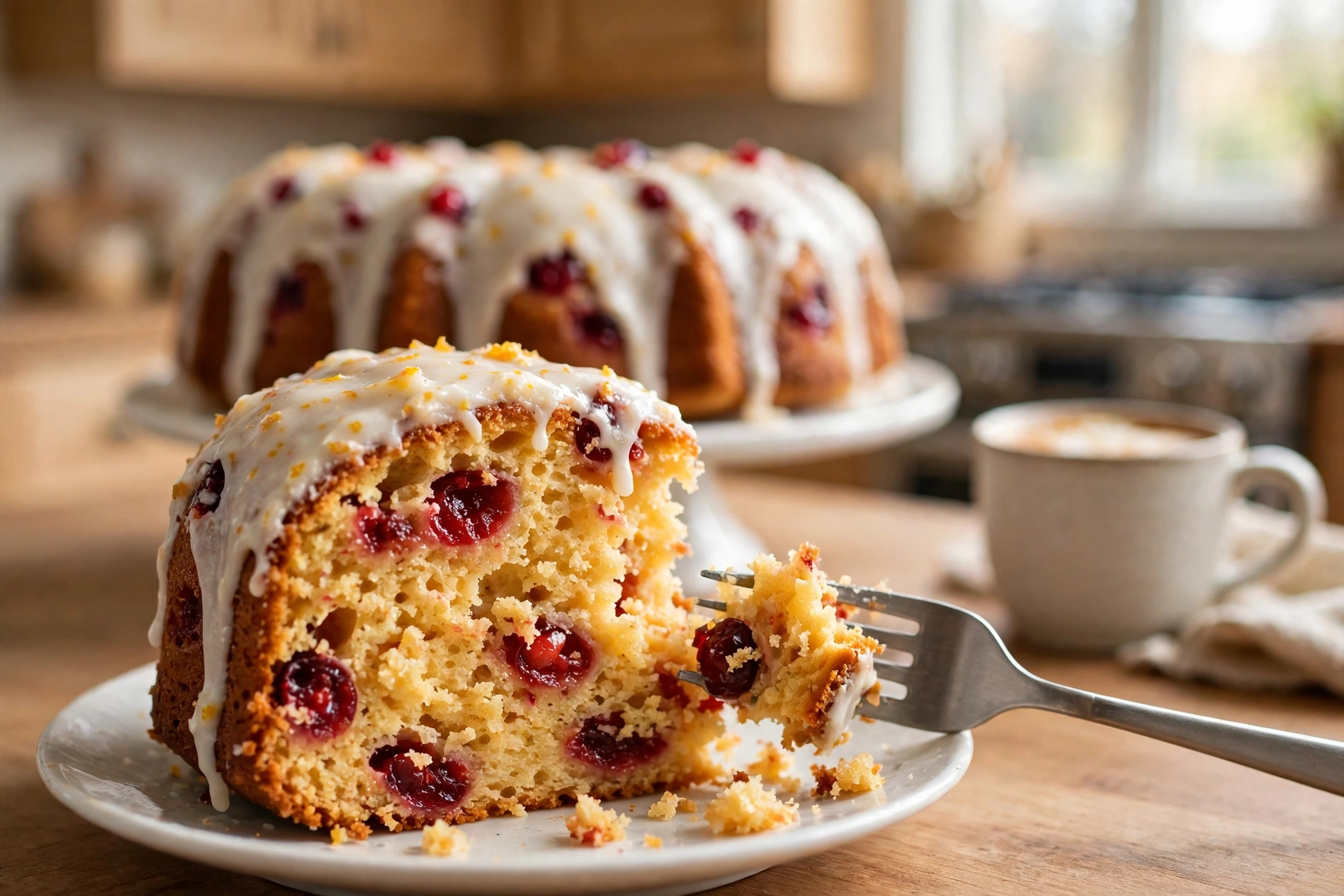
A slice eats in layers. First the glaze, sweet and citrus bright, then the fine golden crumb, dense in the way pound cake is dense but softer, and then a cranberry pops and the whole bite sharpens. It is a cake that keeps changing as you chew, which is why one slice so often becomes two.
The crumb stays moist for days, thanks to the sour cream and the sheer butter content, so the cake on December 27 is nearly as good as the cake on December 25. Served with coffee in the morning it reads as a breakfast cake; served with whipped cream after dinner it reads as dessert. Few cakes cover both shifts without apology.
Temperature changes it more than you would expect. Cold from the fridge, the crumb is firm and the cranberry tartness leads. At room temperature, the butter softens, the orange blooms, and the glaze stays snappy. The sweet spot is a slice cut an hour before serving, which is conveniently exactly how a holiday buffet works.
The look deserves a sentence of its own, because a bundt earns half its welcome before anyone tastes it. The fluted ring comes out of the pan with edges sharp enough to read across the room, the white glaze runs down the ridges in slow drips and stops, and the cut face shows the whole story at once: pale gold crumb, red fruit, no sunken layer, no tunnels. It is the rare cake that needs no decoration beyond a cake stand and maybe a few spare cranberries scattered at its base.
Cranberry Orange Bundt Cake Ingredients
- 3 cups (360 g) all-purpose flour, plus 1 tablespoon (8 g) for the cranberries
- 2 teaspoons (8 g) baking powder
- 1/2 teaspoon (2.5 g) baking soda
- 1 teaspoon (6 g) fine sea salt
- 1 cup (227 g) unsalted butter, softened, plus more for the pan
- 2 cups (400 g) granulated sugar
- 2 tablespoons (12 g) finely grated orange zest, from 2 large oranges
- 4 large eggs, at room temperature
- 1 teaspoon (5 ml) vanilla extract
- 1 cup (240 g) sour cream, at room temperature
- 1/4 cup (60 ml) fresh orange juice
- 2 1/2 cups (250 g) fresh or frozen cranberries, coarsely chopped
- 1 1/2 cups (180 g) powdered sugar, sifted
- 3 tablespoons (45 ml) fresh orange juice
- 1 teaspoon (2 g) finely grated orange zest
Room temperature is doing real work in this batter. Soft butter traps air when it is beaten with the sugar, cold sour cream shocks that butter back into lumps, and cold eggs can curdle the mixture on contact. Set everything on the counter 45 minutes before you start and the batter will come together smooth, glossy and thick.
Making the Cranberry Orange Bundt Cake
- Heat the oven to 350°F. Brush every groove and the center tube of a 12 cup bundt pan with softened butter, dust it with flour and tap out the excess.
- Whisk the 3 cups (360 g) of flour, baking powder, baking soda and salt in a medium bowl.
- Put the granulated sugar and orange zest in the bowl of a stand mixer and rub them together with your fingertips until the sugar looks damp and smells intensely of orange.
- Add the butter and beat on medium for 3 minutes, until pale and fluffy. Beat in the eggs one at a time, then the vanilla, scraping the bowl once.
- Add the flour mixture in three parts, alternating with the sour cream and orange juice, beginning and ending with flour. Mix each addition on low just until it disappears.
- Toss the chopped cranberries with the remaining 1 tablespoon (8 g) of flour, then fold them through the batter with a spatula. The batter will be thick.
- Scrape the batter into the prepared pan, smooth the top and tap the pan once on the counter to settle it into the grooves.
- Bake for 55 to 65 minutes, until a long skewer inserted in the thickest part comes out clean and the cake springs back when pressed.
- Cool the cake in the pan on a rack for exactly 10 minutes, then invert it onto the rack in one confident motion. Cool completely, about 1 hour.
- Whisk the powdered sugar, orange juice and zest into a thick glaze. Spoon it over the cold cake in two passes, letting the first set for 5 minutes so the second stays opaque. Rest 15 minutes before slicing.
The Bundt Pan Protocol: Butter, Flour, Ten Minutes
More bundt cakes are lost to the pan than to the recipe, and the failure is almost always one of three small things. The first is coverage: a fluted pan has dozens of grooves, and a single dry ridge is enough to hold the whole cake hostage. Brush softened butter into every groove with a pastry brush, then flour, then turn the pan and tap out the excess so no white patches remain.
The second is the cooling window, and it is exact. Invert the cake at 10 minutes: the crumb is still warm and pliable, and the butter in the grooves is still liquid enough to release. Wait 30 minutes and the cake cools, firms, and glues itself back to the metal as the butter sets. If a cake does stick, a towel soaked in hot water draped over the inverted pan for 5 minutes loosens most of them.
The third is patience at the end. A bundt cake that feels done at the skewer still needs its full hour of cooling before the glaze, because the crumb continues to set as it cools and a warm slice will tear. None of this is difficult; it is simply a protocol, and following it makes the dramatic unmolding boring, which is the goal.
One more habit separates reliable bundts from lucky ones: test the thickest part of the ring, not the center tube side, and start checking at 55 minutes. Bundt pans vary enormously in weight and darkness, and a dark nonstick pan can run 5 minutes ahead of a pale aluminum one with the same batter. The skewer should come out clean, but the better signal is the cake pulling very slightly away from the walls and springing back under a fingertip. An overbaked bundt is a dry bundt, and no glaze fully rescues it.
Chop the Cranberries Coarse So They Hang in the Crumb
Whole cranberries sink. They are dense, round, and smooth, and in the oven they roll down through softening batter and land in a sour layer at the bottom of the pan, which becomes the top of the served cake. Halving or coarsely chopping them changes the physics: flat sides catch on the thick batter, and the pieces stay distributed from top to bottom.
The tablespoon of flour tossed over the chopped berries helps at the margins, drying their wet cut surfaces so they grip the batter instead of sliding. Frozen cranberries chop even more cleanly than fresh ones, straight from the bag with a heavy knife, and they go into the batter still frozen. Do not thaw them first: thawed berries bleed their juice into the crumb and streak it pink.
The same suspension logic is why our cranberry orange pound cake chops its berries too, and it is the detail that separates a speckled, even slice from a cake with a jam layer hiding at the base.
Bake It in Early December, Glaze It on Christmas Eve
The first week of December is the quietest baking week of the season, and this cake is built to use it. Bake the bundt, cool it completely, wrap it unglazed in two layers of plastic and a layer of foil, and freeze it. The dense, buttery crumb freezes without drying, and the cranberry flavor holds for a full month.
On December 23, move the wrapped cake to the refrigerator to thaw overnight, still wrapped, so condensation forms on the plastic and not on the crumb. On Christmas Eve, unwrap it, let it stand 1 hour at room temperature, and glaze it in its two passes. By the time it reaches the table it tastes freshly baked, because the glaze is.
Once glazed, the cake keeps covered at room temperature for 3 days and in the refrigerator for a week; the USDA FoodKeeper guide gives the same windows for frosted layer cakes. Slices also freeze individually, wrapped, for a January afternoon that needs rescuing. If your December baking list is still growing, the cranberry orange sticky buns cover Christmas morning and the snickerdoodle cookies fill the tin beside them.
Lemon, Blood Orange, and a Cream Cheese Glaze
Lemon takes the cake in a brighter direction: swap the orange zest and juice for lemon, keep the cranberries, and the crumb turns sharper and more summery in spirit, a good version for anyone who finds orange sweet. Blood orange, when it appears in January markets, gives a deeper color and a faint berry note that flatters the cranberries.
A cream cheese glaze makes it richer: beat 4 ounces (113 g) of softened cream cheese with 1 cup (120 g) of powdered sugar and 2 tablespoons (30 ml) of orange juice, and spoon it on thick. It stays soft rather than setting into a shell, so that version is best served the day it is glazed.
Greek yogurt replaces the sour cream one for one with a slightly firmer crumb and a cleaner tang, and it is the swap we use when the cake is headed for a brunch table. What does not swap well is the butter: oil based versions of this cake bake up coarse and lose the fine crumb that makes a bundt slice look tailored. For another cranberry direction entirely, the white chocolate cranberry blondies take the same fruit into a pan of bars.
One Cake for the Whole Christmas Week
Cranberry orange bundt cake is the rare holiday bake that is equal parts decoration and dessert. It sits on the counter under its white glaze like something from a bakery window, and it quietly feeds whoever walks through the kitchen for four days: a slice with coffee, a slice after dinner, a slice wrapped for the road.
Bake it early, freeze it calmly, and glaze it when the house is already full. The bundt pan does the decorating, the cranberries do the color, and you get to be the person who produced a showpiece without spending Christmas Eve in the kitchen.
Cranberry Orange Bundt Cake Questions
My bundt cake stuck to the pan. What went wrong?
Usually a missed groove in the greasing, or the cake cooled too long before inverting. Butter every groove, flour and tap out the excess, and invert at exactly 10 minutes while the butter in the pan is still liquid. If a cake sticks, drape a hot wet towel over the inverted pan for 5 minutes and try again before forcing it.
Can I use frozen cranberries in this bundt cake?
Yes, and they chop more cleanly than fresh ones. Chop them straight from the freezer, toss them in the tablespoon of flour, and fold them in still frozen. Do not thaw them first, or their juice bleeds into the batter and streaks the crumb pink.
Can I bake this in a 10 cup bundt pan instead of 12 cup?
Yes, with one adjustment: fill the pan only three quarters full and bake the remaining batter in two or three greased muffin cups for 20 to 22 minutes. A 10 cup pan filled to the top will overflow in the oven and the center will stay raw while the edges overbake.
Why did my orange glaze disappear into the cake?
The cake was still warm. Glaze melts on contact with a warm crumb and soaks in instead of setting on the surface. Cool the cake for a full hour, then apply the glaze in two thin passes, letting the first set for 5 minutes so the second stays white and opaque.
How do I freeze the bundt cake for Christmas?
Freeze it unglazed: cool completely, wrap in two layers of plastic plus foil, and freeze for up to 3 months. Thaw it overnight in the refrigerator still wrapped, stand it 1 hour at room temperature, then glaze. A frozen glazed cake thaws with a dull, cracked glaze, so the glaze always goes on after thawing.
Cranberry Orange Bundt Cake
A tall, fluted cranberry orange bundt cake with a buttery sour cream crumb, orange zest rubbed into the sugar so the perfume reaches every slice, and coarsely chopped cranberries that stay suspended instead of sinking. Finished with a two pass orange glaze that sets into a thin shell, and built to freeze unglazed from early December to Christmas Eve.
- Total Time: 2 hours 35 minutes
- Yield: 12 servings 1x
Ingredients
3 cups (360 g) all-purpose flour, plus 1 tablespoon (8 g) for the cranberries
1/2 teaspoon (2.5 g) baking soda
1 teaspoon (6 g) fine sea salt
1 cup (227 g) unsalted butter, softened, plus more for the pan
2 cups (400 g) granulated sugar
2 tablespoons (12 g) finely grated orange zest, from 2 large oranges
4 large eggs, at room temperature
1 teaspoon (5 ml) vanilla extract
1 cup (240 g) sour cream, at room temperature
1/4 cup (60 ml) fresh orange juice
2 1/2 cups (250 g) fresh or frozen cranberries, coarsely chopped
1 1/2 cups (180 g) powdered sugar, sifted
3 tablespoons (45 ml) fresh orange juice
1 teaspoon (2 g) finely grated orange zest
Instructions
Heat the oven to 350°F. Brush every groove and the center tube of a 12 cup bundt pan with softened butter, dust it with flour and tap out the excess.
Whisk the 3 cups (360 g) of flour, baking powder, baking soda and salt in a medium bowl.
Put the granulated sugar and orange zest in the bowl of a stand mixer and rub them together with your fingertips until the sugar looks damp and smells intensely of orange.
Add the butter and beat on medium for 3 minutes, until pale and fluffy. Beat in the eggs one at a time, then the vanilla, scraping the bowl once.
Add the flour mixture in three parts, alternating with the sour cream and orange juice, beginning and ending with flour. Mix each addition on low just until it disappears.
Toss the chopped cranberries with the remaining 1 tablespoon (8 g) of flour, then fold them through the batter with a spatula. The batter will be thick.
Scrape the batter into the prepared pan, smooth the top and tap the pan once on the counter to settle it into the grooves.
Bake for 55 to 65 minutes, until a long skewer inserted in the thickest part comes out clean and the cake springs back when pressed.
Cool the cake in the pan on a rack for exactly 10 minutes, then invert it onto the rack in one confident motion. Cool completely, about 1 hour.
Whisk the powdered sugar, orange juice and zest into a thick glaze. Spoon it over the cold cake in two passes, letting the first set for 5 minutes so the second stays opaque. Rest 15 minutes before slicing.
Notes
The 10 minute cooling window is exact: invert too early and the cake tears, too late and it glues itself back to the pan as the butter sets. Chop the cranberries coarse and fold them in floured so they hang in the crumb instead of sinking. Freeze the cake unglazed, double wrapped, for up to 3 months; glaze only after thawing.
- Prep Time: 25 minutes
- Cook Time: 1 hour
Nutrition
- Calories: 510
- Sodium: 330
- Saturated Fat: 13
- Protein: 6
- Cholesterol: 113