
In this article:
- Why Kolaczki Dough Carries Almost No Sugar
- Flaky Edges, a Jam Jewel in the Middle
- Seal Them Like You Mean It: Egg White, Overlap, Chill
- The Cookie Box Schedule: Three Days of Easy Work
- Kolaczki Cookies Ingredients
- How to Shape and Bake Kolaczki Cookies
- Rolling a Soft Dough Without the Fight
- Jam That Behaves in a Hot Oven
- Fillings Beyond Apricot and Raspberry
- Keeping Kolaczki Crisp in the Tin
- Questions Bakers Ask About Kolaczki
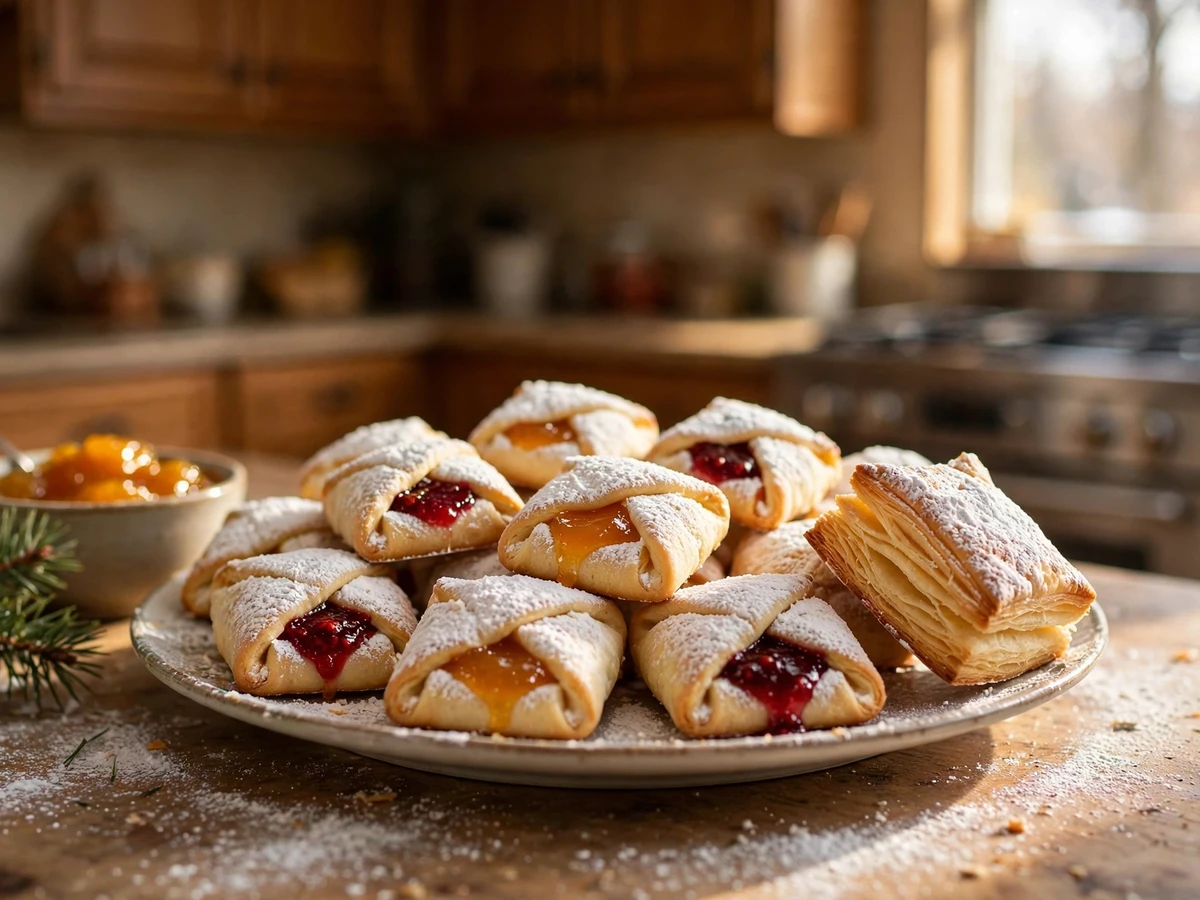
Kolaczki cookies are the quiet overachievers of the Christmas cookie box. No frosting, no sprinkles, just a square of cream cheese pastry folded over a spoonful of jam and snowed with powdered sugar. They look like something a bakery charges by the piece for. At home they cost a block of cream cheese, two sticks of butter, and an afternoon broken into three short jobs.
They also carry a reputation for one specific failure: the folded corners spring open in the oven, and the little envelopes arrive flat, jam leaked onto the tray. That failure has three causes: dough too warm, a seal that was never really sealed, and jam sitting where the fold needs to grip. This recipe answers all three, with an egg white glue, a generous overlap, and a short chill for the shaped trays. The corners stay closed. The jam stays home.
The two fillings here are the classics, apricot and raspberry, one golden and one deep red, because a mixed box looks like you planned it. The dough itself is the traditional Polish American formula, butter and cream cheese in equal parts, barely sweetened, rolled thin at 1/8 inch so it bakes into true flaky layers instead of soft biscuits. Make the dough on Monday, shape on Wednesday, bake on Friday, and the box is done before the weekend starts.
Why Kolaczki Dough Carries Almost No Sugar
Kolaczki cookies break the usual cookie rule, because the dough is a pastry before it is a cookie. Traditional recipes put no sugar in it at all. The sweetness lives in the jam and in the powdered sugar on top, and the plain, buttery dough is the frame that makes both taste brighter. A sweet dough would flatten that contrast and turn a delicate pastry into an ordinary thumbprint.
This version adds two tablespoons of sugar, no more, and it is there for the oven, not the tongue. A trace of sugar helps the thin edges take a light golden color in a short bake, and softens the raw flour taste. You will not taste sweetness in the pastry itself. You will taste butter, a gentle tang from the cream cheese, and then the jam.
The cream cheese is doing structural work, not just flavor. Its acidity relaxes the flour just enough that a thin sheet folds without cracking, and its fat sits between the butter layers as the pastry puffs. That is why the ratio matters: equal weights of butter and cream cheese, flour added only until the dough holds together. More flour rolls easily and eats like cardboard. This dough eats like the corner of a good croissant.
Flaky Edges, a Jam Jewel in the Middle
A good kolaczki shatters a little. The first bite crackles at the folded corner, gives way to tender layers, then reaches the jam, which bakes down into something concentrated and almost chewy at the edges. Apricot goes deep and honeyed; raspberry stays bright and a little tart. The powdered sugar lands last, dissolving before the butter comes back.
None of that happens if the dough is rolled thick. At 1/4 inch, kolaczki bake up bready, the fold turns doughy, and the jam disappears into the chew. At 1/8 inch, the sheet is thin enough to layer and crisp, thick enough to hold its jewel. Roll to the thickness of two stacked credit cards and you are there. The edges will look almost too thin. They are not; they are the best part.
Size plays along. Squares of 2 1/2 inches bake evenly and fold with a proper overlap; bigger squares slump, smaller ones dry out before the jam sets. One batch makes four dozen, which disappears faster than expected once the boxes start leaving.
Seal Them Like You Mean It: Egg White, Overlap, Chill
Here is the whole anti opening method, in the order it matters. First, the glue: a lightly beaten egg white, brushed on one corner of the square before folding. Water works on a calm day, but egg white sets in the heat and holds like it means it. Second, the overlap: bring the two opposite corners over the jam so they cross by at least half an inch, then press down firmly with a fingertip, a real press, not a pat. Third, the chill: the filled, folded trays go into the fridge for twenty minutes before the oven.
The chill is the step home bakers skip, and the one that saves the batch. Butter and cream cheese soften as you work, and a warm fold creeps open the moment it meets oven heat, long before the pastry can set. Twenty cold minutes firm the fold so the first blast of heat locks the shape instead of undoing it. Bakeries chill shaped pastries as a matter of routine; this is that routine, borrowed.
One more placement rule: keep the jam centered and off the corners. Jam under the fold is a lubricant, and a lubricated seal is no seal at all. If a spoonful strays, wipe the corner with a dry fingertip before you brush and fold.
The Cookie Box Schedule: Three Days of Easy Work
Kolaczki reward a baker who spreads the work out. Day one, ten minutes: make the dough, wrap the two disks, and refrigerate; the dough keeps three days and rolls out silkier on day two. Day two or three, forty relaxed minutes: roll, cut, fill, fold, and chill the trays.
At that point the schedule forks. Bake the same day and the cookies keep a week in a tin. Or freeze the shaped trays until solid, tip the cookies into a bag, and hold them up to two months, baking straight from frozen with two extra minutes. No thawing, no reshaping, no second mess.
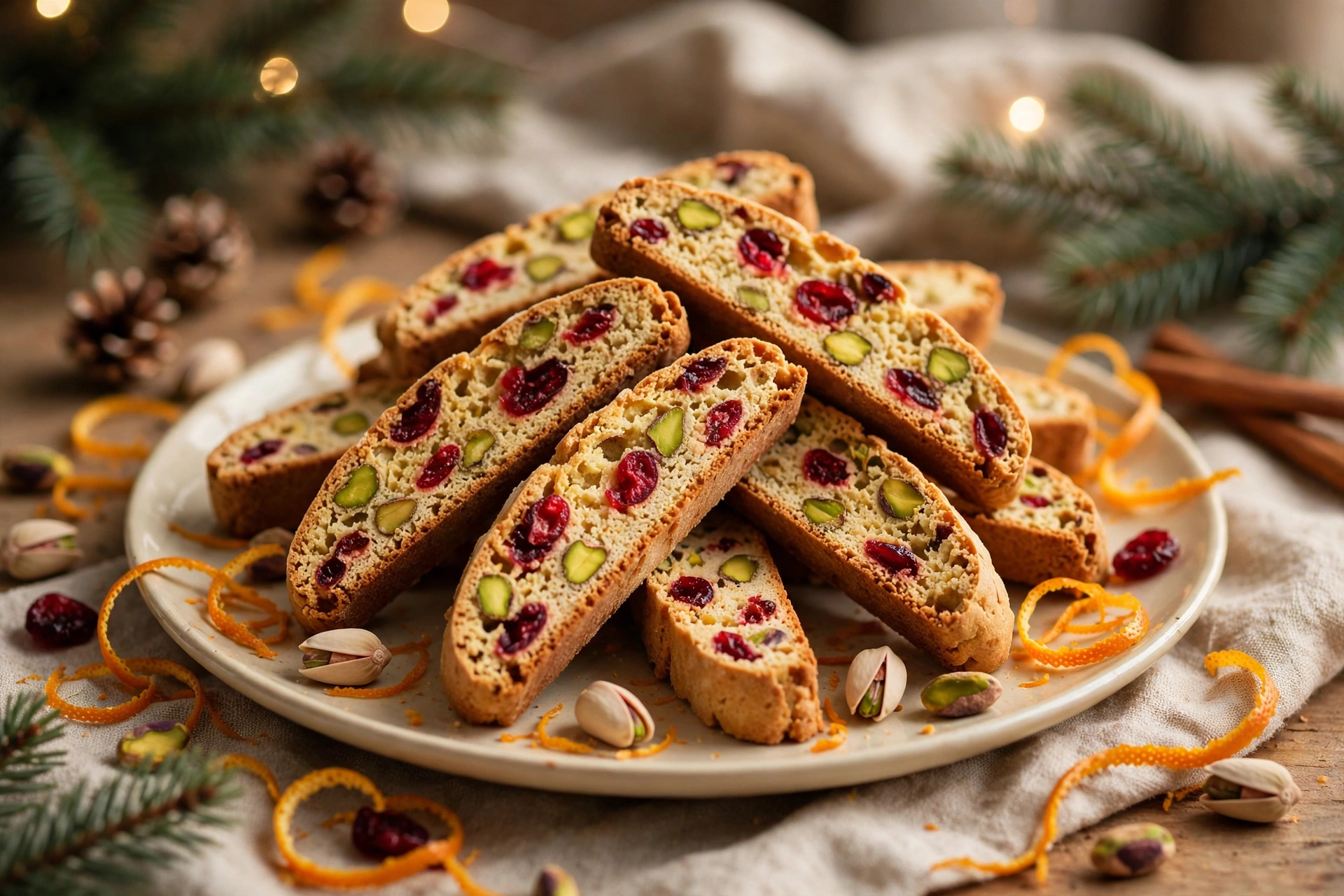
In the box, kolaczki are the jewel toned piece that makes the beige cookies look intentional. They sit beautifully beside almond crescent cookies and a stack of cranberry pistachio biscotti, and they travel well because the fold protects the jam. Dust them once when they cool and once more, lightly, the day you close the box; the second dusting is cosmetic, replacing what the tin absorbed.
Kolaczki Cookies Ingredients
- 1 cup unsalted butter, softened (2 sticks)
- 8 ounces cream cheese, softened
- 2 tablespoons granulated sugar
- 1 teaspoon vanilla extract
- 1/2 teaspoon fine sea salt
- 2 1/4 cups all-purpose flour, plus more for rolling
- 1/2 cup thick apricot preserves
- 1/2 cup thick raspberry preserves
- 1 teaspoon cornstarch, only if your preserves pour thin (optional)
- 1 egg white, lightly beaten
- 1/2 cup powdered sugar, for dusting, plus more before serving
Softened means the butter and cream cheese give under a fingertip but are nowhere near melting, about 65 degrees. If they shine or slump, the dough will be greasy and the layers lost. Twenty minutes too long on the counter is the most common quiet problem with this recipe; when in doubt, start them cooler than you think.
How to Shape and Bake Kolaczki Cookies
- Beat the butter and cream cheese together until smooth and fluffy, about 2 minutes. Beat in the granulated sugar, vanilla and salt.
- Add the flour in two additions, mixing on low just until a soft dough forms and no dry streaks remain. Stop as soon as it comes together; overworked dough bakes tough.
- Divide the dough in half. Form each half into a disk about 1 inch thick, wrap well, and refrigerate at least 1 hour and up to 3 days.
- Heat the oven to 350 degrees F. Line two baking sheets with parchment paper. If either preserve pours thin, stir 1/2 teaspoon of the cornstarch into each 1/2 cup and warm it for 20 seconds so it sets up thick as it cools.
- Roll one disk on a lightly floured surface to 1/8 inch thick. Cut into 2 1/2 inch squares with a knife or fluted cutter. Gather the scraps once, reroll, and cut again.
- Place 1/2 teaspoon of preserves in the center of each square, apricot on half the squares and raspberry on the rest. Keep the jam off the corners.
- Brush one corner of each square with egg white. Fold two opposite corners over the filling so they overlap by at least 1/2 inch, and press the overlap down firmly to seal.
- Arrange the cookies 1 inch apart on the prepared sheets. Refrigerate the filled trays for 20 minutes. At this point the trays can instead be frozen solid and the cookies stored in a bag for up to 2 months.
- Bake 13 to 15 minutes, until the folded corners are set and the edges are just turning golden. From frozen, bake 15 to 17 minutes. The tops stay pale; judge by the corners and the bottoms.
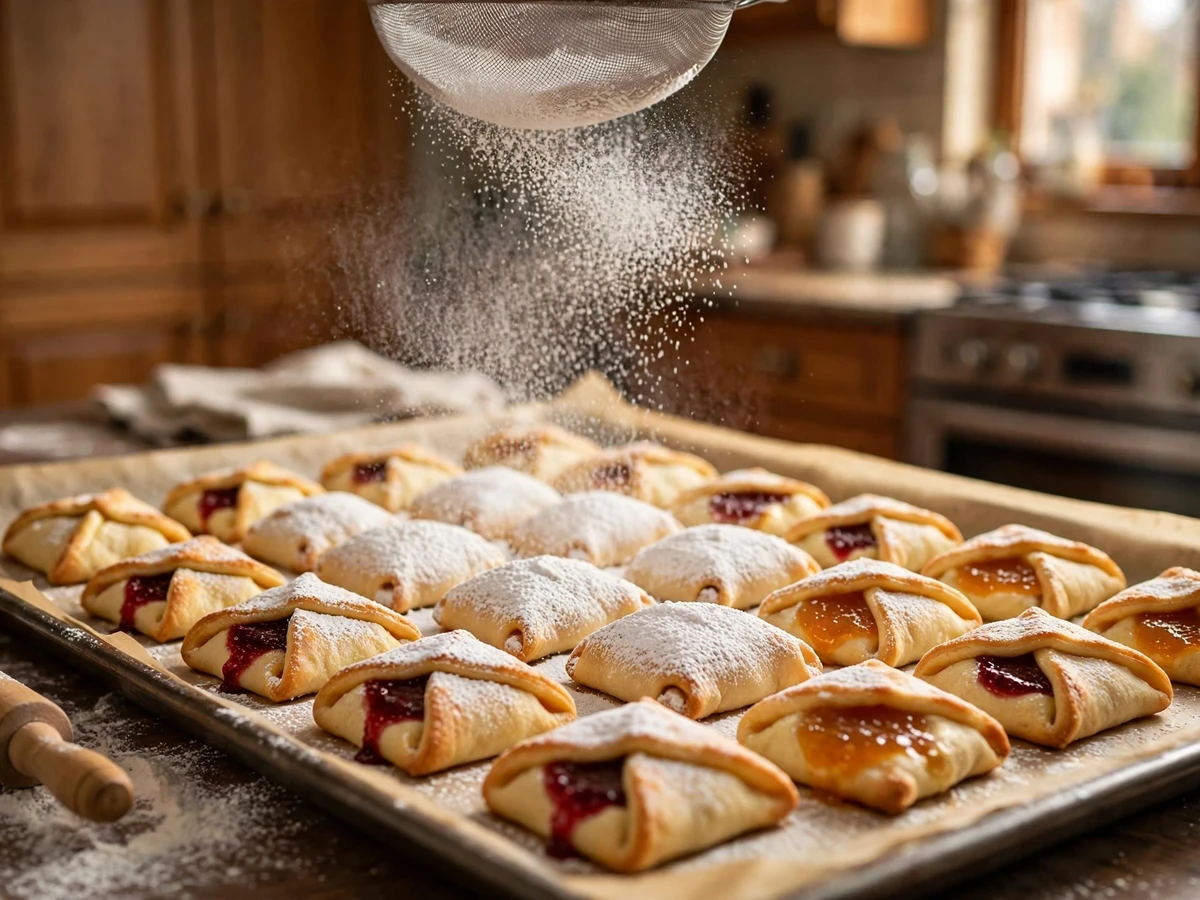
- Cool on the sheet for 5 minutes, then move to a rack to cool completely. Dust generously with powdered sugar once cool, and dust again lightly just before serving or boxing.
Rolling a Soft Dough Without the Fight
This dough is soft by design, and it rolls best cold, in a cool kitchen, on a surface dusted with flour and then dusted again. Work with one disk at a time and keep the second in the fridge. If the sheet starts to stick, slide it, parchment and all if you rolled on parchment, back into the cold for ten minutes instead of muscling through. Warm dough tears; cold dough waits.
Flour is a tool with a cost: every extra handful worked into the sheet toughens the crumb a little, so dust lightly and brush the excess off the squares before filling. Rolling between two sheets of parchment removes the sticking problem almost entirely; peel the top sheet, cut, and lift the squares with a thin spatula.
Thickness you can measure beats thickness you guess: rolling pin guide rings at 1/8 inch, a quarter turn of the sheet between passes, and always roll from the center outward, so the sheet stays even and bakes evenly.
Jam That Behaves in a Hot Oven
The filling rule is simple: thick going in, or it will not stay in. Spoon a little preserve onto a cold plate; if it slowly spreads into a puddle, it is too thin for a fifteen minute bake. The fix takes a minute: stir half a teaspoon of cornstarch into each half cup of preserves, warm it until it just thickens and turns glossy, and let it cool before filling. Dedicated pastry fillings sold in tubes are thicker still and are what bakeries use; they are a fair shortcut, not a compromise.
Quantity matters as much as thickness. Half a teaspoon in a 2 1/2 inch square looks scant and is correct: the jam bubbles and expands as it heats, and an overfilled square pushes its own fold open from the inside. If a few cookies leak anyway, they are the baker’s share, eaten warm at the counter.
Temperature helps too: cold trays into a fully heated oven, never a still warming one. The pastry needs the first minutes of heat to set the fold before the butter fully melts; in a lukewarm oven it slumps in slow motion, and no seal survives it.
Fillings Beyond Apricot and Raspberry
Once the method is yours, the filling is a pantry decision. Plum preserves are the oldest classic, dark and deep. Sour cherry runs bright and tart. A sweetened farmer’s cheese filling, beaten with an egg yolk and a little sugar, is the other traditional branch, closer to a danish. Poppy seed filling, sold in cans near the pie fillings, is dense, dark and very Polish.
Modern boxes wander further: lemon curd, a thick caramel, or dried cranberries chopped fine and folded into cream cheese, in the spirit of our white chocolate cranberry cookies. Keep the two rules: thick enough to hold a soft peak, and half a teaspoon, centered.
One swap truly fails: reduced fat cream cheese makes the dough gummy. Gluten free bakers do well with a one to one gluten free flour blend plus ten extra minutes of chilling, since those doughs soften faster.
Keeping Kolaczki Crisp in the Tin
Baked kolaczki keep one week in a sealed tin at room temperature, layered between parchment so the powdered sugar does not migrate. Keep them away from soft cookies in the same box; a crisp pastry stored against a chewy cookie trades textures with it, and both lose. The FDA guidance on storing food safely covers the general rules if your kitchen runs warm.
The jam slowly softens the pastry from day three, which most families consider a feature: day one kolaczki are crisp, day four kolaczki are tender, and both have loyalists. For longer keeping, freeze baked cookies up to a month and refresh them five minutes in a 300 degree oven. They mail well for the same reason peppermint meltaway cookies do: small, sturdy, and better a few days after baking.
Questions Bakers Ask About Kolaczki
Why did my kolaczki open up in the oven?
One of three reasons: the dough was warm, the overlap was too small, or jam sat under the fold. Brush one corner with egg white, overlap the corners by at least half an inch and press firmly, keep the jam centered, and chill the filled trays for 20 minutes before baking.
How thin should I roll kolaczki dough?
One eighth of an inch, about the thickness of two stacked credit cards. Thicker dough bakes bready and pushes the fold open; thinner dough cracks when folded. Guide rings or two skewers on the counter make the thickness easy to repeat.
Can I freeze kolaczki before baking?
Yes, and it is the best way to build a cookie box ahead. Freeze the shaped, filled cookies on their trays until solid, store them in a bag for up to 2 months, and bake straight from frozen at 350 degrees for 15 to 17 minutes.
My jam ran out and burned on the tray. How do I stop it?
Use less and make it thicker. Half a teaspoon per square is enough, and runny preserves should be stirred with a little cornstarch and warmed until glossy before filling. Jam that starts thick stays in its cookie.
Why is there no sugar in traditional kolaczki dough?
Because the dough is a pastry, not a cookie base. The sweetness is meant to come from the jam and the powdered sugar, against a plain buttery crumb. This recipe adds just two tablespoons, for browning and balance, without changing that character.
Why did my kolaczki open up in the oven?
Usually the dough was warm, the overlap was too small, or jam sat under the fold. Brush one corner with egg white, overlap the corners by at least half an inch and press firmly, keep the jam in the center, and chill the filled trays for 20 minutes before baking.
How thin should I roll kolaczki dough?
One eighth of an inch, roughly two stacked credit cards. Thicker dough bakes bready and pushes the fold open, thinner dough cracks when folded. Work cold, one disk at a time, and reroll scraps only once.
Can I freeze kolaczki before baking?
Yes. Freeze the shaped and filled cookies on their trays until solid, then store in a sealed bag for up to 2 months. Bake straight from frozen at 350 degrees F for 15 to 17 minutes, no thawing needed.
How do I keep the jam from running out of kolaczki?
Use thick preserves and only half a teaspoon per square, kept in the center and off the corners. If a preserve pours thin, stir in half a teaspoon of cornstarch per half cup, warm it until glossy, and cool it before filling.
How long do kolaczki cookies keep?
One week in a sealed tin at room temperature, layered with parchment and stored apart from soft cookies. They soften gently from day three as the jam relaxes the pastry. Baked cookies also freeze for a month and refresh in a 300 degree oven for 5 minutes.
Kolaczki Cookies
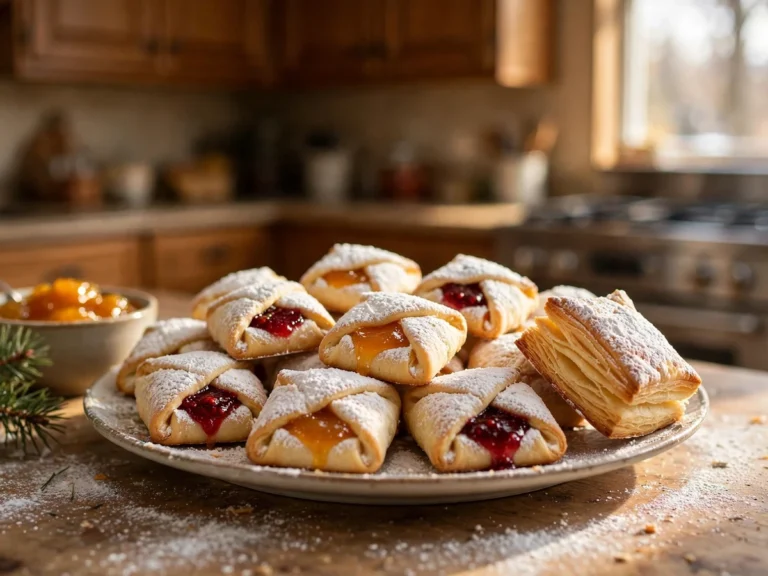
Traditional Polish cream cheese pastry cookies: equal parts butter and cream cheese, a barely sweetened dough rolled to 1/8 inch, filled with apricot and raspberry preserves, and folded with an egg white seal plus a tray chill so the corners never spring open. They freeze shaped and bake from frozen, built for the Christmas cookie box.
- Total Time: 3 hours
- Yield: 48 cookies 1x
Ingredients
- 1 cup unsalted butter, softened (2 sticks)
- 8 ounces cream cheese, softened
- 2 tablespoons granulated sugar
- 1 teaspoon vanilla extract
- 1/2 teaspoon fine sea salt
- 2 1/4 cups all-purpose flour, plus more for rolling
- 1/2 cup thick apricot preserves
- 1/2 cup thick raspberry preserves
- 1 teaspoon cornstarch, only if your preserves pour thin (optional)
- 1 egg white, lightly beaten
- 1/2 cup powdered sugar, for dusting, plus more before serving
Instructions
- Beat the butter and cream cheese together until smooth and fluffy, about 2 minutes. Beat in the granulated sugar, vanilla and salt.
- Add the flour in two additions, mixing on low just until a soft dough forms and no dry streaks remain. Stop as soon as it comes together; overworked dough bakes tough.
- Divide the dough in half. Form each half into a disk about 1 inch thick, wrap well, and refrigerate at least 1 hour and up to 3 days.
- Heat the oven to 350 degrees F. Line two baking sheets with parchment paper. If either preserve pours thin, stir 1/2 teaspoon of the cornstarch into each 1/2 cup and warm it for 20 seconds so it sets up thick as it cools.
- Roll one disk on a lightly floured surface to 1/8 inch thick. Cut into 2 1/2 inch squares with a knife or fluted cutter. Gather the scraps once, reroll, and cut again.
- Place 1/2 teaspoon of preserves in the center of each square, apricot on half the squares and raspberry on the rest. Keep the jam off the corners.
- Brush one corner of each square with egg white. Fold two opposite corners over the filling so they overlap by at least 1/2 inch, and press the overlap down firmly to seal.
- Arrange the cookies 1 inch apart on the prepared sheets. Refrigerate the filled trays for 20 minutes. At this point the trays can instead be frozen solid and the cookies stored in a bag for up to 2 months.
- Bake 13 to 15 minutes, until the folded corners are set and the edges are just turning golden. From frozen, bake 15 to 17 minutes. The tops stay pale; judge by the corners and the bottoms.
- Cool on the sheet for 5 minutes, then move to a rack to cool completely. Dust generously with powdered sugar once cool, and dust again lightly just before serving or boxing.
- Prep Time: 45 minutes
- Cook Time: 15 minutes
Nutrition
- Serving Size: 1
- Calories: 85
- Sodium: 50
- Saturated Fat: 3
- Protein: 1
- Cholesterol: 17