
In this article:
- Rolled warm, so it never cracks
- Chocolate in the sponge, the cream and the bark
- The mascarpone secret to a filling that holds
- What goes into the log
- Whip, bake, roll, fill, frost
- Assembled ahead, frosted on Christmas Eve
- Cracks, sticking and runaway cream, fixed
- Slices, snow and seconds
- Yule log questions, answered
A yule log is the Christmas cake that gets photographed before it gets eaten: a thin chocolate sponge rolled around chocolate cream, frosted into bark, and dusted with sugar snow until it looks like it was carried in from a winter forest.
It also has a reputation it does not deserve. Home bakers file it under difficult because of one fear, the crack, and because the classic versions demand an hour of meringue mushrooms nobody has time for in December.
This version removes both problems. The sponge rolls while it is warm, which is the whole secret, and the decoration is sugared cranberries and rosemary that frost themselves in ten minutes. What is left is pure pleasure: chocolate, cream and a soft spiral in every slice.
Rolled Warm, So It Never Cracks
A yule log cracks for one mechanical reason: a cold or overbaked sponge cannot bend. The fix is built into the method here. The cake comes out of the oven, turns onto a cocoa dusted towel and rolls up while it is still warm and flexible.
Rolling warm does two things at once. It trains the sponge into its spiral shape while the crumb is supple, and it traps a little steam inside the roll, so the cake stays tender as it cools instead of drying at the edges.
The second half of the secret is restraint in the oven. Eleven to thirteen minutes is the whole bake, and the cake is done when the surface springs back under a fingertip. Two extra minutes of insurance baking is exactly how a sponge turns brittle.
King Arthur Baking teaches the same warm roll in its jelly roll recipe, rolling the hot cake in a sugared towel straight from the pan. Here the towel is dusted with cocoa instead of sugar, so the dark sponge never shows a white film.
When the cooled roll opens back up for its filling, it opens flat without fighting and closes again along the shape it remembers. No crack, no drama, and no need for the frosting to hide a disaster, though it still could.
One small cut matters more than it looks: trimming the crisp edges before the warm roll. The edges bake driest, and a dry edge is where a roll splits first. The trimmings are the baker’s taste of the sponge, and the roll that remains is supple from end to end.
The towel choice matters too. Use a smooth, flat weave kitchen towel, not a terry one: loops of terry print their texture into the warm crumb and cling to it. A flour sack towel or an old pillowcase releases the cake without a mark.
Chocolate in the Sponge, the Cream and the Bark
The sponge is a true chocolate sponge, not a vanilla cake dyed brown. Cocoa replaces part of the flour, so every bite tastes of chocolate first and cake second, with the light, springy crumb that only separated eggs can give.
The filling is chocolate cream with body: heavy cream whipped soft, folded through mascarpone whisked with powdered sugar, cocoa and vanilla. It spreads like a mousse and slices like a truffle, dark against the slightly paler spiral of cake.
The bark is ganache, made with chocolate at 60 to 70 percent, and whipped briefly once it cools. Whipping folds in a little air, so the coating spreads in soft ridges instead of a hard shell, and a fork dragged lengthwise turns those ridges into bark.
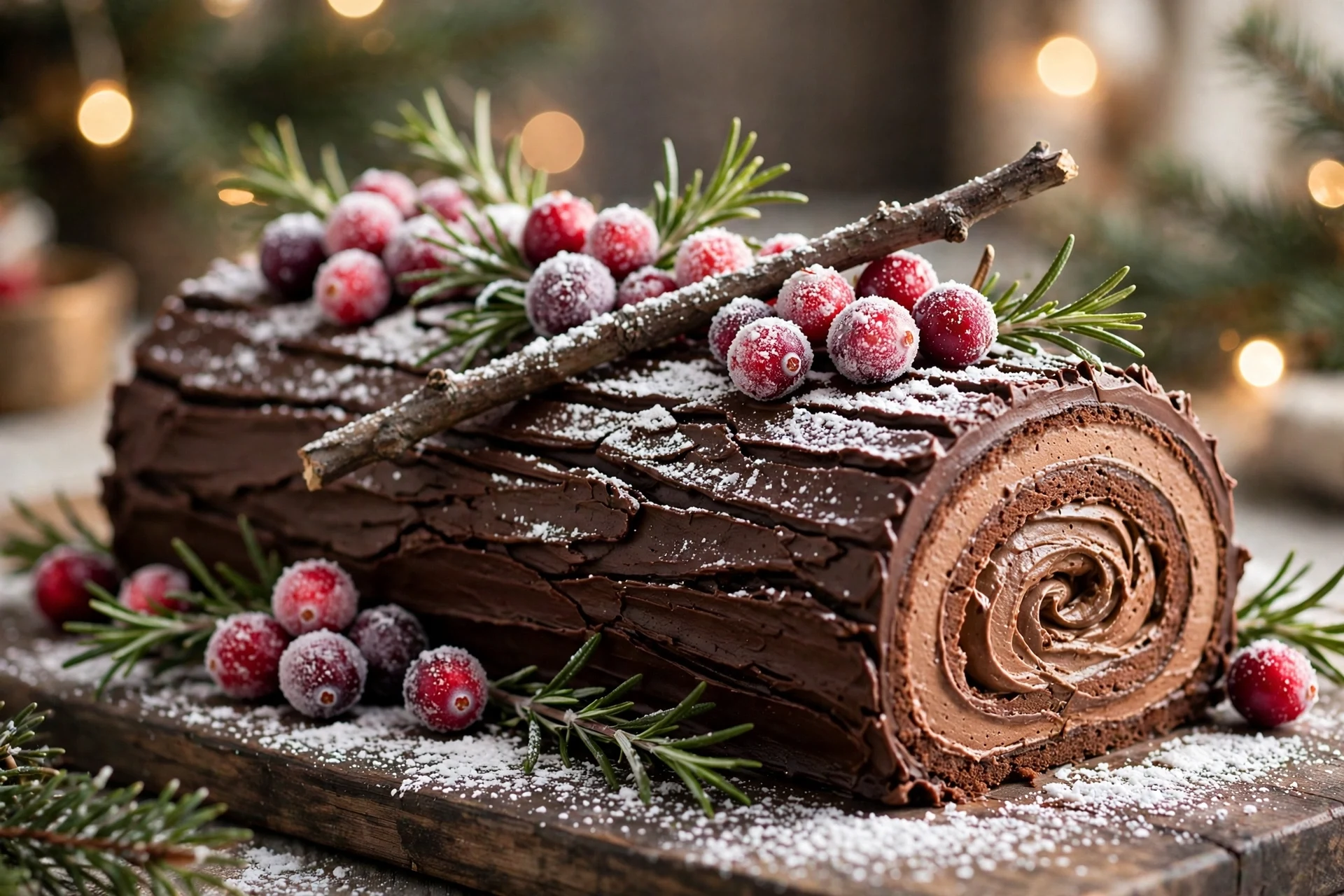
Each slice shows the whole architecture: dark sponge, darker cream spiral, the rough bark outside, a red cranberry or two on top. It is a rich cake in thin slices, which is exactly how Christmas desserts should be portioned.
The flavor stays clean because nothing competes with the chocolate. No liqueur in the cream, no coffee in the sponge, just a pinch of salt doing its quiet work of making chocolate taste more like itself.
The branch is not decoration for its own sake. The diagonal slice cut from one end and set against the log does two jobs: it makes the cake read instantly as a cut log, and it gives the platter an end piece with the spiral showing before anyone slices.
On the cut ends, the ganache is swirled in a spiral with the tip of the fork, like the rings of a sawn trunk. It takes ten seconds per end and it is the detail that makes guests lift their phones before their forks.
The Mascarpone Secret to a Filling That Holds
Plain whipped cream is the weak point of most rolled cakes. It weeps by the second day, slides when the log is sliced, and turns the spiral into a smear. Cream cheese solves the stability and brings a tang that fights the chocolate.
Mascarpone is the middle path this yule log takes. It sets the cream firmly enough to hold a clean spiral for three days, and its flavor is sweet cream rather than cheesecake, so the filling tastes of chocolate and dairy, nothing else.
The technique is order, not effort: whip the cream alone to soft peaks, whisk the mascarpone mixture smooth in a second bowl, then fold. Mascarpone beaten too long turns grainy, so the whisking stops the second it is smooth.
Cold ingredients are non negotiable. Cold cream whips, cold mascarpone folds cleanly, and the finished filling goes onto a completely cold cake. Warm filling on a warm sponge is how spirals melt, and this recipe never lets the two meet warm.
The filling also forgives a busy schedule: mixed and held in its bowl, covered, it keeps its texture for a full day in the refrigerator. Give it three gentle folds before spreading and it behaves exactly as if it were just made.
What Goes Into the Log
- 6 large eggs, separated, at room temperature
- 3/4 cup granulated sugar, divided
- 1 teaspoon vanilla extract
- 1/2 cup all-purpose flour
- 1/3 cup unsweetened cocoa powder, plus more for dusting the towel
- 1/2 teaspoon baking powder
- 1/4 teaspoon fine salt
- 1 cup heavy cream, cold
- 8 ounces mascarpone, cold
- 1/3 cup powdered sugar, plus more for the snow dusting
- 2 tablespoons unsweetened cocoa powder
- 1 teaspoon vanilla extract
- 6 ounces dark chocolate, 60 to 70 percent, finely chopped
- 3/4 cup heavy cream
- 2 tablespoons unsalted butter, softened
- 1/2 cup fresh cranberries
- 4 sprigs fresh rosemary
- 1/4 cup water
- 1/2 cup granulated sugar, for the sugared cranberries and rosemary
The log anchors the sweet end of the cookie season here; it shares the table happily with the hot chocolate cookies and a plate of Danish butter cookies for the guests who graze.
Whip, Bake, Roll, Fill, Frost
- Heat the oven to 375 degrees F. Line a 10 by 15 inch jelly roll pan with parchment and lightly grease the parchment.
- Beat the egg yolks with 1/2 cup of the granulated sugar for 3 to 4 minutes, until thick, pale and falling in ribbons. Beat in the vanilla.
- In a clean bowl, beat the egg whites with the salt to soft peaks. Add the remaining 1/4 cup granulated sugar a spoonful at a time and beat to glossy, stiff peaks.
- Sift the flour, 1/3 cup cocoa powder and baking powder over the yolk base and fold gently. Fold in the beaten whites in three additions, keeping as much air as possible.
- Spread the batter evenly into the corners of the pan. Bake 11 to 13 minutes, until the surface springs back under a fingertip and the edges just begin to pull from the pan. Do not overbake: a dry sponge is the one that cracks.
- Dust a clean kitchen towel generously with cocoa powder. Invert the hot cake onto the towel, peel off the parchment and trim any crisp edges. Starting from a short end, roll the cake up warm with the towel inside and cool completely, seam side down, about 1 hour.
- Make the filling: whip the cold heavy cream to soft peaks. In a second bowl, whisk the mascarpone, powdered sugar, 2 tablespoons cocoa powder and vanilla just until smooth. Fold the whipped cream through in two additions, to firm, spreadable peaks.
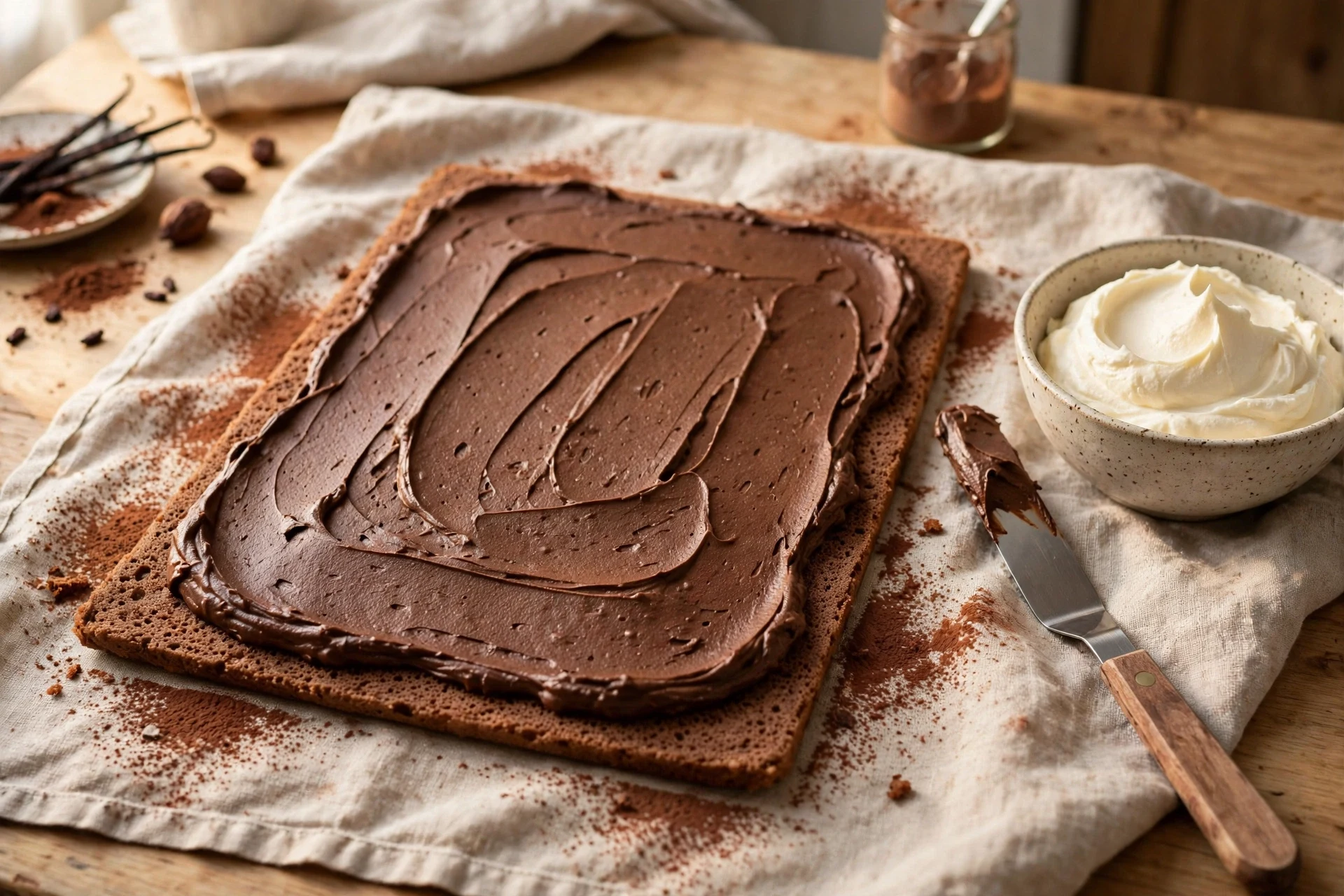
- Unroll the cooled cake gently. Spread the filling evenly, leaving a 1/2 inch border at the far short end. Roll the cake back up without the towel, wrap in plastic and chill at least 1 hour, or overnight.
- Make the ganache: heat the 3/4 cup cream to a bare simmer and pour it over the chopped chocolate. Rest 2 minutes, then stir from the center until smooth. Stir in the butter. Cool 20 to 30 minutes, stirring now and then, until thick and spreadable, then whip briefly for a lighter bark texture.
- Cut a 3 inch piece from one end of the roll on a diagonal and set it against the top side of the log as a branch, fixing it with a spoonful of ganache. Frost the whole log, then drag a fork lengthwise through the ganache to draw the bark, with a spiral swirl on each cut end.
- Simmer the water with 1/4 cup of the rolling sugar for 1 minute, toss in the cranberries and rosemary for 30 seconds, lift out and rest 10 minutes, then roll in the remaining sugar until frosted. Arrange on the log, dust with powdered sugar snow, and chill 30 minutes before slicing with a hot serrated knife.
Assembled Ahead, Frosted on Christmas Eve
The yule log is at its best made in two calm stages. The sponge bakes, rolls and fills a day or two before it is needed, and the filled roll waits in the refrigerator, wrapped, while the flavors settle into each other.
Frosting waits for serving day for one practical reason: ganache forked into bark looks freshest the day it is drawn, and the sugared cranberries keep their frost for about a day before the sugar drinks the berry juice.
The filled, unfrosted roll also freezes for up to a month, wrapped in plastic and then foil. Thaw it overnight in the refrigerator, still wrapped, then frost and decorate. A December cake that can wait in the freezer is a genuine holiday strategy.
Round out the dessert spread while the log chills: the chocolate crinkle cookies echo its flavor in cookie form, and the creamy eggnog cheesecake covers the guests who want their Christmas in a different key.
If the log is traveling to someone else’s Christmas, frost it at home and carry it on its serving platter inside a roasting pan, which gives it walls against car doors and corners. The sugared cranberries go on after the trip; they are the only part of the decoration that does not travel well.
Twelve slices is the honest yield, cut a generous inch thick. The cake is rich enough that seconds tend to be half slices, which means a single log quietly serves a table of fourteen across an evening of grazing.
Cracks, Sticking and Runaway Cream, Fixed
If a crack appears despite everything, read it before you mourn it. A surface crack along the outer curve disappears entirely under ganache; that is what bark texture is for. Trim the two ends as the recipe directs, and most cracks leave with the trimmings.
A cake that sticks to the towel was dusted too lightly or rolled too cool. Next time, more cocoa on the towel and a faster turn out of the pan. This time, patch the torn spots with filling before you roll; the spiral hides its own repairs.
Filling that squeezes out the sides means it was spread to the very edge. The bare 1/2 inch border at the far end is where the filling travels to as you roll; leave it empty and the roll seals itself without a leak.
A spiral that unrolls on the platter was sliced too soon. The chill after frosting is structural, not cosmetic: 30 minutes firms the ganache into the glue that holds the log’s shape against the knife.
Slices, Snow and Seconds
Slice with a long serrated knife dipped in hot water and wiped between cuts, in slices a generous inch thick. Each slice should stand on the plate showing its spiral, bark side up, with the powdered sugar snow still on it.
The cake keeps, covered, for 3 days in the refrigerator, and the slices arguably improve on day two as the sponge absorbs a breath of the cream. Bring slices to the table cool rather than cold, fifteen minutes out of the fridge, so the ganache softens to silk.
Serve it with strong coffee or a small glass of milk for the youngest guests, and nothing else. A cake this complete does not want a sauce; at most, a spare spoonful of barely sweetened whipped cream on the side for the guest who asks.
This yule log closes a Christmas meal the way the old ones were meant to: with a little theater, a lot of chocolate, and a cake that was finished before the guests arrived. Make it once and it becomes the December assignment nobody takes from you.
Yule Log Questions, Answered
Why did my yule log crack when I rolled it?
Almost always one of two causes: the sponge baked a few minutes too long and dried out, or it cooled flat before rolling. Bake only until the surface springs back, 11 to 13 minutes, and roll the cake warm in its towel the moment it leaves the pan.
Can I make a yule log completely ahead of time?
Yes. The filled roll keeps 3 days in the refrigerator and freezes for up to a month before frosting. Frost and decorate the day you serve it so the bark lines and the sugared cranberries look fresh.
I do not have a 10 by 15 inch jelly roll pan. What can I use?
A rimmed half sheet pan, about 12 by 17 inches, works if you spread the batter a little thinner and check the bake 2 minutes early. Avoid deep pans: the sponge must be thin, about 1/2 inch, or it will not roll.
Can I skip the mascarpone in the filling?
You can, but plain whipped cream filling weeps and softens within a day. Cream cheese is the closest substitute, whisked smooth the same way; it adds a slight tang the mascarpone does not. Stabilized mascarpone cream is what lets this log wait 3 days.
Do I have to make meringue mushrooms to decorate it?
No. Sugared cranberries and rosemary, a fork drawn through the ganache, and a dusting of powdered sugar give the full winter forest effect in about 10 minutes. Meringue mushrooms are a lovely variation when you have an extra hour, never a requirement.
Yule Log
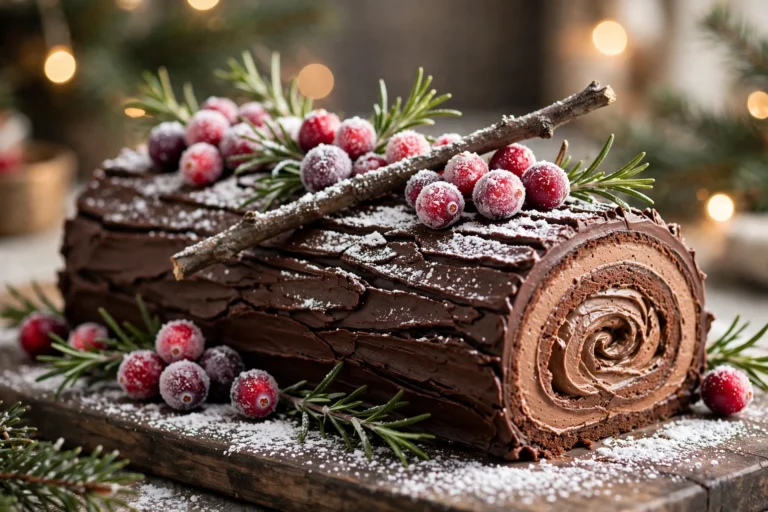
A classic yule log with a thin chocolate sponge rolled warm so it never cracks, a chocolate mascarpone cream that stays stable for 3 days, and a whipped ganache bark finish. The decoration is sugared cranberries and rosemary, ten minutes of work, no meringue mushrooms required.
- Total Time: 3 hours 30 minutes
- Yield: 12 slices 1x
Ingredients
- 6 large eggs, separated, at room temperature
- 3/4 cup granulated sugar, divided
- 1 teaspoon vanilla extract
- 1/2 cup all-purpose flour
- 1/3 cup unsweetened cocoa powder, plus more for dusting the towel
- 1/2 teaspoon baking powder
- 1/4 teaspoon fine salt
- 1 cup heavy cream, cold
- 8 ounces mascarpone, cold
- 1/3 cup powdered sugar, plus more for the snow dusting
- 2 tablespoons unsweetened cocoa powder
- 1 teaspoon vanilla extract
- 6 ounces dark chocolate, 60 to 70 percent, finely chopped
- 3/4 cup heavy cream
- 2 tablespoons unsalted butter, softened
- 1/2 cup fresh cranberries
- 4 sprigs fresh rosemary
- 1/4 cup water
- 1/2 cup granulated sugar, for the sugared cranberries and rosemary
Instructions
- Heat the oven to 375 degrees F. Line a 10 by 15 inch jelly roll pan with parchment and lightly grease the parchment.
- Beat the egg yolks with 1/2 cup of the granulated sugar for 3 to 4 minutes, until thick, pale and falling in ribbons. Beat in the vanilla.
- In a clean bowl, beat the egg whites with the salt to soft peaks. Add the remaining 1/4 cup granulated sugar a spoonful at a time and beat to glossy, stiff peaks.
- Sift the flour, 1/3 cup cocoa powder and baking powder over the yolk base and fold gently. Fold in the beaten whites in three additions, keeping as much air as possible.
- Spread the batter evenly into the corners of the pan. Bake 11 to 13 minutes, until the surface springs back under a fingertip and the edges just begin to pull from the pan. Do not overbake: a dry sponge is the one that cracks.
- Dust a clean kitchen towel generously with cocoa powder. Invert the hot cake onto the towel, peel off the parchment and trim any crisp edges. Starting from a short end, roll the cake up warm with the towel inside and cool completely, seam side down, about 1 hour.
- Make the filling: whip the cold heavy cream to soft peaks. In a second bowl, whisk the mascarpone, powdered sugar, 2 tablespoons cocoa powder and vanilla just until smooth. Fold the whipped cream through in two additions, to firm, spreadable peaks.
- Unroll the cooled cake gently. Spread the filling evenly, leaving a 1/2 inch border at the far short end. Roll the cake back up without the towel, wrap in plastic and chill at least 1 hour, or overnight.
- Make the ganache: heat the 3/4 cup cream to a bare simmer and pour it over the chopped chocolate. Rest 2 minutes, then stir from the center until smooth. Stir in the butter. Cool 20 to 30 minutes, stirring now and then, until thick and spreadable, then whip briefly for a lighter bark texture.
- Cut a 3 inch piece from one end of the roll on a diagonal and set it against the top side of the log as a branch, fixing it with a spoonful of ganache. Frost the whole log, then drag a fork lengthwise through the ganache to draw the bark, with a spiral swirl on each cut end.
- Simmer the water with 1/4 cup of the rolling sugar for 1 minute, toss in the cranberries and rosemary for 30 seconds, lift out and rest 10 minutes, then roll in the remaining sugar until frosted. Arrange on the log, dust with powdered sugar snow, and chill 30 minutes before slicing with a hot serrated knife.
- Prep Time: 45 minutes
- Cook Time: 12 minutes
Nutrition
- Serving Size: 1
- Calories: 385
- Sugar: 31
- Sodium: 95
- Fat: 24
- Saturated Fat: 14
- Unsaturated Fat: 8
- Trans Fat: 0
- Carbohydrates: 40
- Fiber: 2
- Protein: 6
- Cholesterol: 155