
In this article:
- Salted two days early, and proud of it
- Golden skin, juice in every slice
- The herb butter log, mixed days ahead
- What goes on the bird
- Brine, butter, roast, rest, carve
- The Thanksgiving clock, Sunday to Thursday
- Pale skin, dry breast, cloudy juices, fixed
- Friday belongs to the leftovers
- Herb butter roast turkey questions, answered
Herb butter roast turkey is the bird that makes Thanksgiving feel calm: salted two days before anyone arrives, slipped with a log of fresh herb butter under the skin, and roasted until the skin turns the deep, even gold that makes a table go quiet.
Most roast turkey anxiety comes from doing everything on Thursday. The thawing, the seasoning, the butter, the timing panic, all stacked into one morning with guests arriving at three. This recipe refuses that schedule and spreads the work across the week instead.
What reaches the table is a turkey that tastes seasoned all the way through, not just on the surface. The breast slices clean and juicy, the skin shatters lightly at the edges, and every bite carries sage, thyme and garlic in the background.
Salted Two Days Early, and Proud of It
A dry brine is the whole foundation of this herb butter roast turkey. Salt rubbed over the bird two days ahead draws out moisture, dissolves into it, then pulls that seasoned liquid back into the meat. The turkey seasons itself from the inside.
The dose matters, so here it is precisely: 3 tablespoons of kosher salt for a 12 to 14 pound bird, roughly 3/4 teaspoon per pound. If your salt is fine table salt, use half, because it packs denser and oversalts fast.
The second gift of the dry brine is the skin. Two days uncovered in the refrigerator dries the surface the way a fan dries laundry. Dry skin is what roasts crisp and golden instead of pale and rubbery, and no Thursday trick replaces it.
There is no rinsing, ever. Rinsing a dry brined bird washes off the seasoning and wets the skin you spent two days drying. You pat nothing, you rinse nothing; the salt has already gone where it belongs.
Wet brines ask for a bucket, a bag of ice and fridge space shaped like a paint pail. The dry brine asks for a sheet pan and a rack. For a holiday already short on refrigerator real estate, that difference decides the method.
Size the bird before you salt it. Plan on 1 to 1 1/4 pounds of whole turkey per person if you want leftovers, which you do. A 12 to 14 pound bird feeds 10 to 12 people with a Friday margin, and it is the largest size that still roasts evenly in a home oven.
Bigger is not better here. Birds past 16 pounds spend so long in the oven that the breast dries before the thighs finish, no matter the butter. Two smaller turkeys, roasted one after the other, will always beat one giant one.
Golden Skin, Juice in Every Slice
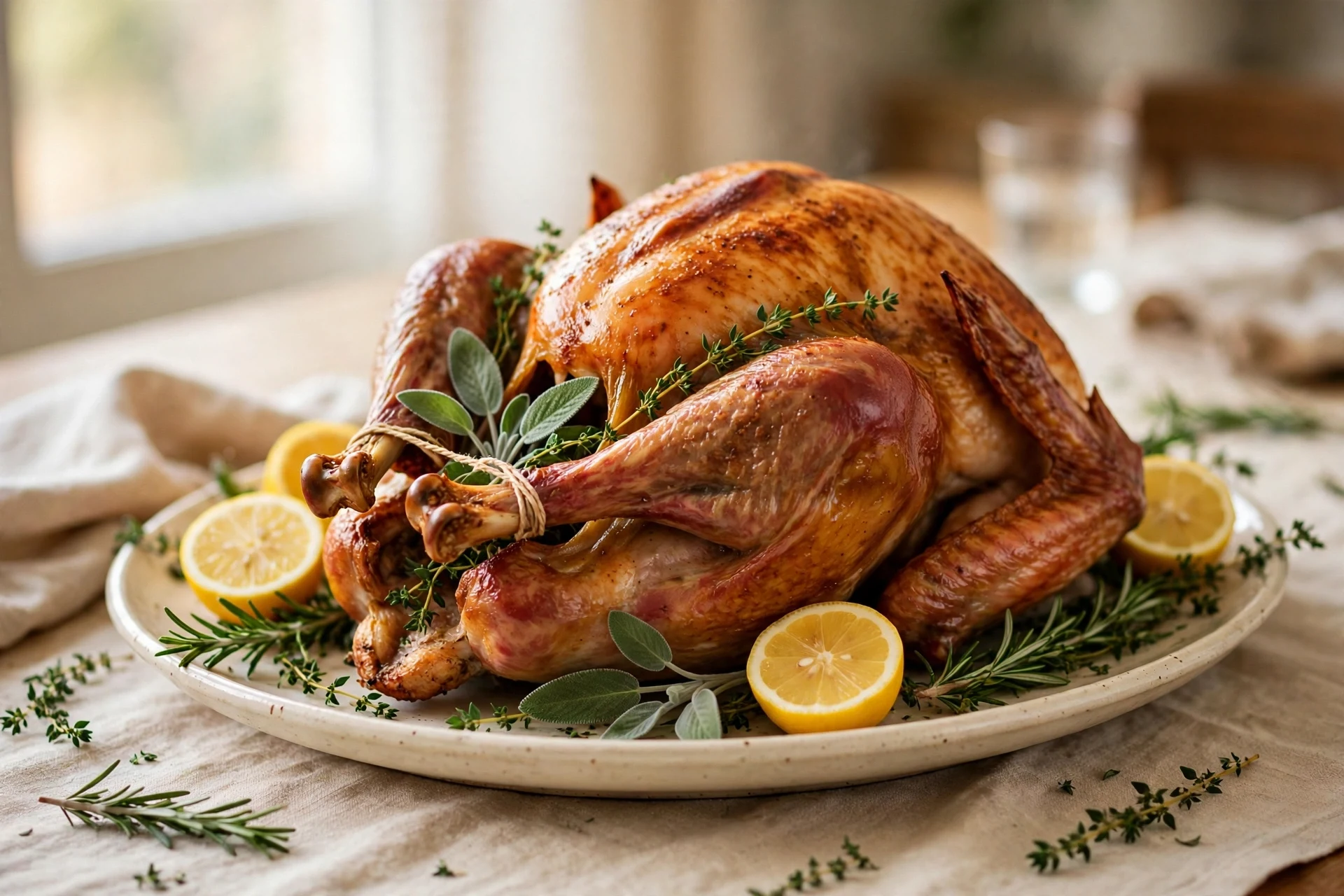
The skin comes out of the oven a deep, lacquered gold, darker at the drumsticks and the wing tips, with the herb butter having basted it from underneath the whole way through. It crackles faintly when the knife first goes in.
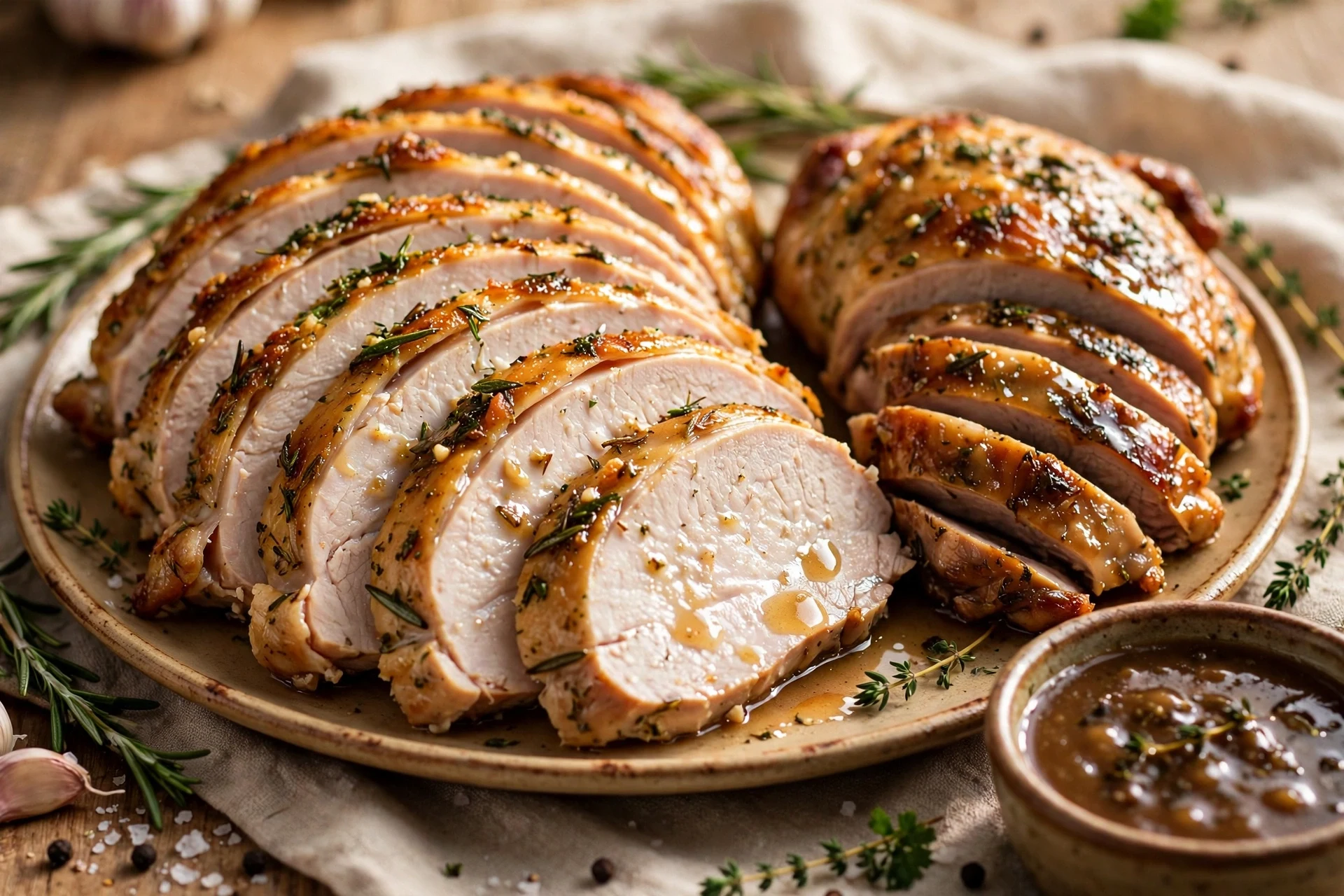
The breast meat is the test, and it passes: slices hold together, glisten at the cut face and stay tender without the chalky crumble of an overcooked bird. The salt did its slow work, and the butter under the skin kept the surface fed.
The dark meat eats differently, rich and almost silky, pulling from the bone in long strands. Guests who claim they only eat white meat tend to go back for a thigh slice once they taste the contrast.
Underneath everything sits the flavor of the fresh herbs, sage first, then thyme and rosemary in support, with garlic warmed into the butter rather than raw on the skin. Lemon zest keeps the richness bright without making the bird taste of lemon.
At the bottom of the pan, the drippings are concentrated and clean tasting, ready for gravy. Nothing about this turkey needs hiding under sauce; the gravy is a partner, not a cover.
The aromatics in the cavity are perfume, not stuffing. Onion, lemon and halved garlic steam gently inside the bird and scent the meat and the pan juices from within. They are not eaten, and they never slow the cooking the way a packed bread stuffing does.
Served on a warm platter with the herbs from the cavity tucked around it, the bird looks the way it tastes: generous, golden and unhurried. This is a turkey built by a calendar, and you can see it.
The Herb Butter Log, Mixed Days Ahead
The herb butter mixes in five minutes and keeps for three days, which is exactly why it is made early. Softened butter, finely chopped sage, thyme and rosemary, parsley, minced garlic and lemon zest, mashed together with a fork.
Rolled into a log inside parchment and chilled, the butter becomes sliceable into coins. On Thursday, those coins slide under the skin in seconds and spread evenly as they melt, with no cold lumps and no torn skin from pushing soft butter around.
Two thirds of the butter goes under the skin, directly on the breast meat, where it bastes from within. The last third rubs over the outside, carrying the skin to its color and giving the carving board that first smell of sage.
Fresh herbs are worth it here. Dried herbs work in the salt rub of some recipes, but in butter their flavor turns dusty against the fresh parsley brightness. If fresh sage is scarce, protect that one; it is the flavor people will name.
The log also freezes perfectly for a month, wrapped tightly over its parchment. If the holidays stack up, make a double batch at Thanksgiving and the Christmas bird, or a Sunday roast chicken, is already buttered before the thought finishes forming.
What Goes on the Bird
- 1 whole turkey, 12 to 14 pounds, fully thawed, neck and giblets removed
- 3 tablespoons kosher salt, for the dry brine (use half if using fine table salt)
- 2 teaspoons black pepper, divided
- 3/4 cup unsalted butter, softened
- 2 tablespoons fresh sage, finely chopped
- 2 tablespoons fresh thyme leaves
- 1 tablespoon fresh rosemary, finely chopped
- 1 tablespoon fresh parsley, finely chopped
- 4 cloves garlic, minced
- 1 teaspoon lemon zest
- 1 yellow onion, quartered
- 1 lemon, halved
- 1 head garlic, halved crosswise
- 6 sprigs fresh herbs (sage, thyme and rosemary)
- 2 cups low sodium chicken broth, for the pan
Save the neck for the gravy pot, and plan the sauce around the pan juices: our make-ahead turkey gravy takes these drippings on Thursday and turns them into the silkiest gravy on the table.
Brine, Butter, Roast, Rest, Carve
- Dry brine, 48 hours ahead: pat the turkey dry inside and out. Rub the salt and 1 teaspoon of the pepper over every surface, including the cavity and under the wings. Set the turkey breast side up on a rack over a rimmed sheet pan and refrigerate uncovered for 48 hours, or at least overnight.
- Herb butter, up to 3 days ahead: mash the softened butter with the sage, thyme leaves, rosemary, parsley, minced garlic, lemon zest and the remaining 1 teaspoon pepper. Scrape onto parchment, roll into a log and refrigerate until firm.
- On roasting day, take the turkey out of the refrigerator 1 hour before it goes in the oven. Heat the oven to 450 degrees F with a rack in the lowest third.
- Slice the cold herb butter log into coins. Loosen the skin over the breast with your fingers, working from both ends without tearing it, and push about two thirds of the butter coins under the skin, flattening them with your palm from outside. Rub the remaining butter over the skin.
- Fill the cavity with the onion, lemon halves, halved garlic head and herb sprigs. Tuck the wing tips under the bird and tie the legs loosely with kitchen twine. Set the turkey on a rack in a roasting pan and pour the broth into the pan.
- Roast at 450 degrees F for 30 minutes, until the skin takes on deep golden color at the edges.
- Reduce the heat to 325 degrees F and continue roasting until an instant read thermometer reads 160 degrees F in the thickest part of the breast and 165 degrees F in the innermost thigh, about 2 to 2 1/2 hours more. If the breast browns too fast, tent it loosely with foil.
- Rest the turkey, tented with foil, for 40 minutes. Do not skip this: the juices settle, the temperature evens out, and the oven is free for the side dishes.
- Carve: cut each breast lobe away from the bone in one piece, then slice it crosswise into thick slices so every slice keeps its skin. Separate the thighs and drumsticks at the joints and slice the thigh meat.
- Strain the pan juices into a measuring cup, let the fat rise, and skim. Use the juices as the base of your gravy and serve the turkey warm.
The Thanksgiving Clock, Sunday to Thursday
Start with the thaw, because it sets everything else. A frozen 12 to 14 pound turkey needs about 24 hours of refrigerator thawing for every 4 to 5 pounds, so it moves to the fridge on Sunday. The Oregon State University Extension turkey basics guide keeps the full thawing and roasting tables if your bird is bigger.
Tuesday is brine day: salt the thawed bird and mix the herb butter log while the kitchen is quiet. Wednesday asks for nothing but a glance at the fridge and the sides that can be built ahead.
Thursday runs on temperatures, not the clock, but plan around this shape: the bird sits out for 1 hour, roasts about 3 hours, then rests for 40 minutes. Those 40 minutes are when the wild rice stuffing bakes and the rolls warm.
For other sizes at this two stage roasting, use these as planning times, and always let the thermometer decide: 8 to 12 pounds, about 2 1/2 to 3 hours total; 12 to 14 pounds, about 3 to 3 1/2 hours; 14 to 18 pounds, about 3 1/2 to 4 1/4 hours. Start checking the breast temperature 45 minutes before the earliest estimate.
One safety note that matters more than any timing chart: a thawed turkey waits no more than 2 days in the refrigerator before roasting, and carved leftovers go back into the cold within 2 hours of the meal. The calendar above is built to respect both limits without thinking about them.
Build the rest of the menu on the same ahead logic. The sweet potato casserole with pecan streusel assembles Wednesday and bakes during the rest, and the hasselback sweet potatoes hold their heat under foil without complaint.
Pale Skin, Dry Breast, Cloudy Juices, Fixed
Pale skin at the end of roasting almost always means wet skin at the start. If it happens, raise the heat to 425 degrees F for the final 10 minutes and brush the breast with a little of the skimmed pan fat. Next year, the uncovered overnight dry is the real fix.
If the breast reaches temperature while the thighs lag, shield the breast with a double layer of foil and give the bird 15 more minutes. The foil slows the breast while the dark meat catches up, and the rest evens the rest.
Dry slices at the table are usually a carving issue, not a cooking one. Slice the breast crosswise, against the grain, in thick slices, and spoon a ladle of warm pan juices over the platter. Thick slices hold their moisture; thin ones surrender it.
Cloudy, greasy pan juices separate if you give them ten quiet minutes in a tall measuring cup. Skim the fat from the top, keep the dark liquid below, and your gravy base is clean and concentrated.
If the skin tears while you are loosening it for the butter, do not panic. A small tear over the breast seals itself as the butter melts, and the roasted skin shrinks back into place. Work slowly from both the neck end and the cavity end, and keep your nails short.
And if the turkey finishes 30 minutes before the guests sit down, that is a gift, not a problem. A rested bird holds beautifully under its tent; carve it at the last moment and let the sides take the oven space it freed.
Friday Belongs to the Leftovers
Refrigerate the carved meat within two hours, in shallow containers, off the bone. Off the bone is not fussiness: the meat cools evenly, slices neatly for sandwiches and is ready for soup without a wrestling match.
The carcass is an ingredient, not garbage. Simmered with the reserved neck, onion ends and herb stems, it gives a stock that carries Friday’s soup and next week’s risotto. Freeze what you will not use in four days, in flat bags that thaw fast.
Kept cold and covered, the sliced turkey holds its quality for 3 to 4 days. Reheat slices gently, covered, with a spoonful of broth in the pan, and this herb butter roast turkey eats on Friday almost as well as it did on Thursday.
Herb Butter Roast Turkey Questions, Answered
How much salt does a dry brine need per pound of turkey?
About 3/4 teaspoon of kosher salt per pound, which is 3 tablespoons for a 12 to 14 pound bird. Fine table salt packs much denser, so use half that amount or the turkey will taste oversalted.
Do I rinse the dry brine off before roasting?
No. The salt has dissolved and seasoned the meat during the 48 hours, and rinsing would wet the skin you dried on purpose. The surface salt that remains is exactly what crisps and flavors the skin.
My turkey is still icy in the center on Wednesday. Can I still brine it?
Yes, with a cold water rescue: submerge the wrapped bird in cold water, changing the water every 30 minutes, until the center thaws, then salt it and give it at least an overnight brine. A shorter brine still beats none.
Why start at 450 degrees and then drop to 325?
The hot start sets the skin and starts the browning before the butter melts away, and the lower finish cooks the breast gently so it stays juicy. It is the same logic as searing a steak before finishing it in a moderate oven.
Should the turkey rest covered or uncovered?
Tented loosely with foil, for 40 minutes. A tight wrap steams the skin soft, and no cover at all lets the surface cool too fast. The loose tent keeps the heat in while the skin stays crisp.
Herb Butter Roast Turkey
A whole roast turkey built on two make ahead moves: a 48 hour dry brine with an exact salt dose, and a fresh herb butter mixed up to 3 days early and rolled into a log. The skin roasts deep gold and crisp, the breast stays juicy, and a 40 minute rest frees the oven for the sides.
- Total Time: 3 hours 45 minutes
- Yield: 12 servings 1x
Ingredients
- 1 whole turkey, 12 to 14 pounds, fully thawed, neck and giblets removed
- 3 tablespoons kosher salt, for the dry brine (use half if using fine table salt)
- 2 teaspoons black pepper, divided
- 3/4 cup unsalted butter, softened
- 2 tablespoons fresh sage, finely chopped
- 2 tablespoons fresh thyme leaves
- 1 tablespoon fresh rosemary, finely chopped
- 1 tablespoon fresh parsley, finely chopped
- 4 cloves garlic, minced
- 1 teaspoon lemon zest
- 1 yellow onion, quartered
- 1 lemon, halved
- 1 head garlic, halved crosswise
- 6 sprigs fresh herbs (sage, thyme and rosemary)
- 2 cups low sodium chicken broth, for the pan
Instructions
- Dry brine, 48 hours ahead: pat the turkey dry inside and out. Rub the salt and 1 teaspoon of the pepper over every surface, including the cavity and under the wings. Set the turkey breast side up on a rack over a rimmed sheet pan and refrigerate uncovered for 48 hours, or at least overnight.
- Herb butter, up to 3 days ahead: mash the softened butter with the sage, thyme leaves, rosemary, parsley, minced garlic, lemon zest and the remaining 1 teaspoon pepper. Scrape onto parchment, roll into a log and refrigerate until firm.
- On roasting day, take the turkey out of the refrigerator 1 hour before it goes in the oven. Heat the oven to 450 degrees F with a rack in the lowest third.
- Slice the cold herb butter log into coins. Loosen the skin over the breast with your fingers, working from both ends without tearing it, and push about two thirds of the butter coins under the skin, flattening them with your palm from outside. Rub the remaining butter over the skin.
- Fill the cavity with the onion, lemon halves, halved garlic head and herb sprigs. Tuck the wing tips under the bird and tie the legs loosely with kitchen twine. Set the turkey on a rack in a roasting pan and pour the broth into the pan.
- Roast at 450 degrees F for 30 minutes, until the skin takes on deep golden color at the edges.
- Reduce the heat to 325 degrees F and continue roasting until an instant read thermometer reads 160 degrees F in the thickest part of the breast and 165 degrees F in the innermost thigh, about 2 to 2 1/2 hours more. If the breast browns too fast, tent it loosely with foil.
- Rest the turkey, tented with foil, for 40 minutes. Do not skip this: the juices settle, the temperature evens out, and the oven is free for the side dishes.
- Carve: cut each breast lobe away from the bone in one piece, then slice it crosswise into thick slices so every slice keeps its skin. Separate the thighs and drumsticks at the joints and slice the thigh meat.
- Strain the pan juices into a measuring cup, let the fat rise, and skim. Use the juices as the base of your gravy and serve the turkey warm.
- Prep Time: 45 minutes
- Cook Time: 3 hours
Nutrition
- Serving Size: 6
- Calories: 480
- Sugar: 0
- Sodium: 890
- Fat: 28
- Saturated Fat: 10
- Unsaturated Fat: 16
- Trans Fat: 0
- Carbohydrates: 1
- Fiber: 0
- Protein: 52
- Cholesterol: 165