
In this article:
- All the Pie, None of the Slicing
- The Well Is the Whole Trick
- Brown Sugar, Butter and Toasted Pecans
- Pecan Pie Cookies Ingredients
- How to Make Pecan Pie Cookies, Step by Step
- A Filling That Sets, Never Soaks
- A Dough That Waits in the Fridge
- Honey, Walnuts and Other Swaps
- Cookie Boxes, Layers and the Freezer
- The Cookie Plate’s Little Pie
- Pecan Pie Cookies Questions
All the Pie, None of the Slicing
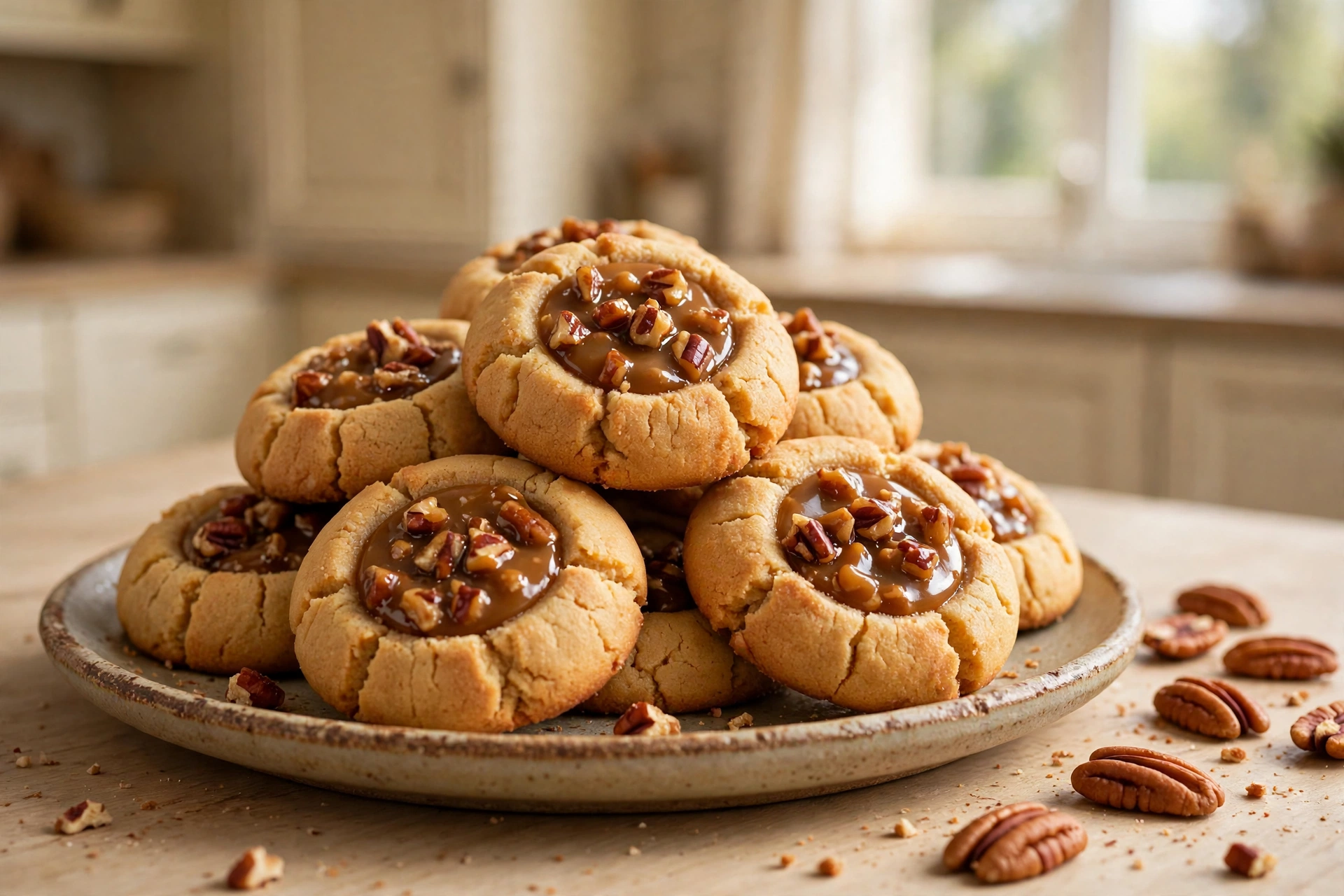
Pecan pie cookies take everything people fight over in a pecan pie, the gooey brown sugar center and the toasted nuts, and rebuild it as a soft butter cookie with a deep well of filling in the middle. No crust to roll, no slices to cut, no wedge collapsing on the plate. Just a cookie that eats like the best forkful of the pie.
The base is a real butter thumbprint, enriched with brown sugar so the cookie itself carries the caramel depth of the pie. Most versions lean on shortening for shape; butter tastes like the dessert this cookie is imitating, and a short chill gives the dough all the structure it needs to hold its well in the oven.
The filling is the second half of the promise. It is cooked briefly on the stove before it ever meets the cookie, so it arrives at the well already on its way to setting. That one pan, four minutes of stirring, is the difference between a glossy pool that firms up and a sticky spill that soaks the base.
They belong to the holidays twice over: pecan pie is Thanksgiving’s signature, and a plate of filled thumbprints is December’s. Bake them in November for the pie lovers, then bake them again for the cookie boxes, where their amber centers make every other cookie look dressed up.
The Well Is the Whole Trick
Ask ten bakers when to press the well into a thumbprint and you will start an argument. One camp presses before baking, the other presses the moment the tray leaves the oven. Both are half right, and this recipe uses the two together, which is why the wells here are deep, neat and crack free.
Pressing cold dough gives the cookie its architecture. The well is shaped while the butter is firm, so the walls stand up straight and the base stays thick enough to hold a full teaspoon of filling. Press with the back of a teaspoon measure rather than a thumb; the round, even bowl it makes fills more neatly and bakes more evenly.
The catch is that wells puff as they bake. Starch and steam lift the center, and a perfect raw well can come out of the oven nearly flat. So the tray comes out at six minutes, each well is pressed again, gently, while the cookie is hot and pliable, and only then does the filling go in. The second press takes twenty seconds and rescues the whole design.
Cracks are the other fear, and they have a simple logic. Cold dough cracks when it is pressed too fast, so let your scooped balls stand five minutes before pressing if they feel very firm. A small crack that does appear is not a failure: press the dough back together with your fingers, and the filling will cover the repair entirely.
Depth is the target to keep in mind. A well about half an inch deep and an inch wide holds the full teaspoon of filling with the pecans mounded, and leaves a wall thick enough to stay tender rather than crisp. Shallow, saucer like wells are the ones that overflow, no matter how carefully the filling was made. When in doubt, press a little deeper and a little narrower than feels necessary; the bake will relax the shape by exactly the margin you were worried about.
Brown Sugar, Butter and Toasted Pecans
The flavor is built in layers that echo the pie exactly. Brown sugar in both the dough and the filling means the caramel note runs through every bite instead of stopping at the center. Butter, salted only by the pinch you add, keeps the sweetness tasting rich rather than flat.
Toasting the pecans is non negotiable. Six minutes in a moderate oven wakes up the oils in the nuts and turns them from woody to fragrant, and that fragrance is what makes a two bite cookie taste like a slice of pie. Chop them after toasting, in pieces small enough to sit inside the well but big enough to keep their crunch.
The filling sets with a gentle chew, glossy on top, soft underneath, with the pecans suspended through it. Against the tender, almost shortbread crumb of the base, the contrast is the whole pleasure: crisp edges, soft cookie, gooey center, crunchy nuts, in that order, every bite.
Serve them barely warm if you can time it, when the filling still gives slightly. Ten seconds in a low oven brings a cooled cookie back to that state, and it is worth doing for guests. On a mixed plate beside the classic pecan pie itself, they read as the pie’s charming miniature, and both disappear.
A final pinch of flaky salt on the warm filling is the baker’s touch worth stealing. It takes ten seconds, it sparkles against the amber caramel, and it sharpens every other flavor in the cookie: the butter reads richer, the pecans nuttier, the brown sugar deeper. Add it the moment the tray leaves the oven, while the surface is still glossy enough to hold it.
Pecan Pie Cookies Ingredients
- 1/2 cup (113 g) unsalted butter, softened
- 3/4 cup (150 g) packed light brown sugar
- 1 large egg (50 g), at room temperature
- 1 teaspoon (5 ml) vanilla extract
- 1 3/4 cups (210 g) all-purpose flour
- 1/2 teaspoon (2 g) baking powder
- 1/4 teaspoon (2 g) fine sea salt
- 1 cup (110 g) chopped pecans, toasted
- 1/2 cup (100 g) packed light brown sugar, for the filling
- 1/4 cup (60 ml) light corn syrup
- 2 tablespoons (28 g) unsalted butter, for the filling
- 1 tablespoon (15 ml) heavy cream
- 1/2 teaspoon (3 ml) vanilla extract, for the filling
- 1 pinch of fine sea salt, for the filling
How to Make Pecan Pie Cookies, Step by Step
- Heat the oven to 350°F (175°C). Spread the pecans on a small tray and toast for 6 to 8 minutes, until fragrant. Cool completely, then chop into small pieces.
- Make the filling first. Combine the filling brown sugar, corn syrup and butter in a small saucepan over medium heat. Stir until the butter melts and the mixture comes to a gentle bubble, then cook for 1 minute, stirring.
- Remove from the heat and stir in the cream, vanilla, salt and toasted pecans. Set aside to cool and thicken until it coats the back of a spoon, about 15 minutes.
- For the dough, beat the softened butter and brown sugar for 2 to 3 minutes, until pale and fluffy. Beat in the egg and vanilla until smooth.
- Whisk the flour, baking powder and salt in a separate bowl. Add to the butter mixture and mix on low just until a soft dough forms.
- Cover and refrigerate the dough for 30 minutes, until firm enough to roll cleanly.
- Line two baking sheets with parchment. Scoop the dough into 24 balls of about 1 1/2 tablespoons each and arrange them 2 inches apart.
- Press a deep well into the center of each ball with the back of a teaspoon measure, pushing the sides up slightly as you press.
- Bake for 6 minutes. Remove the sheet and press each well again, gently, while the cookies are hot. Fill each well with 1 heaping teaspoon of the pecan filling.
- Return to the oven for 5 to 6 minutes, until the edges are golden and the filling bubbles gently at the center.
- Cool on the sheet for 10 minutes, then move to a rack. The filling finishes setting as the cookies cool.
A Filling That Sets, Never Soaks
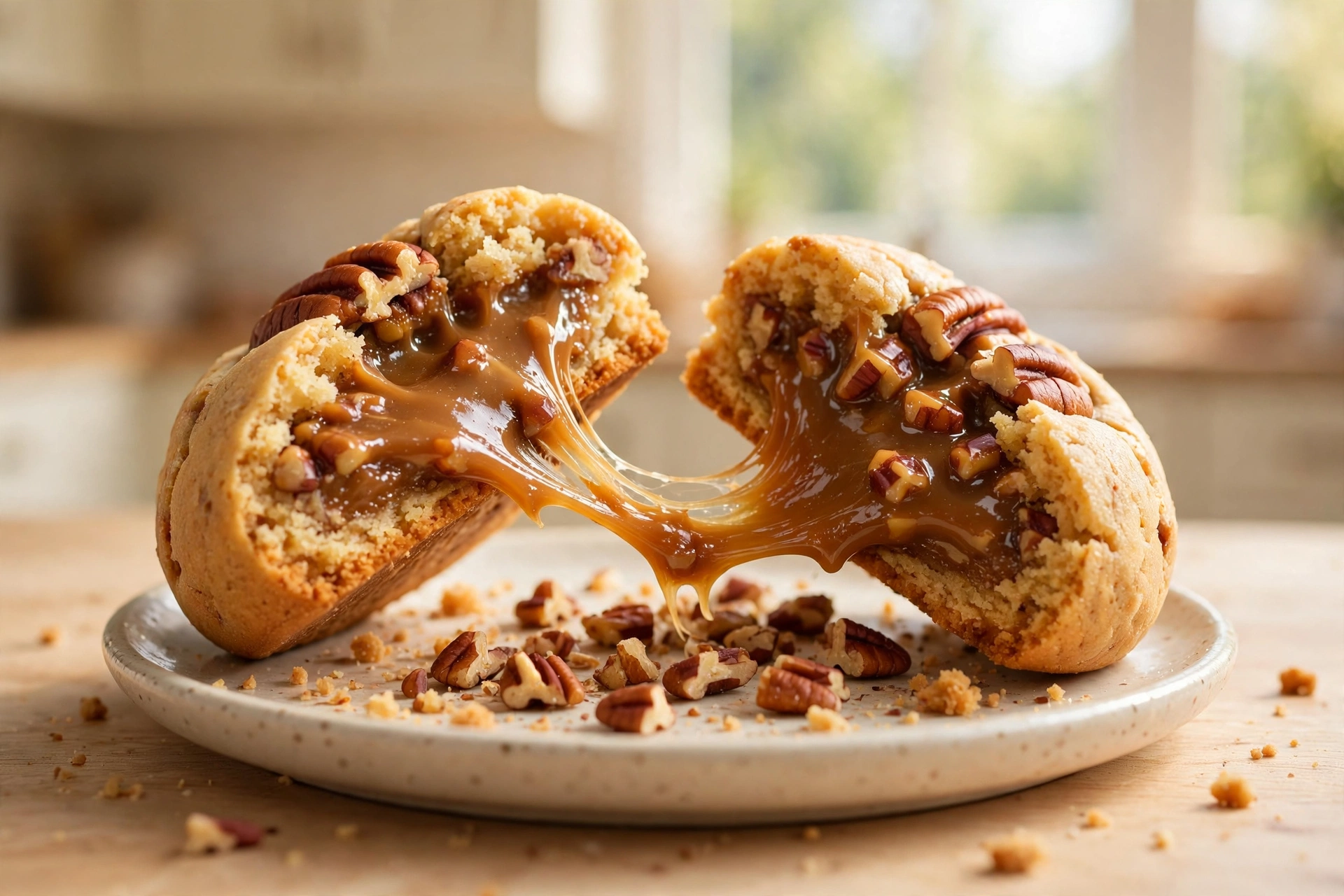
Raw pecan filling spooned into a raw cookie is a gamble: the cookie bakes faster than the filling sets, the syrup runs to find the lowest point, and the lowest point is the baking sheet. Precooking the filling for a few minutes removes the gamble. The sugars dissolve, the syrup thickens, and what goes into the well behaves like a soft caramel instead of a liquid.
The visual cue is simple. Drag the spoon across the pan: the filling should coat the back of it in a glossy layer that holds for a second before it levels. If it runs off like water, give it another minute of cooling; cooling thickens it as surely as cooking does.
Dose matters as much as texture. One heaping teaspoon per cookie fills the well to the brim without crossing it. It is tempting to add a second spoonful, and that temptation is exactly how filling ends up welded to the parchment. The pecans should mound slightly; the syrup should not.
What you get for the discipline is a filling that sets with a clean edge, stays glossy for days, and never turns the cookie base soggy. Day three, the center is still soft and the base still tender, which is more than most filled cookies can claim. Pecans are naturally rich in the oils that make this texture work; their nutrition profile is documented in the USDA FoodData Central database if you like reading labels as much as recipes.
A Dough That Waits in the Fridge
The dough keeps, covered, for up to 3 days in the refrigerator, and the filling keeps just as long in its own container. On baking day, the work is scooping, pressing and twelve minutes of oven time. For a holiday week, that split is the difference between baking these and merely intending to.
The shaped, filled cookies also freeze before baking. Freeze them on the tray until solid, bag them, and bake from frozen at 350°F (175°C) for 14 to 15 minutes. The wells hold, the filling sets, and a tray of pecan pie cookies can appear on a December evening with almost no notice.
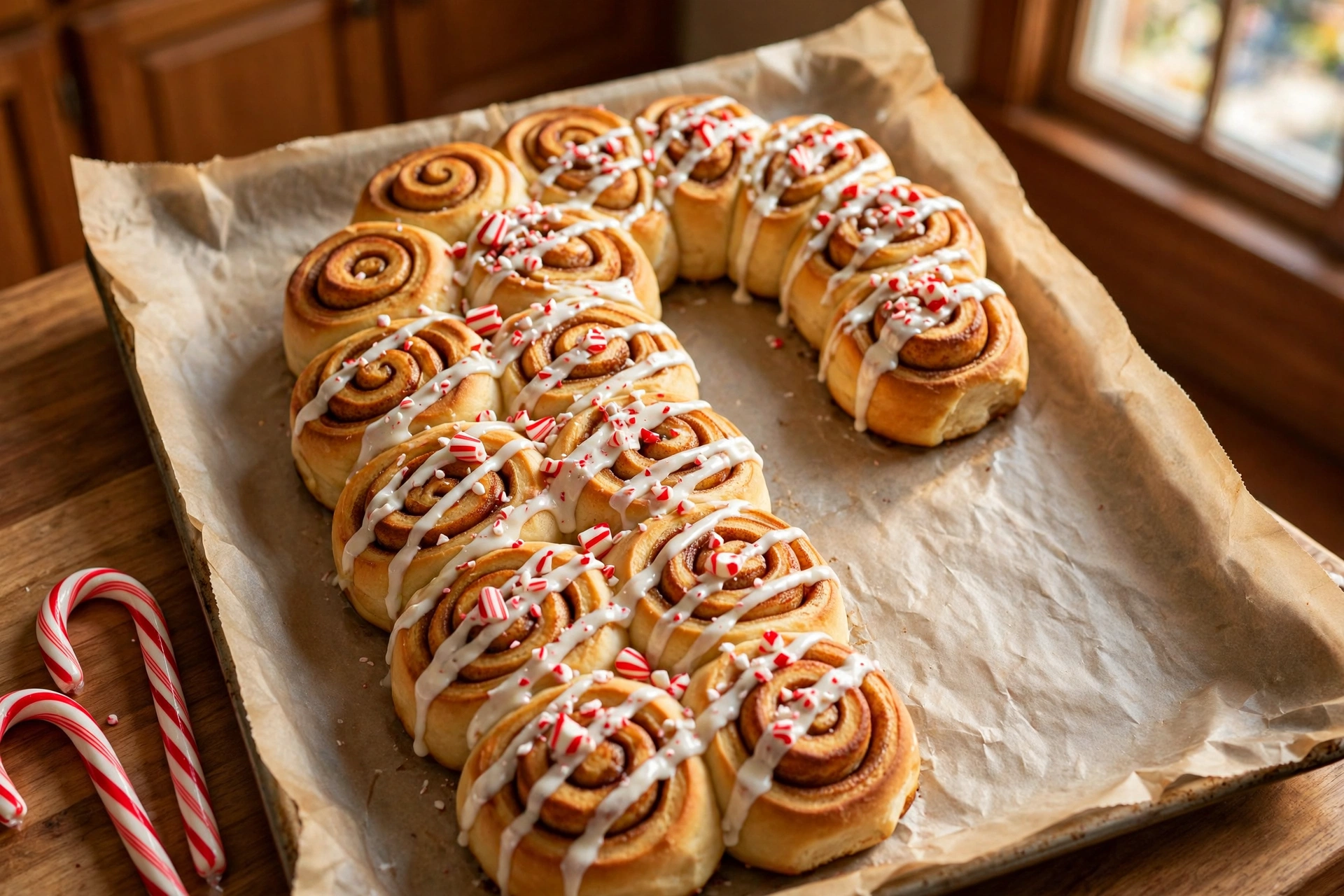
They share an oven schedule happily with the rest of a cookie day: our grinch cookies bake at the same temperature, and so do the candy cane cinnamon rolls for the morning after. One temperature, three trays rotating, and the season’s baking is done in an afternoon.
Two practical notes for baking day. Rotate the sheets halfway through the final bake if your oven runs hot at the back, because the filling at the rear will bubble a full minute sooner than the filling at the front. And let the filled cookies rest on the hot sheet for the full ten minutes before moving them: the filling is molten sugar at oven temperature, and it needs that time to settle into its glossy, sliceable set.
Honey, Walnuts and Other Swaps
Corn syrup is the traditional setting agent, but honey stands in for it spoon for spoon, with a filling that sets a touch softer and tastes faintly floral. Maple syrup works too, in the version our pecan pie muffins use, though the filling will be looser and the wells should be filled a little less generously.
Walnuts replace pecans without changing a single measurement, giving a cookie with a slightly bitter, more tannic edge that some bakers prefer. Toast them the same way and watch them closely; walnuts darken faster than pecans and turn bitter if they pass fragrant into scorched.
A pinch of cinnamon in the dough moves the cookie toward snickerdoodle territory, and a spoon of cocoa in the filling makes a chocolate pecan version that disappears at parties. The base dough also welcomes a teaspoon of orange zest, which lifts the brown sugar and makes the whole cookie taste brighter.
For a dairy free batch, a firm plant based butter works in both the dough and the filling, and coconut cream replaces the heavy cream. The wells press the same, the filling sets the same, and the pecans remain, correctly, the main event.
Cookie Boxes, Layers and the Freezer
Store the cooled cookies in an airtight tin at room temperature for up to 4 days. The one rule is layers: the filling stays slightly tacky, so stack only with parchment between the layers, or the cookies will arrive at their destination holding hands. A single layer in a wide tin is the safest packing of all.
For cookie boxes, these are the jewel cookies, the ones to place on top where they can be seen. Their amber centers carry the look of the whole box, and they travel well because the filling is set rather than soft. Pack them last, lid the box, and resist reopening it to admire them.
Baked cookies freeze for up to 2 months, layered with parchment in a rigid container. Thaw at room temperature for an hour, still in the container, so any condensation lands on the box instead of the filling. A minute in a low oven restores the just baked softness of the center.
The Cookie Plate’s Little Pie
Pecan pie cookies are proof that a holiday classic does not need to be served in wedges to be itself. Butter, brown sugar and toasted pecans do the same work in a cookie that they do in a pie, and the cookie adds something the pie cannot: it travels, it boxes, it freezes, and it fits in one hand beside a cup of coffee.
Bake the full batch. Half will go faster than you planned, and the other half is your cookie box insurance, the tray that makes you look like a person who had the season organized all along.
Pecan Pie Cookies Questions
Why did my pecan filling overflow the cookies?
The filling was either too warm and thin, or there was too much of it. Precook the filling and let it cool until it coats the back of a spoon, then use exactly 1 heaping teaspoon per well. The pecans should mound slightly; the syrup should never cross the rim.
Why did the wells in my thumbprint cookies disappear?
Wells puff as the cookie bakes, which is normal. Take the tray out at 6 minutes and press each well again with the back of a teaspoon measure while the cookies are hot and soft, then fill them. That second press is what keeps the well deep enough to hold the filling.
Can I make pecan pie cookies without corn syrup?
Yes. Honey replaces the corn syrup spoon for spoon and sets a little softer with a gentle floral note. Maple syrup also works but gives a looser filling, so fill the wells slightly less and let the filling cool a few extra minutes before spooning it in.
Can I use walnuts instead of pecans?
Yes, with no other change. Toast chopped walnuts the same way, 6 to 8 minutes, and watch them closely since they darken faster than pecans. The flavor is a little more bitter and tannic, which many bakers prefer against the sweet filling.
Can I freeze pecan pie cookies?
Yes, baked or unbaked. Freeze baked cookies layered with parchment for up to 2 months and thaw them in the closed container. Or freeze the shaped, filled cookies on a tray, bag them, and bake from frozen at 350°F (175°C) for 14 to 15 minutes.
Pecan Pie Cookies
Pecan pie cookies rebuild the best forkful of pecan pie as a soft, all butter thumbprint cookie. The brown sugar dough is chilled, pressed into deep wells, and filled with a pecan filling that is cooked briefly on the stove first, so it sets glossy and never soaks the base. A second press at the six minute mark keeps the wells deep, and one heaping teaspoon of filling per cookie means no overflow, ever.
- Total Time: 1 hour 20 minutes
- Yield: 24 cookies 1x
Ingredients
1/2 cup (113 g) unsalted butter, softened
1 large egg (50 g), at room temperature
1 teaspoon (5 ml) vanilla extract
1 3/4 cups (210 g) all-purpose flour
1/2 teaspoon (2 g) baking powder
1/4 teaspoon (2 g) fine sea salt
1 cup (110 g) chopped pecans, toasted
1/2 cup (100 g) packed light brown sugar, for the filling
1/4 cup (60 ml) light corn syrup
2 tablespoons (28 g) unsalted butter, for the filling
1 tablespoon (15 ml) heavy cream
1/2 teaspoon (3 ml) vanilla extract, for the filling
1 pinch of fine sea salt, for the filling
Instructions
Heat the oven to 350°F (175°C). Spread the pecans on a small tray and toast for 6 to 8 minutes, until fragrant. Cool completely, then chop into small pieces.
Make the filling first. Combine the filling brown sugar, corn syrup and butter in a small saucepan over medium heat. Stir until the butter melts and the mixture comes to a gentle bubble, then cook for 1 minute, stirring.
Remove from the heat and stir in the cream, vanilla, salt and toasted pecans. Set aside to cool and thicken until it coats the back of a spoon, about 15 minutes.
For the dough, beat the softened butter and brown sugar for 2 to 3 minutes, until pale and fluffy. Beat in the egg and vanilla until smooth.
Whisk the flour, baking powder and salt in a separate bowl. Add to the butter mixture and mix on low just until a soft dough forms.
Cover and refrigerate the dough for 30 minutes, until firm enough to roll cleanly.
Line two baking sheets with parchment. Scoop the dough into 24 balls of about 1 1/2 tablespoons each and arrange them 2 inches apart.
Press a deep well into the center of each ball with the back of a teaspoon measure, pushing the sides up slightly as you press.
Bake for 6 minutes. Remove the sheet and press each well again, gently, while the cookies are hot. Fill each well with 1 heaping teaspoon of the pecan filling.
Return to the oven for 5 to 6 minutes, until the edges are golden and the filling bubbles gently at the center.
Cool on the sheet for 10 minutes, then move to a rack. The filling finishes setting as the cookies cool.
Notes
Press the wells twice: once in the cold dough, once at the 6 minute mark while the cookies are hot. Store layered with parchment for up to 4 days, or freeze baked cookies for up to 2 months.
- Prep Time: 30 minutes
- Cook Time: 12 minutes
Nutrition
- Calories: 155
- Sodium: 55
- Saturated Fat: 3
- Protein: 2
- Cholesterol: 20