
In this article:
- What Makes These Grinch Cookies Special
- Soft Vanilla Centers, Snowy Crackled Tops
- A Dough That Waits for the Party
- Smaller Scoops, Same Big Green
- Grinch Cookies Ingredients
- How to Make Grinch Cookies, Step by Step
- The Warm Heart Trick
- Colors and Flavors to Try Next Time
- Cookie Boxes, Tins and the Freezer
- The Cookie That Steals the Platter
- Grinch Cookies Questions
What Makes These Grinch Cookies Special
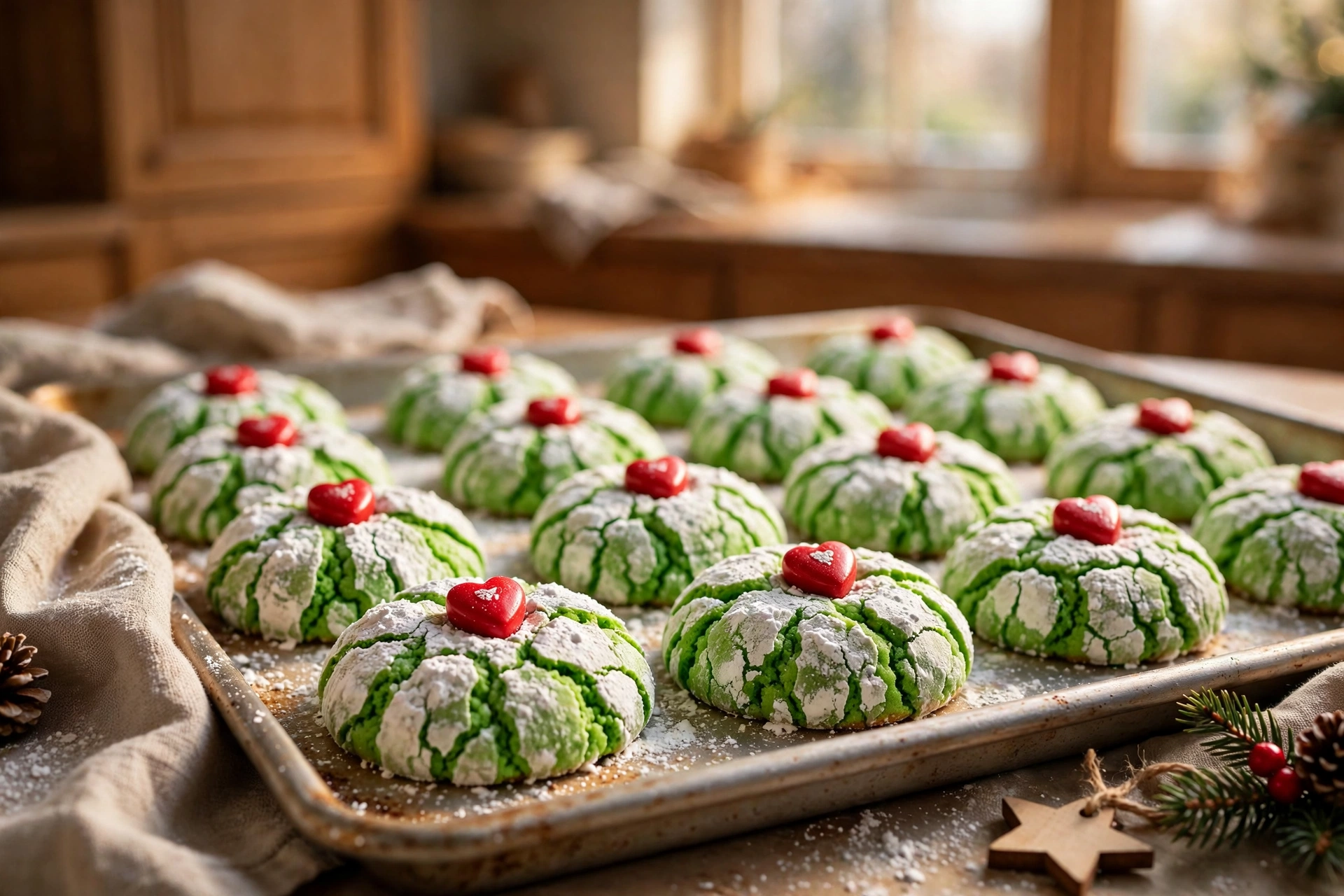
Grinch cookies are special because they do the hardest thing a Christmas cookie can do: they make a whole room smile before anyone takes a bite. The green is unapologetic, the snowy crackle looks like frost, and the single red heart lands the whole story in one glance.
These are baked entirely from scratch, with no cake mix anywhere in the bowl. A from scratch dough gives you what the mix cannot: real butter flavor, a tender crumb that stays soft for days, and edges that hold their shape instead of spreading into green puddles.
Cream cheese is the quiet reason the texture works. It melts into the dough and keeps the centers soft and almost cake like, while the double sugar coating dries into the crackled white shell that makes the green underneath look even greener.
The color is measured, not guessed. One and a half teaspoons of gel coloring, beaten into the wet ingredients before the flour goes in, gives the vivid green of the photos on the first try, with no streaks and no pale, apologetic batch.
Grinch cookies come out of the oven looking like they were decorated by someone with a piping bag and a free afternoon. They were not. The crackle happens on its own in the heat, and the heart takes two seconds per cookie while the tray is still warm.
That is the real charm of this recipe for a busy December. The dough waits in the refrigerator, the coating is two bowls of sugar, and the decoration is a single candy pressed into a warm cookie. Maximum effect, minimum fuss, every single tray.
Children read them instantly, of course, but watch the adults. The green cookie with the red heart is the one the grown ups photograph, the one they ask about, and the one that vanishes from the platter while the elegant shortbread sits untouched.
Soft Vanilla Centers, Snowy Crackled Tops
The first bite breaks through a delicate sugar crust that gives with a faint crackle, then lands in a center that is soft, pale green and gently rich. Vanilla leads, butter follows, and the cream cheese leaves a faint tang that keeps the sweetness in line.
These are not mint cookies unless you want them to be. The classic flavor here is vanilla and butter, closer to a tender sugar cookie than to a candy cane, which is exactly why they sit so well on a mixed platter beside spiced and chocolate cookies.
The crackle is more than a look. The granulated sugar layer keeps the powdered sugar from melting into the dough, so the white coating stays snowy and distinct, and the two sugars together give the surface a fine, crisp shell that contrasts with the soft middle.
The red heart is a small bite of pure sweetness at the center, and it softens just enough from the warmth of the cookie to feel like part of the bake rather than a decoration balanced on top. One heart per cookie is the rule; two would crowd the story.
Served on a white platter, the green reads almost luminous against December’s usual palette of brown and gold. A few cookies turned heart side up, a few stacked, and the whole tray looks styled by someone who plans these things weeks ahead.
They also keep their texture honestly. Day two, the centers are still soft, the crackle still visible, the hearts still seated. A cookie that survives the cookie tin with its looks intact is a cookie worth an annual place in the rotation.
A Dough That Waits for the Party
The dough needs one hour in the refrigerator, and that hour is a feature, not a delay. Cold dough rolls into clean balls, takes the sugar coating evenly, and bakes into thick, puffy cookies instead of thin, spreading ones.
Stretch the wait if December demands it. The dough keeps, well wrapped, for up to 3 days in the refrigerator, and the flavor deepens slightly as it rests. Roll and coat the balls just before baking, since the powdered sugar layer should go into the oven dry and fresh.
Better still, the rolled balls freeze beautifully. Freeze them uncoated on a tray, bag them, and bake from frozen whenever the season asks, adding the sugar coating and 2 extra minutes. Fresh Grinch cookies on a school night, with ten minutes of warning, is a very good trick to own.
The bake itself is short and forgiving. Twelve minutes at 350 degrees, one tray at a time, and the cookies come out puffed with set edges and centers that look a breath underdone. That soft center is the whole point; it finishes setting as the tray cools.
On a full cookie day, these share the oven kindly with our peppermint meltaway cookies and the classic snowball cookies. Three doughs, three colors, one afternoon, and the year’s cookie boxes are suddenly done.
Smaller Scoops, Same Big Green
For a lighter tray, scoop the dough at one tablespoon instead of one and a half. You will get about 36 smaller cookies that bake in 10 minutes, each one a two bite version with the same crackle, the same heart, and a noticeably smaller footprint on the day.
The sugar coating can lighten too. Roll the balls in granulated sugar only, skip the powdered layer, and the tops bake into a sparkly green with fine cracks rather than the full snowy effect. Less sweet, still unmistakably festive, and the green turns even more vivid.
For a dairy free batch, a plant based butter and a dairy free cream cheese both work in this dough; choose a cream cheese alternative with a mild flavor, and expect the centers to be a touch less rich. The method, the color and the crackle stay exactly the same.
Grinch Cookies Ingredients
- 2 1/4 cups (270 g) all-purpose flour
- 1 teaspoon (4 g) baking powder
- 1/2 teaspoon (3 g) fine sea salt
- 1/2 cup (113 g) unsalted butter, softened
- 4 ounces (113 g) cream cheese, softened
- 1 cup (200 g) granulated sugar
- 1 large egg (50 g), at room temperature
- 2 teaspoons (10 ml) vanilla extract
- 1 1/2 teaspoons (8 ml) green gel food coloring
- 1/3 cup (65 g) granulated sugar, for rolling
- 3/4 cup (90 g) powdered sugar, for rolling
- 24 red candy hearts (about 60 g)
How to Make Grinch Cookies, Step by Step
- Whisk the flour, baking powder and salt in a medium bowl and set aside.
- Beat the butter, cream cheese and 1 cup of sugar for 2 to 3 minutes, until pale and fluffy. Beat in the egg and vanilla until smooth.
- Add the green gel coloring and beat until the mixture is one even, vivid green with no streaks. Color now, before the flour, is what keeps the shade uniform.
- Add the flour mixture in two additions, mixing on low just until no dry streaks remain. The dough will be soft.
- Cover and refrigerate for 1 hour, until firm enough to roll cleanly.
- Heat the oven to 350°F (175°C) and line two baking sheets with parchment. Put the rolling sugars in two separate shallow bowls.
- Scoop the dough into 24 balls of about 1 1/2 tablespoons each. Roll each ball first in the granulated sugar, then generously in the powdered sugar, until thickly coated.
- Arrange the balls 2 inches apart on the sheets. Bake one sheet at a time for 11 to 13 minutes, until the tops are crackled and the edges are set but the centers still look slightly soft.
- The moment the sheet comes out, press one red candy heart gently into the center of each warm cookie. Work within 2 minutes, while the surface is still soft enough to take the candy.
- Cool on the sheet for 10 minutes, then move to a rack to cool completely. The centers finish setting as they cool.
The Warm Heart Trick
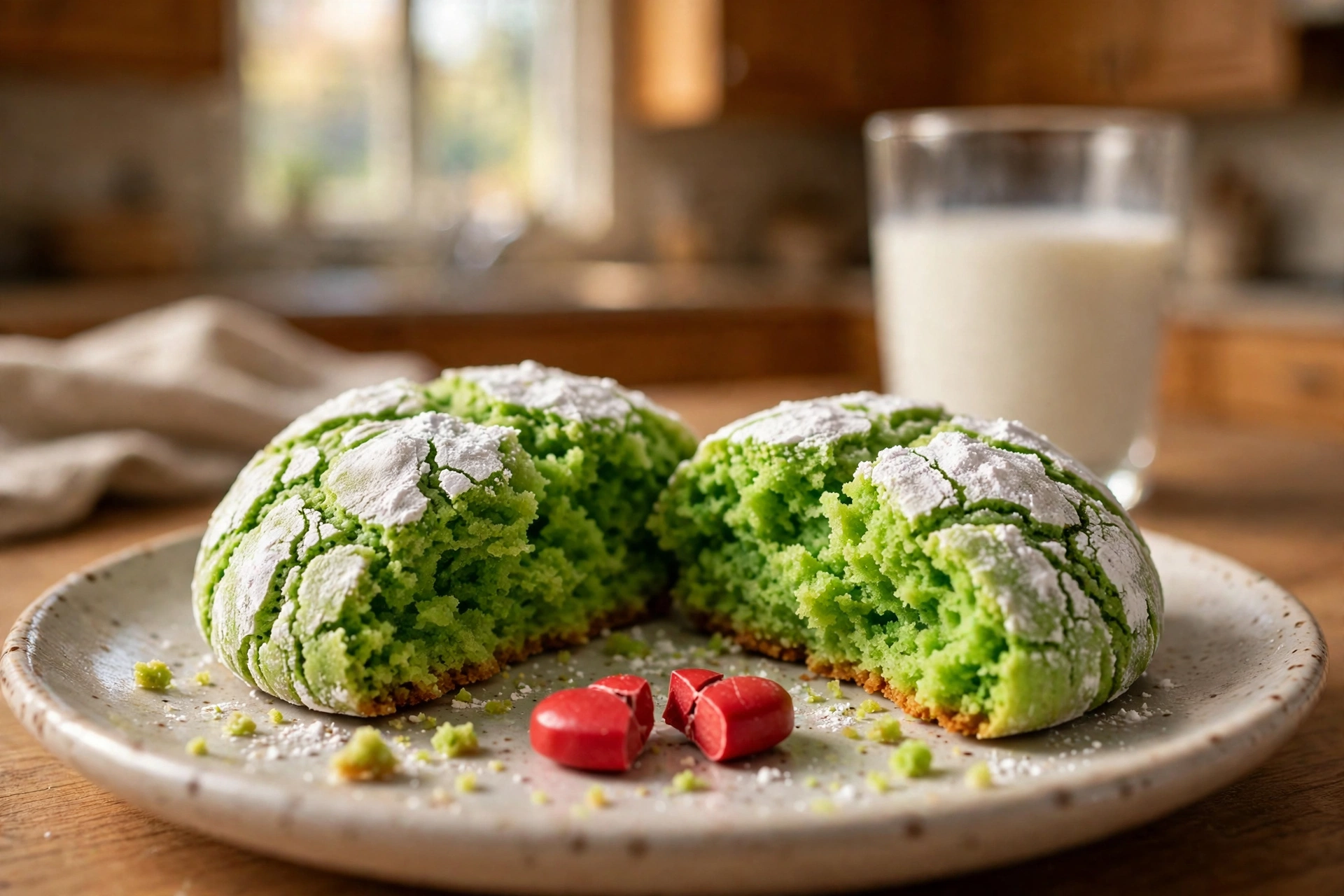
The heart is pressed into the cookie after baking, never before, and the reason is simple physics. In the oven, a candy heart would slump, bleed its color into the green, and lose the clean shape that makes the cookie read at a glance.
On a warm cookie, the opposite happens. The residual heat softens the very base of the candy just enough that it melts into the surface by a fraction and seals itself in place as everything cools. Pressed gently, centered, and left alone, the heart stays put through stacking, boxing and travel.
Timing is the whole trick. You have about 2 minutes from the moment the sheet leaves the oven, while the crackled top is still soft enough to dimple. Set the hearts out in a little dish before the tray comes out, and press them in a steady rhythm, one per cookie, no rearranging.
If a heart lands crooked, leave it. A slightly tilted heart looks handmade and charming, and pulling it off a cooling cookie tears the crackle. Perfection is not the aesthetic here; a platter of green with red hearts in slightly human positions is.
No candy hearts in the pantry? A single red cinnamon candy, a red jelly bean cut side down, or a small dot of red icing piped after cooling all stand in well. The cookie needs its one red point; the exact candy is negotiable.
Colors and Flavors to Try Next Time
A drop of peppermint extract, a quarter teaspoon only, turns these toward the candy cane end of the season. It is lovely, but measure honestly: peppermint takes over a dough faster than any other flavor in the cupboard, and the vanilla version is the crowd pleaser.
The color story travels beyond December. The same dough, tinted pink with a white heart, is a Valentine cookie waiting to happen, and a pale blue batch with a white chocolate dot reads as a winter cookie long after the tree comes down.
For a chocolate contrast on the platter, bake these beside our chocolate crinkle cookies. The two crackles side by side, one deep brown, one bright green, make the simplest platter look deliberately composed.
A lemon version deserves a mention too: skip the coloring, add the zest of one lemon to the sugar before beating, and top with a yellow candy dot. Same soft center, same crackle, entirely different season, which is the mark of a dough worth keeping.
Cookie Boxes, Tins and the Freezer
Store the cooled cookies in a single layer, or stacked with parchment between the layers, in an airtight tin at room temperature for up to 5 days. The hearts stay seated and the centers stay soft; the crackle fades slightly by day four, which nobody has ever complained about.
For cookie boxes, these are the anchor cookie: the color carries the whole box. Pack them heart side up in a single layer on top of sturdier cookies, with a sheet of parchment above them so the powdered sugar does not dust the neighbors. Given the season, they pair naturally with the pull apart candy cane cinnamon rolls on a Christmas morning table.
Baked cookies freeze for up to 2 months, layered with parchment in a rigid container. Thaw at room temperature for an hour, still in the container, so condensation lands on the box and not on the crackle. Ten seconds in a low oven brings back the just baked softness.
General food storage guidance from the USDA Food Safety and Inspection Service is worth a look before the big December bake: most home baked cookies hold their quality for two to three weeks refrigerated and months frozen, and these follow the same pattern.
The Cookie That Steals the Platter
Grinch cookies are, in the end, a small lesson in what December baking is actually for. They are not the most technical cookie on the table, and they do not try to be. They are the one that makes a child point, a grandparent laugh, and a whole platter look like a party.
Bake the full batch even for a small household. They box well, they freeze well, and they travel well, which means the extra dozen becomes gifts instead of leftovers. A green cookie with a red heart, still soft on day three, is a very good ambassador for your kitchen.
Grinch Cookies Questions
Why are my Grinch cookies pale instead of bright green?
The coloring was either too little or the wrong kind. Liquid coloring dilutes before it colors, and a single drop will never get past pastel. Use 1 1/2 teaspoons of gel coloring, beaten into the butter mixture before the flour goes in, and the green will match the photos on the first try.
Why did the powdered sugar crackle melt or disappear?
The balls were under coated, or the dough was too warm. Roll first in granulated sugar, which keeps the powdered layer dry, then in a thick coat of powdered sugar, and bake the dough cold from the refrigerator. A thin or warm coating soaks in and the crackle never forms.
My candy hearts slide off. What went wrong?
They were pressed in too late, after the surface had already set and cooled. The hearts must go on within about 2 minutes of the sheet leaving the oven, so the warmth softens the base of the candy and seals it as the cookie cools. Have them counted out before baking.
Can I make Grinch cookies without food coloring?
Yes, with a different look. Matcha powder, about 1 tablespoon sifted with the flour, gives a soft natural green and a gentle tea note. The color will be muted rather than vivid, but the soft center, crackle and red heart all stay the same.
Can I freeze the dough balls and bake later?
Yes. Freeze the rolled, uncoated balls on a tray until solid, then bag them for up to 2 months. Roll in both sugars straight from the freezer and bake at 350°F (175°C) for 13 to 15 minutes, pressing the hearts on as soon as the sheet comes out.
Grinch Cookies
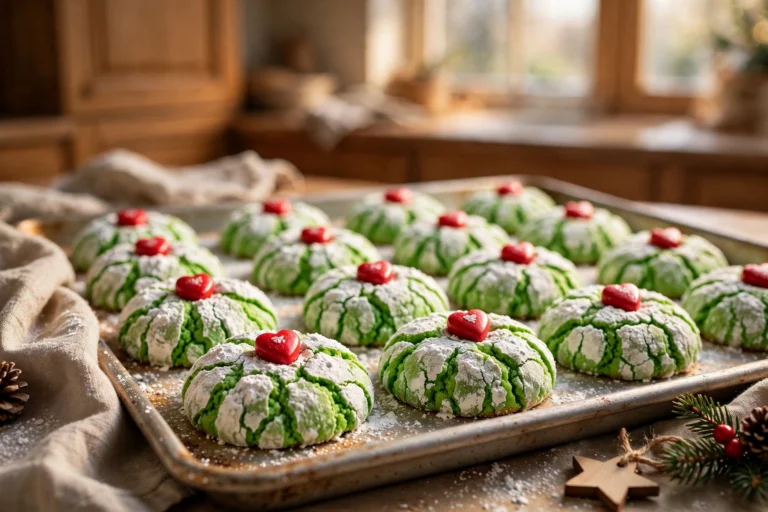
Grinch cookies are soft, vivid green crinkle cookies made entirely from scratch, with cream cheese in the dough for a tender center that stays soft for days. Each ball is rolled in granulated sugar, then in a thick coat of powdered sugar, so the tops bake into a snowy crackle over the green. One red candy heart is pressed into each warm cookie, where the residual heat seals it in place. No cake mix, a measured dose of gel color, and a dough that waits in the refrigerator or freezer until the party asks.
- Total Time: 1 hour 45 minutes
- Yield: 24 cookies 1x
Ingredients
2 1/4 cups (270 g) all-purpose flour
1/2 teaspoon (3 g) fine sea salt
1/2 cup (113 g) unsalted butter, softened
4 ounces (113 g) cream cheese, softened
1 cup (200 g) granulated sugar
1 large egg (50 g), at room temperature
2 teaspoons (10 ml) vanilla extract
1 1/2 teaspoons (8 ml) green gel food coloring
1/3 cup (65 g) granulated sugar, for rolling
3/4 cup (90 g) powdered sugar, for rolling
24 red candy hearts (about 60 g)
Instructions
Whisk the flour, baking powder and salt in a medium bowl and set aside.
Beat the butter, cream cheese and sugar for 2 to 3 minutes, until pale and fluffy. Beat in the egg and vanilla until smooth.
Add the green gel coloring and beat until the mixture is one even, vivid green with no streaks.
Add the flour mixture in two additions, mixing on low just until no dry streaks remain.
Cover and refrigerate the dough for 1 hour, until firm enough to roll cleanly.
Heat the oven to 350°F (175°C) and line two baking sheets with parchment. Put the rolling sugars in two separate shallow bowls.
Scoop the dough into 24 balls of about 1 1/2 tablespoons each. Roll each ball first in the granulated sugar, then generously in the powdered sugar.
Arrange the balls 2 inches apart on the sheets. Bake one sheet at a time for 11 to 13 minutes, until the tops are crackled and the edges are set but the centers still look slightly soft.
The moment the sheet comes out, press one red candy heart gently into the center of each warm cookie, within 2 minutes.
Cool on the sheet for 10 minutes, then move to a rack to cool completely.
Notes
The dough keeps up to 3 days in the refrigerator, or freeze the rolled uncoated balls for up to 2 months and bake from frozen at 350°F (175°C) for 13 to 15 minutes. Press the hearts on within 2 minutes of the sheet leaving the oven.
- Prep Time: 20 minutes
- Cook Time: 12 minutes
Nutrition
- Calories: 150
- Sodium: 85
- Saturated Fat: 4
- Protein: 2
- Cholesterol: 22