
In this article:
- The whip is the recipe
- Pale, sandy and gone in seconds
- Six ingredients, one bowl, no rolling pin
- Gentler tins and dietary twists
- What goes into the dough
- Whipping and baking, step by step
- Read the tops, not the timer
- Plain, cherry, lemon or chocolate dipped
- Keeping them crisp in the tin
- First into the Christmas tin
- Questions from the cookie tin
Whipped shortbread cookies are the quiet overachievers of the Christmas tin. Five minutes of whipping turns plain butter, sugar and flour into a dough so light that the baked cookies dissolve on the tongue before you have finished deciding to take a second one.
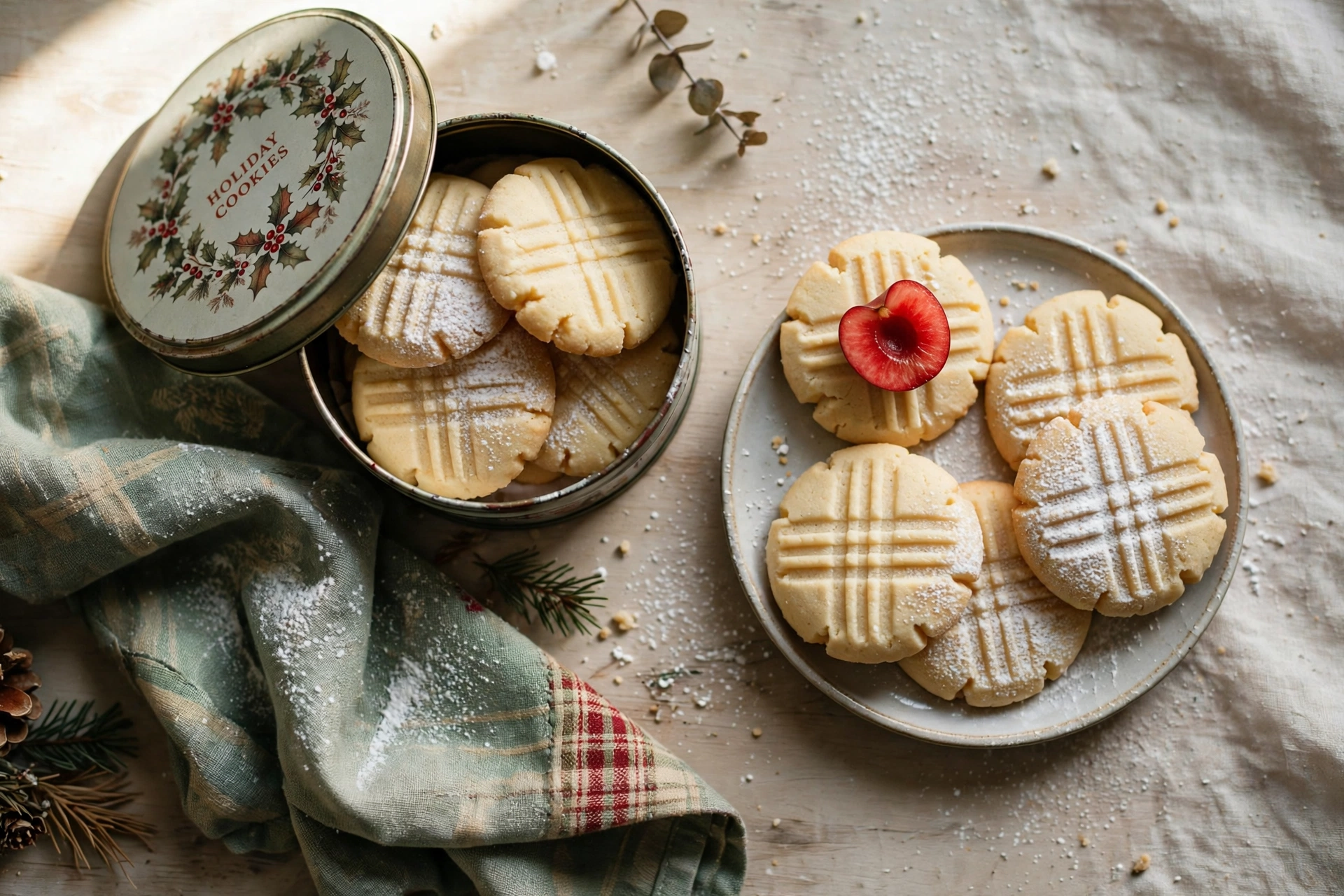
They carry no frosting, no glaze and no decoration worth the name. Their whole beauty is texture: pale, sandy and impossibly tender, with a fork mark pressed into the top like a signature from the baker.
Because the dough is scooped rather than rolled, a full batch moves from mixer to oven in minutes. These are the cookies you make on a weeknight, in December, when the tin still has room and the list still has names.
The Whip Is the Recipe
Whipped shortbread cookies work because the mixer does what no rolling pin can. Beating the butter alone for five full minutes folds in air and nearly doubles its volume, and that air is what later bakes into a cookie that crumbles into powder instead of snapping like a cracker.
The cornstarch is the second quiet worker. It dilutes the flour’s gluten, so the crumb stays short and tender rather than bready, which is the entire difference between a whipped shortbread and an ordinary one.
Powdered sugar matters as much as the butter. It dissolves instantly into the whipped fat, leaving no grit, and it helps the dough hold its shape without the toughness granulated sugar can bring to a low moisture dough.
The low oven finishes the design. At 300 degrees the cookies set before they can spread or brown, so the butter flavor stays clean and sweet, and the color stays the pale gold that signals a proper shortbread.
Shortbread itself is an old Scottish bake, traditionally little more than butter, sugar and flour. According to Wikipedia’s history of shortbread, it was once a celebration food, reserved for holidays exactly like the Christmas tin it still fills today.
In my own tin they play peacemaker. My pizzelle bring the crunch and the snowball cookies bring the nuts, while these bring pure butter and melt, the texture every other cookie is measured against.
Pale, Sandy and Gone in Seconds
The first thing you notice is how little there is to chew. A whipped shortbread gives way at the lightest pressure, breaking into a fine, sandy crumble that coats the mouth with butter and then simply disappears.
The flavor is deliberately plain, in the best sense. Good butter leads, vanilla warms the middle, and a pinch of salt keeps the sweetness from going flat. Nothing competes, because nothing needs to.
Temperature shapes the experience. At room temperature the crumb is at its most fragile and fragrant, while a cookie eaten cold from the tin feels firmer and more buttery, almost like the center of a buttercream.
The look is modest and proud of it. Pale rounds, a crosshatch of fork tines, perhaps one red cherry half in the center of a few. On a crowded holiday plate, that restraint reads as confidence.
Break one open before you judge a batch. The inside should be uniformly pale and dry, with a fine, even grain and no translucent streaks. A glossy or dense center means the whip was cut short, and the melt will not be there.
The sound gives them away too. A proper whipped shortbread makes almost none: no snap, no crunch, just a soft collapse. If a cookie crackles when it breaks, the oven ran hot or the bake ran long, and the next sheet wants two minutes less.
Six Ingredients, One Bowl, No Rolling Pin
There is no dough to chill for hours, roll, cut and reroll. The dough whips in one bowl, rests briefly, and is scooped straight onto the sheet, which makes this the rare Christmas cookie that fits between dinner and bedtime.
The mixer does the labor. A stand mixer is easiest, a hand mixer works with a little more patience, and the only real investment is refusing to shorten the five minutes of whipping, because that time is the recipe.
Scooping also means perfect uniformity. Every cookie is the same tablespoon of dough, so the whole sheet finishes at the same moment, and the tin fills with neat, stackable rounds instead of a gradient of pale and burnt.
For gifting, the arithmetic is kind. One batch makes two dozen cookies from a single cup of butter, and a double batch whips in the same bowl with no change in method.
They sit happily beside the other fast bakes of the season. My easy Christmas spritz cookies share the same butter forward logic, and a tray of the two covers most of a cookie exchange in one afternoon.
Children can genuinely help here, which is rare in December baking. There are no sharp cutters and no hot trays to decorate around; small hands can roll the balls, press the fork and place the cherries, and the cookies forgive uneven enthusiasm.
Gentler Tins and Dietary Twists
A lighter butter is not really an option here, since butter is the recipe. What you can adjust is portion and pace: scoop slightly smaller cookies, a level tablespoon instead of a heaped one, and the tin still looks generous at thirty smaller rounds.
For a gluten free batch, replace the flour with a one to one gluten free baking blend and keep the cornstarch as written. The dough will feel softer, so give the shaped cookies a full 20 minutes of chilling before the oven.
A dairy free version works with a firm, stick style plant butter, whipped a minute longer than dairy butter. The flavor leans where the butter leans, so choose one you enjoy plain, and expect a slightly paler cookie.
Reducing the sugar is the least successful edit. Powdered sugar is structural in this dough, and cutting it by more than a tablespoon or two gives a fragile, floury cookie. If sweetness is the concern, serve them plain and skip the dusting.
Salted butter is the one swap many bakers already have on hand, and it works without drama. Use it exactly as written, leave out the added salt, and expect a slightly deeper, more savory butter note that many families quietly prefer.
What Goes Into the Dough
- 1 cup unsalted butter, softened but still cool to the touch (226 g)
- 1/2 cup powdered sugar, plus more for dusting and for the fork
- 1 teaspoon vanilla extract
- 1 1/2 cups all-purpose flour, spooned and leveled
- 1/4 cup cornstarch
- 1/4 teaspoon fine sea salt
- Candied cherry halves or sprinkles, optional, for the centers
Whipping and Baking, Step by Step
- Beat the butter alone in a stand mixer on medium high for 5 full minutes, scraping the bowl once, until it is nearly white, glossy and doubled in volume, holding soft peaks.
- Add the powdered sugar and vanilla. Beat 2 more minutes, until the mixture looks like a pale, fluffy frosting with no trace of grain.
- Sift the flour, cornstarch and salt over the bowl. Mix on the lowest speed only until a soft, smooth dough forms, about 1 minute; stop as soon as no dry flour remains.
- Rest the dough in the refrigerator for 20 minutes. This firms the butter just enough that the cookies keep their edges and their fork marks.
- Heat the oven to 300 degrees and line two baking sheets with parchment. Cold sheets matter here, so let a used sheet cool before reloading it.
- Scoop tablespoon sized balls of dough and set them 2 inches apart. Dip a fork in powdered sugar and press a gentle crosshatch into each ball; add a cherry half to the center of any you like.
- Bake for 15 to 18 minutes, until the tops look matte and dry and the bottoms are barely blond. The cookies should not brown at the edges.
- Rest the sheet on a rack for 10 minutes without touching the cookies; they are at their most fragile now. Move them to the rack to cool completely, then dust lightly with powdered sugar.
Read the Tops, Not the Timer
Doneness here is a surface, not a color. A finished cookie has lost its raw sheen and looks matte and set, while the underside has turned the faintest blond. If the tops still shine at 15 minutes, give them two more.
Spreading is the one real enemy, and it is almost always temperature. Butter that felt greasy or looked shiny before whipping was too warm; the dough should start cool, around 65 degrees, soft enough to scoop but never slack.
If a first sheet spreads more than you like, chill the remaining shaped cookies for 15 minutes and lower nothing else. Cold dough on a cold sheet, into the low oven, is the whole correction.
Measure the flour gently. A scooped, packed cup can add two extra tablespoons, enough to turn melt into density. Spoon the flour into the cup and level it, or weigh 180 grams, and the crumb stays true.
Do not move the cookies early. Fresh from the oven they have almost no structure, and a spatula now will crumble what ten patient minutes on the sheet will set into a clean, liftable round.
The fork belongs in powdered sugar, not flour. Sugar keeps the tines from sticking without leaving white, pasty marks, and it melts into the surface so the crosshatch stays crisp and clean.
Trust, but verify, your oven’s low end. Many ovens run 25 degrees hot at the 300 mark, which browns edges before the centers set. An inexpensive oven thermometer settles the question once, and every pale bake of the season benefits.
Rotate the sheet once, halfway through, turning it front to back rather than moving cookies between racks. Hot spots announce themselves as one corner of deeper color, and the rotation keeps the whole batch at the same tender pale.
Plain, Cherry, Lemon or Chocolate Dipped
The classic finish is a candied cherry half pressed into the center before baking. It adds the single spot of color the pale cookie wants, and it is the version most people are reaching for when they say the name with nostalgia.
For a lemon tin, replace the vanilla with a teaspoon of finely grated lemon zest beaten into the butter. The crumb stays the same, the finish brightens, and the cookies sit beautifully beside richer chocolate bakes.
Chocolate dipping suits a cooled cookie best. Dip one half in melted dark chocolate, set on parchment until firm, and store those apart from the plain ones; they are the first to vanish and the last to be admitted to.
An almond path swaps the vanilla for half a teaspoon of almond extract and tops each cookie with a slivered almond. It makes a natural partner for my Italian ricotta Christmas cookies in an Italian leaning gift box.
Sprinkles are the children’s vote and the easiest finish of all. Use fine nonpareils pressed on before baking; jimmies soften and bleed less, and a light hand keeps the cookie looking grown up enough for the main tin.
Keeping Them Crisp in the Tin
Cool every cookie completely before the tin, without exception. One warm cookie steams the whole layer, and whipped shortbread trades its melt for a stale softness faster than almost any other bake.
Stored in a metal tin at room temperature, layered with parchment, the cookies keep for 2 weeks and arguably improve on day two, when the butter flavor settles. Keep them away from strong scented neighbors like mint or spice cookies.
Freezing is excellent for up to 2 months, baked or unbaked. Freeze shaped dough balls on a sheet, bag them, and bake from frozen with 2 extra minutes; or freeze baked cookies in a rigid container and thaw uncovered at room temperature.
If a tin softens in a humid kitchen, ten minutes in a 250 degree oven restores most of the crumb. Cool them fully on the rack before re tinning, and they will taste like the day they were baked.
For mailing, these are sturdier than they feel once fully cool. Pack them in a rigid tin with parchment between layers and no room to slide, and they travel across the country in better shape than any frosted cookie on the same truck.
First Into the Christmas Tin
Whipped shortbread cookies ask for one bowl, six plain ingredients and five honest minutes of whipping. In return they give the Christmas tin its most tender cookie, the one that disappears first and is asked about most.
Bake a batch early in December, while the calendar is still kind. Learn the matte top and the pale bottom once, and you will never again buy a tin of shortbread that crumbles like sand instead of melting like butter.
FAQ
Why did my whipped shortbread cookies spread flat in the oven?
The butter was too warm or the dough went in unrested. Start with butter that is soft but cool, rest the dough 20 minutes, and if a test cookie still spreads, chill the shaped balls 15 minutes on a cold sheet before baking.
What does the cornstarch actually do in whipped shortbread?
Cornstarch dilutes the flour’s gluten and interrupts its structure, which is what turns a firm shortbread bite into a melting one. Skip it and the cookies still work, but they bake up crisper and more ordinary, closer to a classic shortbread.
How can I tell the cookies are done if they never turn brown?
Read the tops: they should look matte and dry, with set edges and bottoms that are barely blond. They will feel fragile and soft in the center while hot, then firm as they cool on the sheet for 10 minutes.
Can I pipe this dough instead of rolling balls?
Yes, use a large open star tip and a dough that has rested only briefly, so it stays soft enough to pipe. If the bag resists, let it stand 5 minutes at room temperature rather than forcing it, and chill piped cookies 10 minutes before baking.
How long do whipped shortbread cookies keep in a holiday cookie box?
Two weeks in a metal tin at room temperature, layered with parchment, and 2 months in the freezer. Keep them in their own layer or tin, since they absorb moisture and strong flavors from softer, spiced neighbors.