
In this article:
- The cookie that smells like December
- Why these stay soft for days
- Two molasses, two different cookies
- Double ginger, warmth and sparkle
- What goes into the dough
- Mixing, chilling and rolling, step by step
- The crackle in three moves
- Built for the cookie box
- When cookies spread, harden or refuse to crackle
- Small twists worth trying
- From my tin to yours
- Questions about the cookies
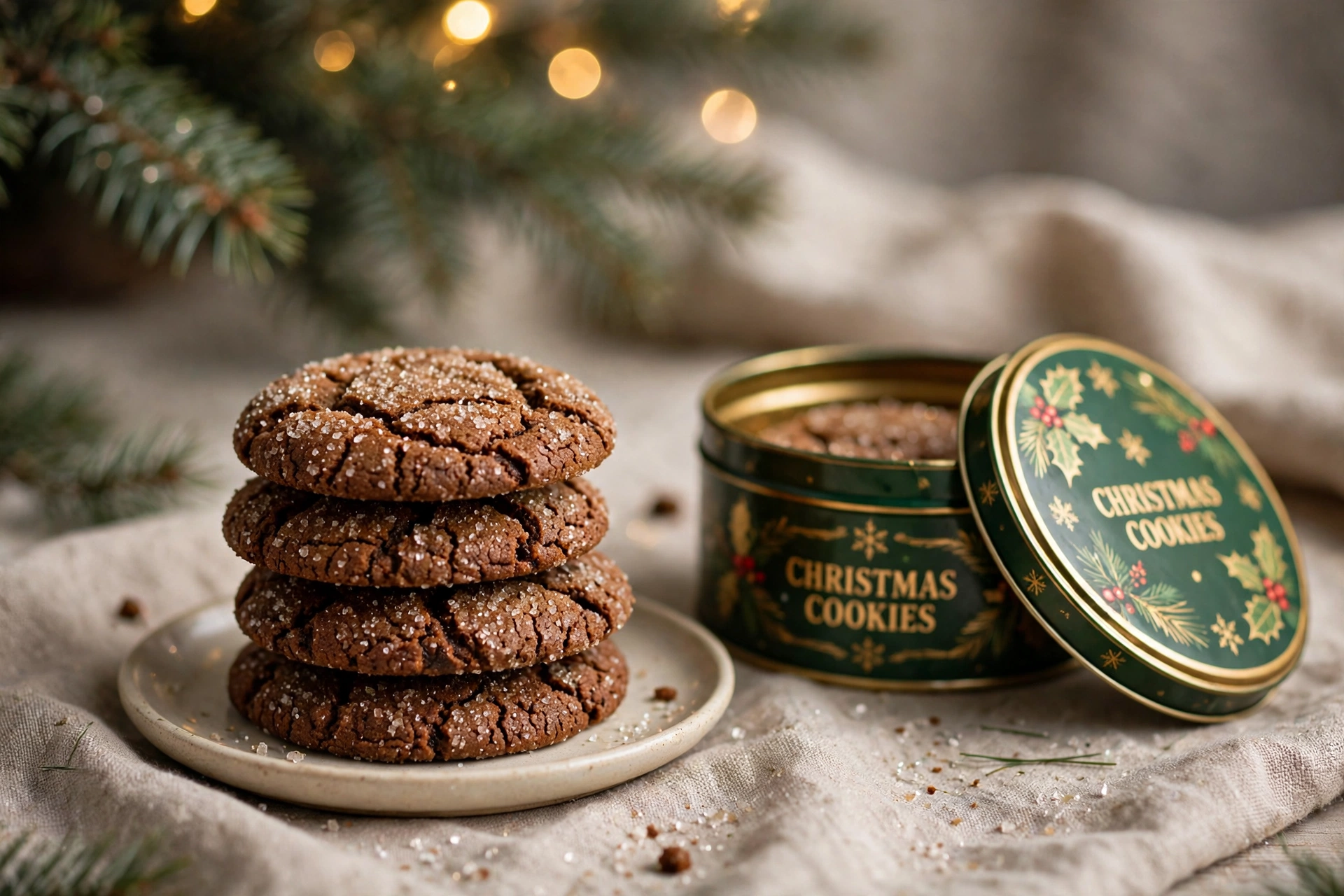
Ginger molasses cookies are the moment December officially starts in my kitchen. The dough is dark with molasses and warm with ginger, cinnamon and cloves, and every ball is rolled in coarse sugar before baking, so the tops crackle into a sparkling, fissured crust over a center that stays soft for days.
They are also the hardest working cookie in the holiday tin. The dough freezes in balls for three months, the baked cookies keep for five days without drying, and one batch perfumes the whole house more honestly than any candle I have ever bought.
The Cookie That Smells Like December
Some Christmas cookies are decoration first and dessert second. Ginger molasses cookies are the opposite: humble, dark, a little rugged, and completely devoted to flavor. They are the cookie people reach for with coffee in the morning and again after dinner.
Baking them fills the house in stages, and it is half the pleasure. First the butter and brown sugar turn the kitchen sweet, then the molasses and spices take over, dark and warm, until the whole place smells like the inside of a bakery on the first cold morning of the year.
Their character comes from contrast. The sugar crust shatters lightly between your teeth, then the crumb gives way, dense and chewy, with the deep caramel bitterness of molasses rolling into warm spice. Nothing about them is delicate, and that is the point.
In the cookie box they play an essential role. Between the pale shortbread and the frosted cutouts, these dark, crackled rounds are the ones that disappear first, which is why the batch below is sized for real life: thirty cookies, not twelve.
They also carry a long memory. Molasses cookies were working kitchen cookies long before they were holiday cookies, sweetened with what farms had on hand and spiced against the cold. The soft version here keeps that spirit, with better texture than the hard gingersnaps of the old cookie jars.
Why These Ginger Molasses Cookies Stay Soft for Days
Ginger molasses cookies stay soft because three choices protect their moisture. Brown sugar forms the base, and its own molasses content holds water in the crumb. The molasses in the dough is hygroscopic, pulling moisture from the air instead of surrendering it.
The chill is the second protection. An hour in the refrigerator firms the butter, so the cookies spread slowly and stay thick in the oven. Thick cookies have a center that never fully dries, which is exactly the chewy middle you want on day three.
The third protection is the pull. These cookies leave the oven looking slightly underdone, puffed and soft in the middle, and they finish setting on the hot tray. Two extra minutes of baking is all it takes to turn a chewy cookie into a hard one, so the clock matters.
The egg and the baking soda quietly support the same goal. One egg keeps the crumb tender without turning it cakey, and soda, lifted by the acidic molasses, gives the cookies their puff. That puff collapses gently as they cool, settling into the dense chew instead of a dry snap.
Two Molasses, Two Very Different Cookies
The jar you buy decides the cookie you get. Regular unsulphured molasses, the kind labeled mild or original, is sweet, dark and rounded, with enough bitterness to taste interesting. It is the right jar for this recipe, every time.
Blackstrap molasses is a different ingredient wearing a similar label. Boiled a third time, it is thick, nearly black and aggressively bitter, with a mineral edge that bullies ginger and cinnamon out of the picture. Cookies made with blackstrap come out hard, dark and faintly medicinal.
Check the label before the jar goes in the cart: you want the word unsulphured and no mention of blackstrap. If blackstrap is all you have, use half molasses and half honey; the cookies will be gentler and lighter in color, but properly spiced and properly chewy.
Between the two good options, mild and dark unsulphured molasses differ only in depth. Mild gives a brighter, more caramel forward cookie; dark gives a moodier one with a longer finish. Both work in this recipe, and the choice is taste, not technique. Store the jar at room temperature; refrigerated molasses pours like tar.
Double Ginger: Warmth First, Sparkle Second
Ground ginger alone gives these cookies their base warmth, a slow heat that blooms at the back of the tongue. On its own, though, it can taste dusty, which is why so many homemade ginger cookies read as flat spice cake.
A tablespoon of finely grated fresh ginger changes the top note entirely. It adds a bright, almost citrus sparkle that makes the dried spices taste freshly ground. The two gingers together are the whole flavor architecture of this recipe.
Cinnamon rounds the blend, cloves deepen it, and a pinch of black pepper, invisible as itself, stretches the ginger heat a few seconds longer. Keep the spices fresh; ground ginger that has sat open for two winters will not carry a cookie built on spice.
Grate the fresh ginger on the fine side of a grater, straight into the mixing bowl, so none of its juice is lost on the board. Fibrous bits are fine at a tablespoon; they melt into the crumb. Peel with the edge of a spoon, which follows the knobs and wastes almost nothing.
What Goes Into Ginger Molasses Cookies
- 2 1/4 cups all-purpose flour, spooned and leveled
- 2 teaspoons baking soda
- 2 teaspoons ground ginger
- 1 1/2 teaspoons ground cinnamon
- 1/4 teaspoon ground cloves
- 1/4 teaspoon fine sea salt
- 1 pinch black pepper
- 3/4 cup unsalted butter, softened
- 3/4 cup packed dark brown sugar
- 1/4 cup granulated sugar
- 1 large egg, at room temperature
- 1/3 cup unsulphured molasses
- 1 tablespoon finely grated fresh ginger
- 1 teaspoon vanilla extract
- 1/3 cup coarse raw sugar, for rolling
Weighing the flour is the quiet upgrade here. The King Arthur ingredient weight chart puts a cup of all-purpose flour at 120 grams; scoop heavy and the cookies turn cakey and dry no matter what else you do right.
Softened butter and a room temperature egg are not details to skip. Cold egg hitting creamed butter makes the mixture curdle and the dough streaky, while butter melted in a hurry spreads the cookies thin. Twenty minutes on the counter for both is all the planning this recipe asks.
Mixing, Chilling and Rolling the Ginger Molasses Cookies, Step by Step
- Whisk the flour, baking soda, ground ginger, cinnamon, cloves, salt and pepper in a medium bowl until the spices disappear evenly into the flour.
- Beat the butter, brown sugar and granulated sugar for 2 to 3 minutes, until pale and fluffy. Beat in the egg, then the molasses, fresh ginger and vanilla, scraping the bowl once.
- Add the flour mixture and mix on low just until no dry streaks remain. The dough will be soft and dark. Cover and chill for at least 1 hour, or overnight for a deeper flavor.
- Heat the oven to 350 degrees Fahrenheit and line two baking sheets with parchment. Put the coarse sugar in a small bowl.
- Scoop the dough into balls of about 1 1/2 tablespoons. Roll each ball in the coarse sugar until heavily coated, then set the balls 2 inches apart on the sheets.
- Bake one sheet at a time for 9 to 11 minutes, until the tops are crackled and puffed and the centers still look slightly soft and shiny.
- Rest the cookies on the hot sheet for 10 minutes; they finish setting as they cool. Move them to a rack to cool completely before boxing.
An overnight chill pays you back in flavor. The spices hydrate, the molasses soaks into the flour, and the baked cookies taste rounder and deeper than the one hour version. If December is busy, make the dough on Sunday and bake on Wednesday; it keeps, covered, for three days.
The Crackle, Explained in Three Moves
The fissured top is not decoration applied at the end; it is chemistry you can steer. Move one: baking soda reacts with the acidic molasses and lifts the dough quickly, so the surface stretches and splits as the cookie expands.
Move two is the sugar coat, and it must be generous. A heavy crust dries first in the oven, forming a shell that the rising center then breaks from underneath. A timid sprinkle gives you freckles, not crackle, so roll the balls twice if the coat looks thin.
Move three is restraint. Pull the tray while the centers still look soft and the cracks have that moist, dark look inside. The fissures set as the cookies rest on the hot pan, turning glossy in the valleys and sparkling on the ridges.
Coarse raw sugar earns its place over plain granulated here. Its big crystals survive the oven as distinct sparkle, crunch lightly, and outline every crack so the tops read dramatic from across the room. Fine sugar melts into a matte coat and the fissures nearly vanish.
Built for the Cookie Box: Freeze, Ship, Store
For the full white chocolate cranberry cookies treatment, plan this dough like a bakery does. The chilled dough balls, rolled in sugar, freeze on a tray and then keep in a freezer bag for up to three months. Bake them from frozen at the same temperature, adding one to two minutes.
Baked cookies hold their chew for five days in a sealed tin at room temperature, layered with parchment. A slice of sandwich bread in the tin keeps them softer still; swap the slice when it dries out. Keep them away from peppermint anything, because molasses cookies absorb neighboring flavors and mint always wins.
They ship beautifully, packed snugly so they cannot rattle, and they sit proudly in a mixed box next to chocolate crinkle cookies, snowball cookies and pfeffernusse cookies. Dark, pale, powdered and crackled: that range of browns and whites is what makes a box look generous.
For gifting, bake them the day the box goes out and tuck a small note with the freeze ahead tip inside the lid. Recipients always ask how the centers stay soft, and the honest answer, a short bake and the right molasses, makes you look like the family expert.
When Cookies Spread, Harden or Refuse to Crackle
Flat, greasy cookies mean warm dough. If the butter was melted or the chill was skipped, the balls slump before the edges set. Chill the scooped trays for fifteen minutes while the oven heats, and the next batch will stand tall.
Hard cookies on day two mean two extra minutes in the oven, or blackstrap in the dough. A ten second microwave ride or an hour in the tin with fresh bread revives most batches; after that, crumble them over vanilla ice cream and call it a sundae topping.
Missing crackle points back to the sugar and the soda. Use coarse sugar, coat heavily, and check that your baking soda is fresh: a half teaspoon fizzing in vinegar means it still has the lift this recipe leans on. Old soda gives smooth, dull tops.
Cakey, bready cookies point at the flour and the mixing bowl. Too much flour, or two minutes of enthusiastic beating after the flour went in, builds a cake crumb instead of a chew. Mix just until the last streak disappears, then stop and let the chill do the rest.
Small Twists Worth Trying
Fold two tablespoons of finely chopped candied ginger into the dough for chewy, fiery pockets, a variation that turns these into the spiciest cookie in the tin. Or press a small square of dark chocolate into the center of each warm cookie and let it melt into a puddle.
An orange version swaps the vanilla for a teaspoon of orange zest and sits naturally beside the gingerbread cookies in a citrus leaning box. For a bakery edge, roll half the balls in sugar mixed with a pinch of flaky salt.
The dough also makes a fine ice cream sandwich cookie when baked a minute less and scooped slightly larger. Vanilla or coffee ice cream, edges rolled in chopped pecans: that is a January use for a December recipe, and a good reason to freeze extra dough.
For a dressier plate, sandwich two cooled cookies with a thin layer of cream cheese frosting and roll the exposed edge in extra coarse sugar. They read like a bakery special, hold for two days in the refrigerator, and still keep the soft center the recipe promises.
From My Tin to Yours
Ginger molasses cookies are not the prettiest bake of the season, and they might be the best one. Dark, crackled, warm with two kinds of ginger and soft for days, they carry the whole mood of December in a single tin. Bake the batch, freeze half the dough, and let the house smell like a holiday.
FAQ
Can I use blackstrap molasses in ginger molasses cookies?
It is not recommended for this recipe. Blackstrap is boiled longer and tastes bitter and mineral heavy, which makes the cookies dark, hard and harsh. Regular unsulphured molasses gives the deep caramel flavor and the chewy texture the recipe is built on.
Do ginger molasses cookies really need the chill time?
Yes, at least one hour. The dough is soft and the butter needs to firm up, or the cookies spread thin and lose their chewy centers. Chilled dough also rolls cleanly in the coarse sugar, which is what produces the crackled tops.
How do I freeze ginger molasses cookie dough?
Roll the chilled dough into balls, coat them in coarse sugar, and freeze solid on a parchment lined tray. Bag them for up to three months and bake from frozen at 350 degrees, adding one to two minutes to the bake time.
Why are my ginger molasses cookies hard the next day?
They were almost certainly baked two minutes too long, or the flour was scooped heavy. Pull them when the centers still look soft and slightly shiny, and rest them on the hot tray for ten minutes; they finish setting outside the oven.
Can I make ginger molasses cookies without fresh ginger?
You can, and they will still be good cookies. Add an extra half teaspoon of ground ginger to compensate. The fresh ginger brings a bright, citrusy sparkle on top of the warm base spice, so use it whenever a knob of ginger is in the house.