
In this article:
- A Southern classic that earns its place
- Sweet, savory and unapologetically rich
- Chunks and crushed, on purpose
- What goes into the dish
- Drain, fold, top and bake, step by step
- Read the bubbles at the edge
- Assemble it Wednesday, bake it Thursday
- What to serve alongside it
- Pineapple casserole questions, answered
Pineapple casserole is the dish that puzzles people right up until the first bite lands. Sweet pineapple, sharp cheddar and a buttery cracker crust sound like a dare, and then the whole thing melts together into the warm, jammy, salty sweet side that disappears before the turkey does.
This version is built for a crowded Thanksgiving oven and a cook who has better things to do on Thursday. The filling is assembled the night before, the topping goes on at bake time, and the dish needs just over half an hour in the oven.
The details matter more than the ingredient list suggests. Two cuts of pineapple, a full fifteen minutes of draining and freshly grated cheddar are what separate a casserole that sets in clean spoonfuls from one that weeps into the plate.
A Southern Classic That Earns Its Place
Pineapple casserole comes out of the community cookbook era of the American South, where church suppers and holiday tables rewarded dishes that fed a crowd from a single pan. It traveled north slowly, one handwritten card at a time.
The recipe sits at the same table as the other sweet savory classics of that era. Pineapple brought sunshine to a late November menu, canned fruit made it possible in any season, and the cheddar on top announced that this was a side dish, not a dessert.
Families argue about it the way they argue about dressing. Some swear by chunks only, others by crushed, and nearly everyone guards a grandmother’s version with strong feelings about the exact cracker on top.
This recipe takes a position in that argument, and the position is both. Chunks give the casserole its bite, crushed pineapple fills the gaps and binds the filling, and together they bake into something no single cut can manage.
What has never been up for debate is the casserole’s job on the table. Next to salty meats, rich gravies and a row of brown and beige sides, it is the bright spoonful that resets the palate between bites.
Modern tables have kept it for the same reason the church suppers did. It is inexpensive, it scales without complaint, it asks nothing of the cook on the day itself, and it gives the menu one dish that tastes like sunshine in the middle of November.
It also crosses the table in both directions. Older relatives recognize it instantly and claim the corner pieces, and younger ones, after the polite first spoonful, quietly go back for the serving that proves the old recipes knew what they were doing.
Sweet, Savory and Unapologetically Rich
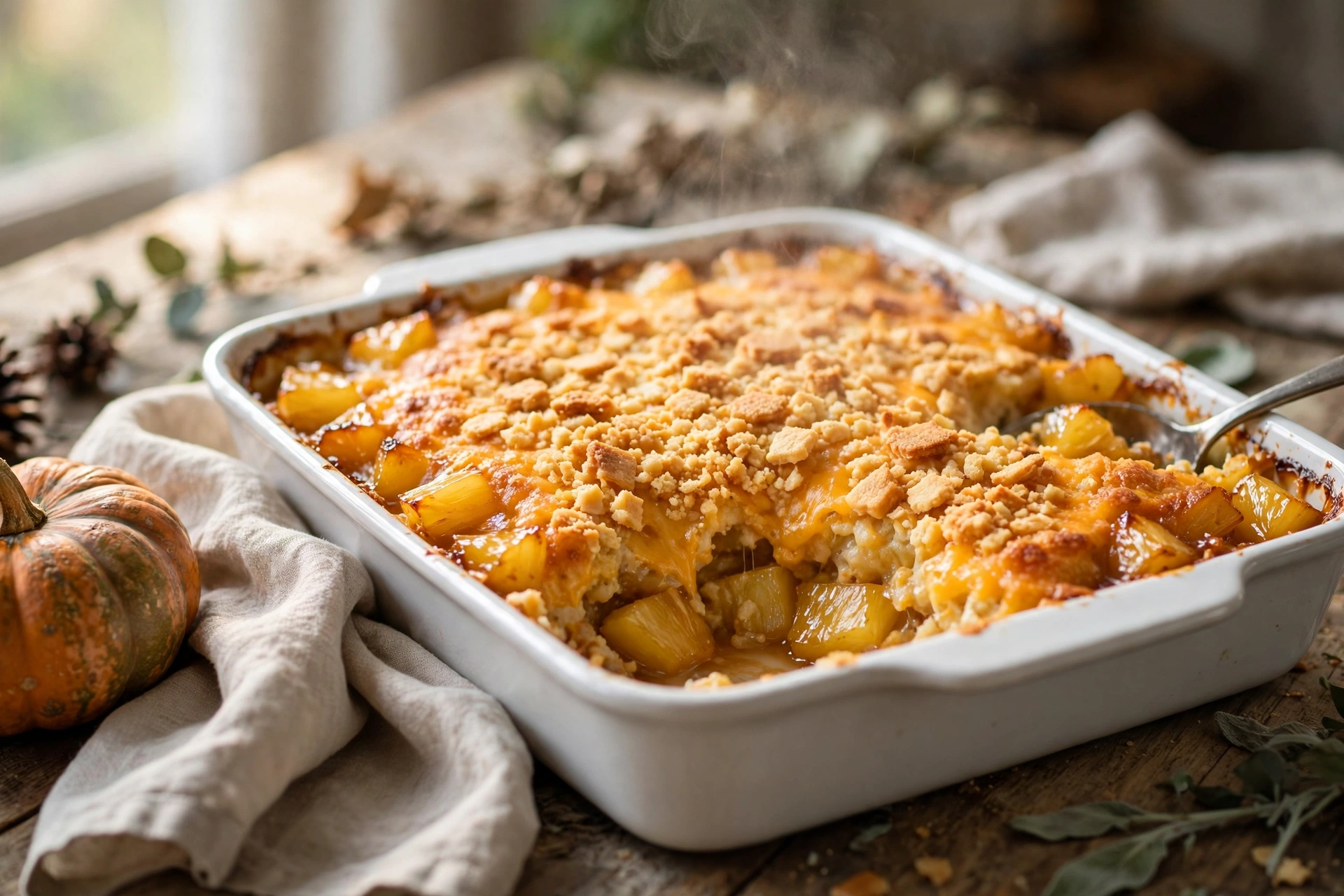
The first spoonful is warm pineapple, soft and almost candied at the edges, with a sauce that tastes like the fruit’s own syrup thickened into silk. Then the cheddar arrives, salty and sharp, and the two flavors lock together.
The cracker topping is the third act. It bakes into a crisp, buttery lid that shatters softly under the spoon, and its crumbs catch the juices at the edges of the dish where the casserole caramelizes hardest.
Nothing about the dish hides what it is. There is real sugar, real butter and real cheese, in holiday proportions, and the result tastes like a celebration rather than a compromise.
Served hot, the filling spoons out in soft, glossy mounds that hold their shape for a few seconds before settling. It sits proudly next to roasted meats, and it is just as good eaten standing at the counter the next morning.
Chunks and Crushed, On Purpose
Most versions of this casserole pick one cut of pineapple and live with the trade off. Chunks alone leave pockets of thin juice between the pieces, and the filling can bake up loose and soupy at the bottom of the dish.
Crushed pineapple alone has the opposite problem. It binds beautifully, but the texture turns uniform, more like a pudding than a casserole, and the fruit loses the bite that makes the dish interesting.
Splitting the difference solves both problems at once. The chunks stay distinct and jammy, the crushed fruit fills every gap around them, and the flour in the filling has something to hold on to as it bakes.
The same thinking governs the juice. Two cans of pineapple carry far more liquid than the casserole needs, so all of it drains away except a measured quarter cup, which goes back in to carry the sugar and flour through the fruit.
Even the cheese is a texture decision. Freshly grated cheddar melts into the filling in soft strands, while the coated shreds from a bag stay stubbornly separate and can leave the sauce greasy and broken.
If the clock ever argues with the colander, there is a shortcut that mostly works: spread the drained fruit on a tray lined with paper towels and blot the top gently. It is not as thorough as the full fifteen minutes, but it is far better than skipping the draining altogether.
One habit to avoid is packing the fruit down in the colander to speed things along. Pressing hard crushes the chunks into the crushed, and the casserole loses the two texture contrast that this whole design is built on.
What Goes Into the Dish
Everything here is a supermarket staple, and the short list rewards choosing the good version of each one. Use pineapple packed in juice rather than syrup, sharp cheddar you grate yourself, and the buttery round crackers you would happily eat plain.
- 1 can (20 ounces) pineapple chunks in juice
- 1 can (20 ounces) crushed pineapple in juice
- 1/2 cup granulated sugar
- 3 tablespoons all-purpose flour
- 1/4 teaspoon fine salt
- 2 cups freshly shredded sharp cheddar cheese (8 ounces)
- 1 1/2 cups crushed buttery round crackers (about 36 crackers)
- 6 tablespoons unsalted butter, melted
- Softened butter or cooking spray, for the dish
The nutrition figures for pineapple published by USDA FoodData Central explain why the fruit can carry so little added help: it brings its own acidity, its own sweetness and enough natural pectin character to set a filling with only a few spoonfuls of flour.
If your crowd leans sweet, the sugar can rise to two thirds of a cup without hurting the set. If the cheddar is extra sharp and salty, keep the sugar where it is and let the contrast do the talking.
Drain, Fold, Top and Bake, Step by Step
- Heat the oven to 350 degrees. Butter a 9×9 inch baking dish or a 2 quart casserole and set it on a rimmed baking sheet for easy handling.
- Pour both cans of pineapple into a colander set over a bowl and let them drain for a full 15 minutes, pressing very lightly once or twice. Reserve 1/4 cup of the juice and save or discard the rest.
- In a large bowl, whisk the sugar, flour and salt until no streaks of flour remain.
- Add the drained pineapple and the reserved 1/4 cup of juice to the bowl and fold until every piece is glossed with the mixture.
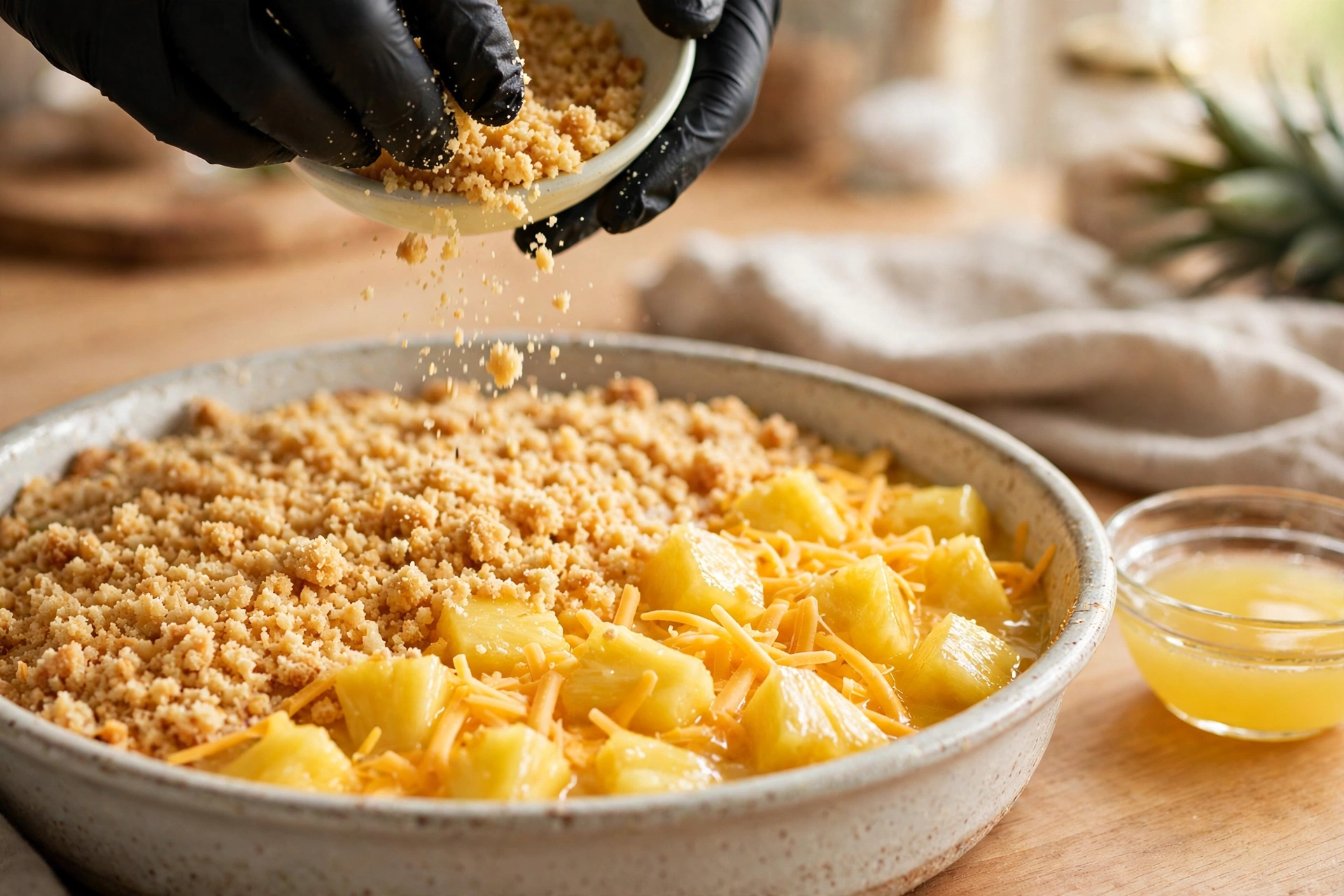
- Fold in the shredded cheddar last, turning the mixture just until the cheese is evenly distributed and no dry pockets remain.
- Scrape the filling into the prepared dish and level the top with the back of a spoon.
- Stir the cracker crumbs and melted butter together until every crumb looks damp, then scatter the topping evenly over the filling, right out to the corners.
- Bake for 30 to 35 minutes, until the topping is deeply golden and the filling bubbles thickly at the edges and in the center.
- Rest the casserole for 10 minutes on a rack. The sauce finishes setting as it stands, and the first spoonful will hold together instead of running.
- Spoon it up warm, making sure every serving gets a full share of the crisp topping.
Read the Bubbles at the Edge
The timer gets you close, but the casserole tells you when it is done. Look for bubbles that rise slowly and thickly at the edges, the sign that the flour has cooked through and the sauce has reached a true set.
Thin, fast bubbles mean water is still escaping the fruit, and the filling will be loose when you spoon it. Give the dish another five minutes and look again rather than pulling it on schedule.
The topping has its own cue. It should be an even, deep gold from corner to corner, closer to the color of a baked biscuit than to the pale crumbs that went in. Pale topping almost always means a soggy one.
If a casserole ever does come out looser than you like, the fix is patience, not panic. A full ten minute rest, uncovered, firms the sauce considerably as the steam escapes and the cheese resets.
One more defense against a watery result lives back at the colander. Draining for the full fifteen minutes, and resisting the urge to add extra juice for luck, is what keeps the bottom of the dish jammy instead of soupy.
The dish itself plays a small part. Ceramic and glass hold their heat and carry the casserole to the table still bubbling, while a thin metal pan cools faster and can leave the center behind the edges. If metal is what you have, give the casserole the full rest and serve it promptly.
Assemble It Wednesday, Bake It Thursday
This casserole was practically designed for the night before. The filling holds beautifully in the refrigerator for up to 24 hours, and baking it from assembled is exactly how the dish was served at a generation of church suppers.
Mix the filling on Wednesday, scrape it into the buttered dish, cover it tightly and refrigerate. Crush the crackers and keep them in a sealed bag at room temperature, and wait to stir them with the melted butter until Thursday.
The topping is the one element that must stay last minute. Buttered crumbs refrigerated overnight soften against the moist filling and bake up leathery instead of crisp, which undoing the whole point of the crust.
On Thursday, let the dish stand at room temperature for 20 minutes while the oven heats, add the freshly buttered crumbs, and bake as directed, adding about 5 minutes to the time since the filling starts cold.
Leftovers keep for up to 4 days in the refrigerator, covered. Reheat a full dish at 300 degrees for 12 to 15 minutes, until warmed through and bubbling again at the edges; the microwave works for single servings, though the topping softens.
What to Serve Alongside It
Pineapple casserole earns its keep by contrast, so build the rest of the plate around it. It is at its best next to the make ahead classics that fill a holiday table without filling the cook’s Thursday.
Set it beside a pan of make-ahead mashed potatoes for the creamy element, and a green bean casserole for the green one, and the three dishes cover sweet, rich and savory without competing.
A tray of make-ahead honey glazed carrots rounds out the color on the table, and the shared theme means everything can be assembled the day before and baked in rotation.
When the meal ends, whatever casserole remains is a cook’s treat. Eaten cold from the dish or warmed over a piece of toast, it makes a strong case for always baking the full pan, even for a small table.
Pineapple Casserole Questions, Answered
Can I use fresh pineapple instead of canned?
Yes. Use about 4 cups of finely chopped fresh pineapple and drain it the same way, then measure 1/4 cup of the collected juice, topping it up with water if there is not enough. The flavor is brighter, though the set is a touch softer than with canned fruit.
Why did my pineapple casserole come out watery?
Almost always the draining. If the fruit drains for only a minute or two, its juice floods the filling as it bakes. Drain for a full 15 minutes, add only the measured 1/4 cup of juice, and grate the cheddar fresh, since bagged shreds resist melting and leave the sauce thin.
Can I leave the cheese out?
You can, and the result is a pleasant baked pineapple dessert. But the cheddar is the signature of the dish: its salt is what turns sweet fruit into a side that belongs next to roasted meats. If the idea troubles you, start with a mild cheddar before deciding the classic version is not for you.
What crackers work best for the topping?
Buttery round crackers are the traditional choice and crush into crumbs that bake up crisp and rich. Saltines make a leaner, saltier crust, and plain panko with an extra tablespoon of butter gives the crunchiest lid of all. Whichever you choose, crush them to a mix of fine crumbs and small pieces for the best texture.
Can I double the recipe for a crowd?
Yes, double everything and bake in a 9×13 inch dish at the same temperature. Add 5 to 8 minutes to the bake time and judge doneness by the thick bubbles at the edges rather than the clock. The assembled filling doubles cleanly the night before, which makes it one of the easiest large format sides on the table.