
In this article:
- Assembled on Christmas Eve, baked in pajamas
- Tart cranberry, bright orange, custard soft center
- Dry the brioche first, never serve a soggy center
- What goes into the casserole
- Cube, candy, soak, bake
- The orange streusel goes on in the morning
- How long it can soak, and when to stop
- Berry swaps and a smaller pan
- Cranberry orange French toast casserole questions, answered
Cranberry orange French toast casserole is the Christmas morning breakfast that asks almost nothing of Christmas morning: brioche cubes soaked overnight in an orange scented custard, tart cranberries candied in orange sugar, and a streusel top that goes into the oven while the coffee brews.
Everything about the dish is front loaded to the night before. The assembly lands between the last gift wrapped and the house going quiet, and the morning that follows is measured in coffee refills, not tasks.
Two small techniques carry the whole recipe. The bread is dried in a low oven so it can drink the custard without collapsing, and the cranberries are chopped and sugared so their tartness reads as brightness instead of a wince. Get those two right and the casserole is foolproof.
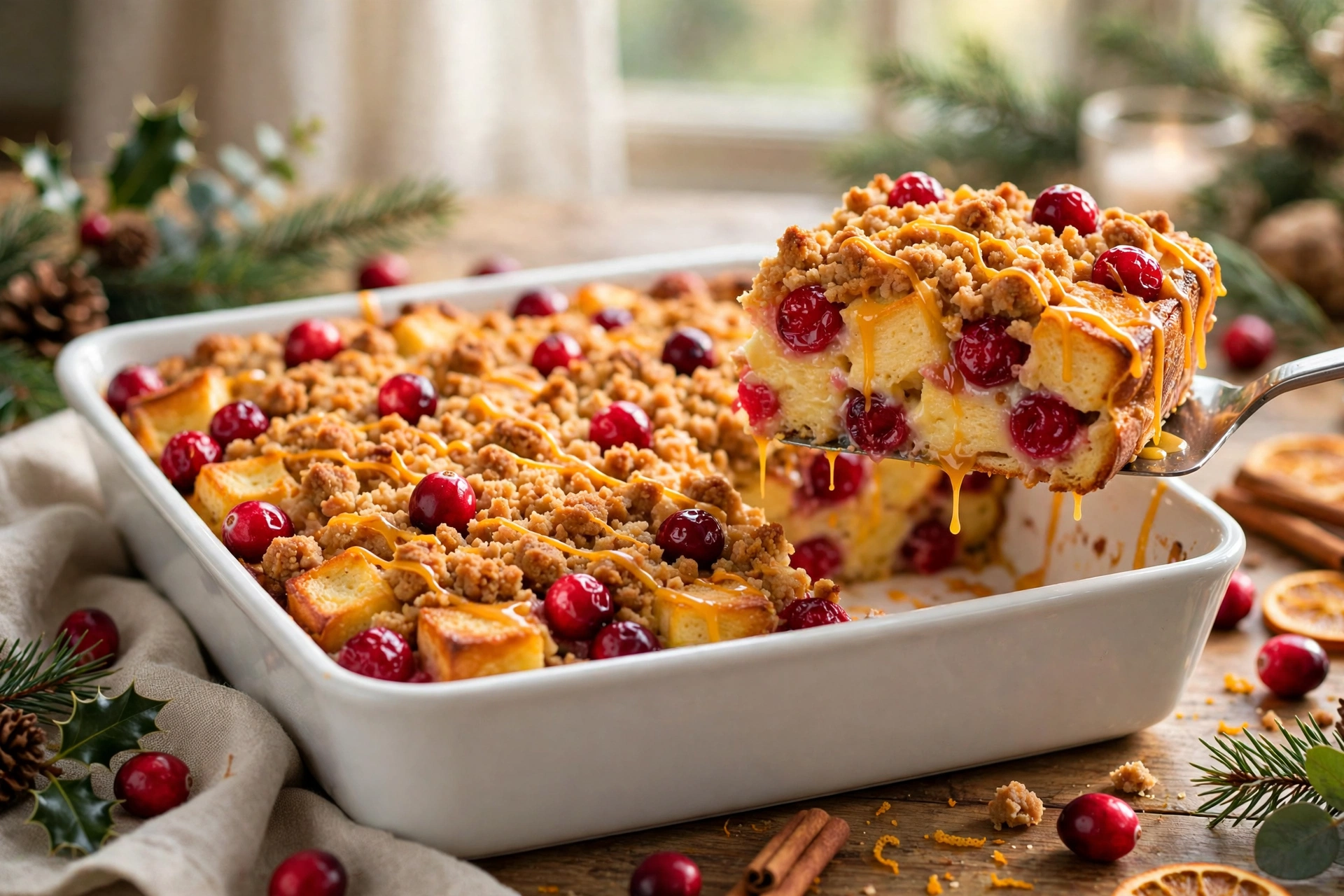
Assembled on Christmas Eve, Baked in Pajamas
Cranberry orange French toast casserole earns its place on the 25th because the work belongs to the 24th. Cubes cut, custard whisked, dish covered: twenty minutes of calm kitchen work after dinner, and the casserole waits in the refrigerator like a gift addressed to the cook.
The morning timeline runs itself. The dish comes out of the refrigerator at the same moment the oven starts heating, rests on the counter for thirty minutes, gets its streusel, and bakes covered then uncovered while presents happen in the next room. When the last ribbon falls, breakfast is hot.
The format scales to the house you actually have. A full 9 by 13 feeds ten at brunch. A half batch in an 8 by 8 serves a small family with slices left for the 26th, and the method, including the soak, does not change at all.
It also shares the oven gracefully. At 350 degrees it sits comfortably beside a ham free brunch spread, next to egg dishes and roasted potatoes, and it holds for twenty minutes after baking without losing its texture, covered loosely, while people find their seats.
Our other Christmas morning bakes follow the same philosophy, from the gingerbread monkey bread that rises overnight to the easy Christmas morning casserole built for a crowd. The rule of the day is simple: the cook stays in pajamas as long as possible.
Tart Cranberry, Bright Orange, Custard Soft Center
Fresh cranberries are aggressively tart, and that is their job here. Against a sweet, vanilla scented custard, each berry lands like a small red exclamation point, the bite that keeps a rich breakfast from eating heavy at nine in the morning.
Chopping the cranberries is what makes them pleasant. A whole berry bursts into one sour pocket; chopped pieces distribute, soften in the bake, and streak the custard pink where their juices bleed. The orange sugar coating does the rest, caramelizing lightly on the exposed pieces.
Orange shows up three times, each time differently. Zest in the cranberry sugar gives perfume. Zest and juice in the custard give the background brightness that reads as Christmas. A thin glaze of powdered sugar and juice, drizzled warm at the table, gives the finish a glossy, citrus snap.
The center should eat like bread pudding at its best: set, silky, holding the print of the spoon. The edges go golden and slightly crisp, and the streusel on top supplies the crunch that keeps every bite interesting. Warm maple syrup is welcome at the table, though most people find the glaze is enough.
Dry the Brioche First, Never Serve a Soggy Center
Every recipe for this casserole says to use day old bread, and almost none of them say what to do when the bread in the house is fresh. The answer is ten minutes in a 300 degree oven, and it is the step that guarantees the center of this cranberry orange French toast casserole sets instead of slumping.
Fresh brioche is mostly water and soft crumb. Poured custard turns it to paste before the dish ever reaches the oven, and no baking time rescues a paste. Dried cubes behave like sponges with structure: they absorb the custard fully, swell, and keep their shape through the soak and the bake.
The drying is gentle on purpose. The cubes should feel crisp at the surface and still soft in the middle, never toasted or colored. Ten minutes at 300 degrees gets exactly that; day old bread, honestly stale and dry to the touch, can skip the step entirely.
Press the top layer down once after the custard goes over. The cubes at the top of the dish sit above the liquid line, and a gentle press with the back of a spoon makes sure every piece drinks. Do not compact the dish; a light press, nothing more.
If your bread tearing tends to shred instead of cube, chill the loaf for twenty minutes first. Cold brioche slices cleanly with a serrated knife, and the cubes keep the edges that brown so well in the oven.
What Goes Into the Casserole
Brioche is the first choice for its rich crumb and the way it custards, but the dish forgives substitutions; the swaps section covers challah and sturdy white bread. Fresh cranberries are in every store from October on, and they freeze beautifully, so a bag bought early waits patiently. Their tart profile, and the egg figures behind the custard, are documented at USDA FoodData Central.
- 1 loaf brioche (about 16 ounces), cut into 1 inch cubes
- 2 cups fresh cranberries (about 8 ounces), coarsely chopped
- 1/4 cup granulated sugar, for the cranberries
- 1 tablespoon orange zest, for the cranberry sugar
- 6 large eggs
- 1 1/2 cups whole milk
- 3/4 cup heavy cream
- 1/3 cup granulated sugar, for the custard
- 1/4 cup maple syrup
- 1/4 cup fresh orange juice
- 2 teaspoons vanilla extract
- 1 tablespoon orange zest, for the custard
- 1 teaspoon ground cinnamon
- 1/4 teaspoon ground nutmeg
- 1/2 teaspoon fine salt
- 1/2 cup all-purpose flour, for the streusel
- 1/3 cup packed brown sugar, for the streusel
- 1 teaspoon orange zest, for the streusel
- 4 tablespoons cold unsalted butter, cubed, for the streusel
- 3/4 cup powdered sugar, for the glaze
- 2 tablespoons fresh orange juice, for the glaze
Zest the orange before you juice it, always. The recipe needs one large orange’s worth of zest across its three uses and juice from two; trying to zest a squeezed orange is a small Christmas Eve frustration nobody needs.
Cube, Candy, Soak, Bake
- Heat the oven to 300 degrees F. Spread the brioche cubes on a rimmed sheet pan and dry for 10 minutes, until the surfaces feel crisp and the centers stay soft. Cool completely. Day old bread can skip this step.
- Rub the 1/4 cup granulated sugar with the 1 tablespoon orange zest between your fingers until it turns fragrant and pale orange. Toss with the chopped cranberries and set aside.
- Butter a 9 by 13 inch baking dish. Add half the brioche cubes, scatter over half the cranberries, then add the remaining brioche and the remaining cranberries.
- Whisk the eggs, milk, cream, 1/3 cup granulated sugar, maple syrup, orange juice, vanilla, 1 tablespoon orange zest, cinnamon, nutmeg and salt until smooth. Pour slowly and evenly over the dish, then press the top cubes down gently so every piece drinks.
- Cover and refrigerate at least 4 hours and up to 24 hours. Eight to twelve hours, a true overnight, is the sweet spot.
- For the streusel, rub the flour, brown sugar, 1 teaspoon orange zest and a pinch of salt with the cold butter until coarse crumbs form. Refrigerate in a small covered bowl overnight.
- In the morning, set the dish on the counter for 30 minutes while the oven heats to 350 degrees F. Scatter the streusel evenly over the top.
- Bake covered with foil for 30 minutes, then uncovered for 20 to 25 minutes more, until puffed and deep gold and the center reads 160 degrees F with only the faintest jiggle.
- Rest 10 minutes. Whisk the powdered sugar with the 2 tablespoons orange juice into a pourable glaze, drizzle over the warm casserole and serve.
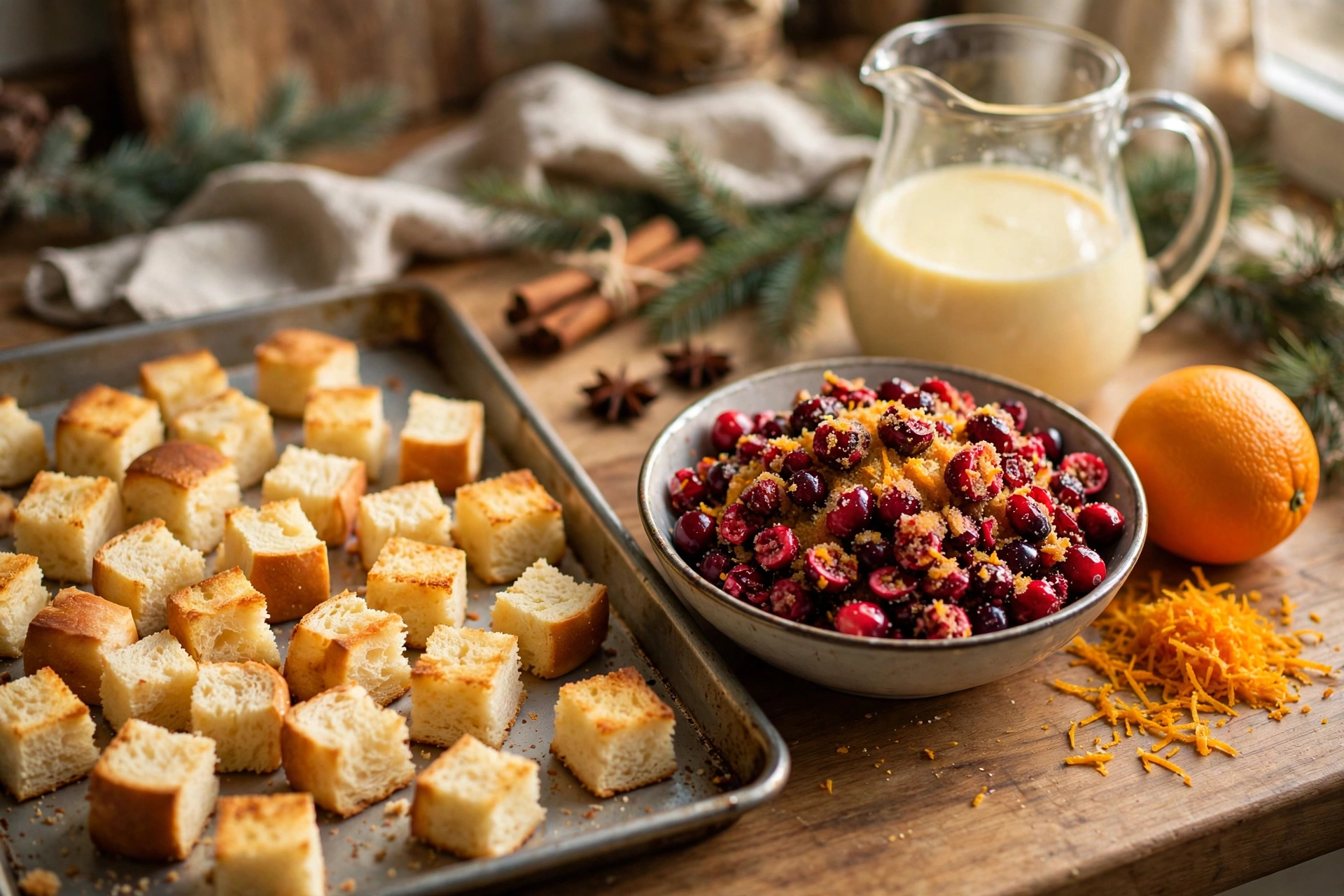
The Orange Streusel Goes On in the Morning
Streusel baked from a cold soak has a problem: it sits on wet bread all night, drinks moisture, and bakes into a soft, cakey layer. Made the night before but scattered on in the morning, it stays what streusel should be, crisp rubble over a soft center.
The orange zest in the rubble matters more than its quantity suggests. Heat releases its oils in the oven, and the whole kitchen smells like Christmas before the dish is even cut. It is the first thing guests notice, often before they see the casserole.
Cut the butter small and keep it cold. Warm butter creams into the flour instead of crumbling, and creamed streusel bakes flat and greasy. Rub it quickly, with fingertips only, and stop at pea sized crumbs with a few larger ones for texture.
If anyone at the table wants crunch beyond streusel, a quarter cup of chopped pecans can ride along in the rubble. Add them in the morning with everything else, so they toast in the bake rather than softening in the refrigerator overnight, a trick we also use on the blueberry French toast casserole.
How Long It Can Soak, and When to Stop
The soak has a floor, an ideal, and a ceiling. Four hours is the floor: less than that and the centers of the cubes stay dry and bready while the custard pools between them. Eight to twelve hours is the ideal, long enough for every cube to saturate evenly and for the cranberries to candy in their orange sugar.
Twenty four hours is the ceiling, and it is a food safety line as much as a quality one. A raw egg custard belongs at 40 degrees or below, and even refrigerated, its texture declines after a day: the bread disintegrates and the baked center turns dense, the standard caution behind the FoodSafety.gov storage guidance.
Leftovers, happily, are excellent. Refrigerate slices for up to three days and reheat in a 325 degree oven for 12 to 15 minutes, which re-crisps the streusel in a way a microwave never will. Individual slices also freeze for a month, thawed overnight and reheated the same way.
The unbaked casserole does not freeze well, and it is worth saying plainly. Raw custard and bread freeze at different rates, and the thawed dish bakes up wet. Assemble it fresh the night before instead, the way the dependable overnight cinnamon roll casserole is timed, and bake the leftovers into the freezer if you need them later.
Berry Swaps and a Smaller Pan
Raspberries swap in beautifully for a February brunch, used whole and unchopped, with lemon zest standing in for the orange. Blueberries make a softer, sweeter casserole; reduce the custard sugar by a tablespoon and keep the soak at the shorter end, since they bleed less acid than cranberries.
Dried cranberries work in a true pantry emergency. Use half the quantity, since they are sweetened and concentrated, and soak them in the orange juice for fifteen minutes so they plump instead of baking into raisins with commitment issues.
For a half batch, halve everything, bake in an 8 by 8 inch dish, and start checking ten minutes early; the covered time drops to about 25 minutes. For a slow morning for two, the same batter divides into four large ramekins, baked 25 minutes total and served in their dishes.
However the table is set, the point of cranberry orange French toast casserole holds: Christmas Eve does the work, Christmas morning takes the credit, and the cook is there for all of it, coffee in hand.
Cranberry Orange French Toast Casserole Questions, Answered
My bread is fresh today. Can I still make this tonight?
Yes. Cube the brioche and dry it in a 300 degree F oven for 10 minutes, until the surfaces feel crisp and the centers stay soft. Drying is what lets fresh bread absorb the custard without collapsing, and it fully replaces day old bread.
Can I use frozen cranberries instead of fresh?
Yes. Chop them straight from frozen, since partially thawed berries crush instead of cutting, and toss them with the orange sugar while still cold. Do not thaw them first; thawed cranberries bleed juice into the custard and streak the whole dish pink.
Why is the bottom of my French toast casserole soggy?
The bread went in too fresh, or the soak ran too long. Fresh cubes turn to paste under custard, and past 24 hours the crumb disintegrates. Dry the bread first, keep the soak between 4 and 24 hours, and bake until the center reads 160 degrees F.
How do I know the center is done?
The edges will be puffed and deep gold and the center will jiggle only faintly when the dish is nudged. For certainty, an instant read thermometer in the center should read 160 degrees F, the temperature at which an egg custard sets safely.
What is the best way to reheat leftovers?
Reheat slices, uncovered, in a 325 degree F oven for 12 to 15 minutes. The oven restores the crisp streusel and warm center together. A microwave works in a pinch but softens the topping, so save it for the slices nobody will judge.