
In this article:
- The Canned Soup Shortcut, Replaced
- Hash Brown Casserole Ingredients
- Making the Hash Brown Casserole
- Thawing the Potatoes So They Bake Creamy, Not Watery
- The Cornflake Top: Buttery, Never Soggy
- Sliding It Into the Thanksgiving Oven Schedule
- Assemble It Tuesday, Bake It Thursday
- Swaps for the Hash Brown Casserole
- Golden, Bubbly, Gone by Seconds
- Hash Brown Casserole Questions
Hash brown casserole is the dish our Thanksgiving guests ask about before they even sit down: shredded potatoes folded into a creamy cheddar sauce, baked until the edges bubble and the top turns crisp and gold. It is funeral potatoes dressed for the holiday table.
This version skips the canned soup completely. A quick stovetop sauce of butter, onion, flour, milk and broth takes five minutes and tastes like real food, because it is. Sour cream and sharp cheddar finish what the roux starts.
It is also built for the cook. The potatoes thaw while you do other things, the dish assembles the night before, and it bakes while the turkey rests. Warm, cheesy and calm: that is exactly what a holiday side should be.
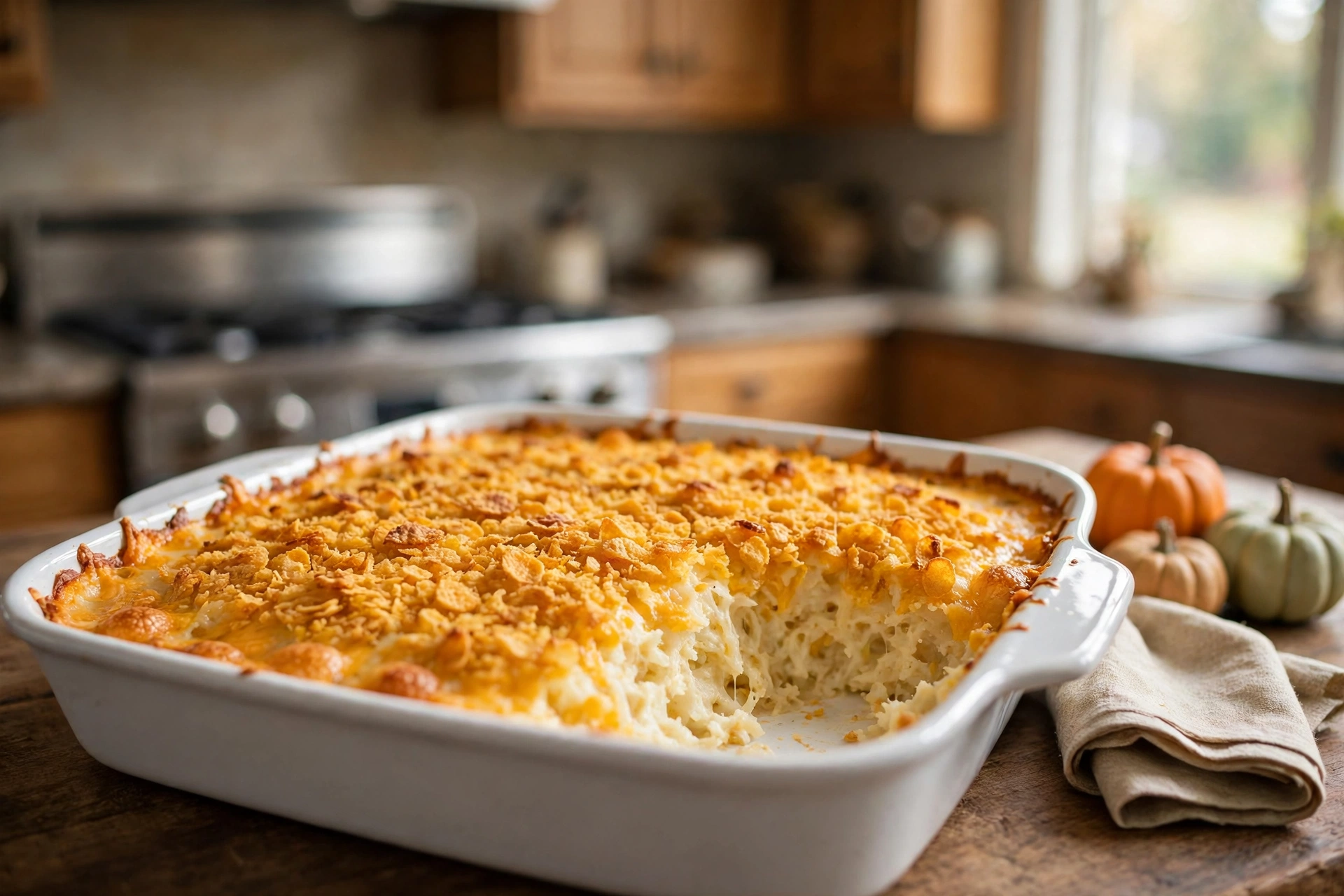
The Canned Soup Shortcut, Replaced
Hash brown casserole built on a homemade sauce works for one simple reason: you control the salt, the thickness and the flavor. Canned soup brings a tinny sweetness and more sodium than this dish needs. A light roux brings body without heaviness.
The sauce starts like a classic béchamel, then veers toward comfort. Onion softens in butter until sweet, flour cooks for a full minute, and milk plus broth whisk in slowly. What forms is a sauce that coats a spoon in a slow, glossy sheet.
Sour cream goes in off the heat, and that timing matters. Boiling sour cream can split and turn grainy; folding it into a warm sauce keeps it silky. Its tang cuts the richness of the cheddar and keeps the potatoes from tasting flat.
Sharp cheddar does double duty here. Two cups melt into the sauce for flavor in every bite, and a final half cup waits for the top, where it browns under the cornflakes. Shredding it yourself, straight from a cold block, melts smoother than the bagged kind.
The potatoes themselves stay shredded, never cubed, and that choice is about texture. Shreds drink up the sauce and bake into a tender, almost layered bite. Cubes stay distinct and firm, which suits breakfast skillets better than this soft holiday casserole.
This dish travels under another name at many tables: funeral potatoes, the church supper and family gathering staple of the Mountain West. The bones are identical, potatoes, creamy sauce, cheese and a crisp top. Our version simply trades the can for a saucepan and dresses the result for Thanksgiving.
There is one more quiet advantage to the homemade sauce: it reheats like a sauce, not like a gel. Canned soup versions set into a firm slice when cold and weep when warmed. This one returns to creamy with gentle heat and a spoonful of milk, which matters on a holiday built on leftovers.
Hash Brown Casserole Ingredients
Everything here is a regular grocery item, and the list is shorter than the canned version suggests. Buy a full fat sour cream and a block of sharp cheddar, and thaw the potatoes before you start.
- 1 bag (30 ounces, 850 g) frozen shredded hash brown potatoes, thawed
- 4 tablespoons (57 g) unsalted butter, plus more for the dish
- 1 cup (150 g) finely diced yellow onion
- 2 cloves garlic, minced
- 1/4 cup (31 g) all-purpose flour
- 1 cup (240 g) whole milk
- 1 cup (240 g) low sodium chicken broth
- 1 teaspoon (6 g) fine sea salt
- 1/2 teaspoon (1 g) black pepper
- 1/2 teaspoon (1 g) dry mustard powder
- 1 cup (240 g) sour cream, at room temperature
- 2 1/2 cups (283 g) shredded sharp cheddar, divided
- 2 cups (60 g) cornflakes, lightly crushed
- 2 tablespoons (28 g) unsalted butter, melted
About the hash browns: shredded style is not a suggestion here, it is the structure of the dish. If the bag says diced or Southern style, keep looking. The shreds should feel loose and separate after thawing, never frozen into a solid brick.
Room temperature sour cream folds in without cooling the sauce down. Set it out when you start the thaw, alongside the cheddar. Cold dairy stirred into hot sauce is how grainy casseroles happen, and it is easy to avoid.
Making the Hash Brown Casserole
The work is gentle and mostly hands off. Build the sauce, fold, bake, then add the topping near the end so it stays crisp. Read the thawing notes below before you start if your potatoes are still frozen.
- Heat the oven to 350°F. Butter a 9 by 13 inch baking dish and set it aside.
- Squeeze the thawed hash browns in a clean kitchen towel, a handful at a time, until no more water drips out. Set them in a large mixing bowl.
- Melt the 4 tablespoons (57 g) of butter in a medium saucepan over medium heat. Add the onion and cook for 4 to 5 minutes, until soft and sweet.
- Stir in the garlic and cook for 30 seconds. Sprinkle the flour over the onions and cook, stirring, for 1 full minute.
- Slowly whisk in the milk, then the broth. Simmer for 2 to 3 minutes, whisking, until the sauce thickens enough to coat the back of a spoon.
- Take the pan off the heat. Stir in the salt, pepper and mustard powder, then the sour cream, until smooth.
- Fold 2 cups (226 g) of the cheddar into the warm sauce until mostly melted. Pour the sauce over the potatoes and fold until every shred is coated.
- Scrape the mixture into the prepared dish and smooth the top. Scatter the remaining 1/2 cup (57 g) of cheddar over it.
- Bake uncovered for 35 minutes, until the edges are bubbling. Toss the crushed cornflakes with the 2 tablespoons (28 g) of melted butter and scatter them over the top.
- Bake for 12 to 15 minutes more, until the topping is deep golden and the center is hot and set. Rest for 10 minutes before serving.
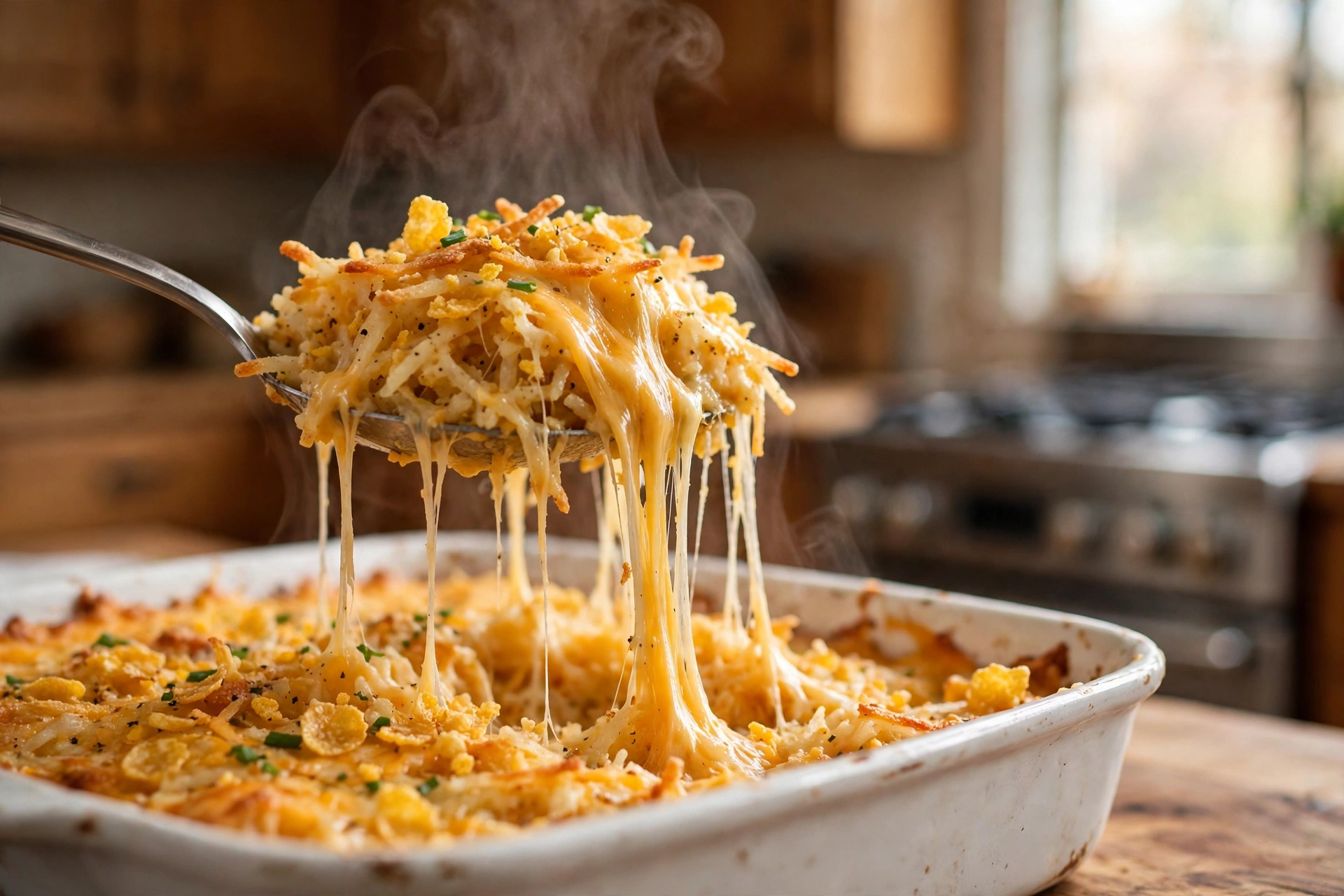
Serve it straight from the dish, family style, with a big spoon. The first scoop should stretch a little and settle soft on the plate. Leftovers, if your family allows them, are covered in the storage notes below.
Thawing the Potatoes So They Bake Creamy, Not Watery
Frozen potatoes carry a surprising amount of water, and that water is the enemy of a creamy bake. A 30 ounce (850 g) bag can release close to a cup of liquid as it thaws. Baked in, that liquid thins the sauce and steams the shreds instead of saucing them.
Two thawing routes both work. The slow route is a night in the fridge, bag opened and set in a bowl. The faster route is two hours on the counter, spread on a rimmed sheet pan so the shreds thaw in a thin, even layer.
Either way, the squeeze matters more than the method. Gather the thawed shreds in a clean towel, twist and press until the dripping stops. It takes two minutes, and it is the single step that separates a rich casserole from a watery one.
Freshly grated potatoes can stand in, with respect for their extra water. Peel and shred 850 g of russets, soak them for 10 minutes to rinse off surface starch, then drain and squeeze even harder than the frozen ones. The flavor runs a little earthier, and the texture stays close to the original.
If you love sliced potatoes instead, our scalloped potatoes trade the shreds for thin rounds in a similar creamy bath. Both dishes earn their place on the holiday table; the hash brown version is simply the softer, scoopable one.
The Cornflake Top: Buttery, Never Soggy
The cornflake top is this casserole’s signature, a buttery crunch over all that softness. It fails in one predictable way: added at the start, it steams under the sauce’s moisture and turns leathery long before the potatoes finish baking.
The fix is timing, not ingredients. The flakes go on for the last 12 to 15 minutes only, tossed with melted butter so they toast instead of scorch. They should land in loose handfuls, never pressed down into the sauce.
Crush them lightly, keeping some pieces big. A bag rolled a few times with a rolling pin gives the right mix of crumbs and flakes. Dust fine crumbs burn fast; big flakes toast into something closer to a chip.
No cornflakes in the pantry? Crushed plain potato chips or buttered panko both work in the same late window. Keep the amount close to 2 cups (60 g) so the coverage stays even and the top still crisps.
Serve the casserole straight out of its short rest, while the top still crackles under the spoon. Ten minutes of resting is not dead time: the sauce thickens to its final silkiness and the cheese settles into the shreds. Served too early, it slumps; served on time, it scoops like a dream.
Sliding It Into the Thanksgiving Oven Schedule
Thanksgiving runs on oven shifts, and this casserole takes the friendliest one. It needs about 50 minutes at 350°F, a temperature low enough to share the oven and forgiving enough to wait its turn without complaint.
Our plan is simple. The dish goes in as the herb butter roast turkey comes out to rest, and it leaves the oven just as carving ends. The full menu, with timings for every dish, lives on our Free Thanksgiving Recipe Cards page.
While it bakes, the make-ahead mashed potatoes reheat on the stove and the gravy gets its final whisk. Three hot dishes finish inside the same ten minutes, which is the closest a Thanksgiving kitchen gets to peace.
If dinner slips, the baked casserole holds gracefully. Cover it loosely with foil and park it in a 200°F oven for up to 30 minutes. The top softens a touch, but the center stays creamy and the cheese stays supple.
For a buffet style meal, the same mixture bakes in a buttered muffin tin for individual portions, about 25 minutes plus the cornflake finish. Guests take a portion, the line keeps moving, and nobody fights over the crispy corner pieces. Well, almost nobody.
Assemble It Tuesday, Bake It Thursday
Assemble the whole dish the night before, sauce and potatoes together, and refrigerate it covered and unbaked. Hold back the cornflake topping until bake day; it must stay dry. Add 10 minutes to the bake when it goes in cold from the fridge.
Leftovers keep well for a potato dish. Cool, cover and refrigerate for up to 4 days, and reheat portions to 165°F as the USDA leftovers guide recommends. A spoonful of milk stirred in before reheating brings back the creamy texture.
Freezing is honest but imperfect: the sauce can turn slightly grainy after thawing. If you freeze, do it before baking, wrap the dish tightly, and keep it for up to 2 months. Thaw overnight in the fridge and bake as written.
Single portions reheat best in the oven, where the top can crisp again: 15 minutes at 325°F in a small dish, with the cornflakes waking back up. The microwave is faster and fine for a quiet lunch, but the topping trades its crunch for convenience.
For a balanced plate, this rich casserole likes green company. Our creamed spinach brings the same comfort in a darker shade, and both dishes can share the Wednesday prep session without crowding the stove.
Swaps for the Hash Brown Casserole
Cheese is the easiest swap. Monterey Jack melts milder and creamier, Gruyère turns the sauce nutty, and pepper Jack adds gentle heat. Keep the total at 2 1/2 cups (283 g) so the sauce keeps its body.
Greek yogurt can stand in for the sour cream, cup for cup, with a slightly firmer set and a brighter tang. For a gluten free sauce, swap the flour for the same amount of cornstarch, whisked into the cold milk before it meets the pan.
Stir ins change the dish without changing its bones. A cup of diced cooked chicken makes it a main, and a handful of thawed peas or diced bell pepper adds color for a brunch table. Keep additions under a cup so the sauce still coats everything.
For a smaller table, halve everything and bake in an 8 inch square dish. The bake shortens to about 35 to 40 minutes, and the cornflake window still lands in the final 12 minutes. Leftovers for two reheat beautifully, covered, at 325°F with a spoonful of milk.
Prefer your potatoes twice baked and fluffy? The twice-baked potato casserole builds on the same flavors in a different shape. Both recipes reward a cook who likes to finish the work a day early.
Golden, Bubbly, Gone by Seconds
Hash brown casserole, made from scratch, is proof that the classics survive for a reason. No can, no fuss, just shredded potatoes in a sauce you seasoned yourself, under a top that crackles when the spoon goes in.
Make it once this Thanksgiving and watch it disappear. Around here, the dish comes back to the kitchen scraped clean, and the recipe request arrives before dessert.
Hash Brown Casserole Questions
Can I make hash brown casserole without thawing the potatoes first?
It is not recommended. Frozen shreds release close to a cup of water as they bake, which thins the sauce and leaves the center soupy. Thaw overnight in the fridge or for two hours on the counter, then squeeze them dry in a clean towel.
Why did my hash brown casserole turn out watery?
Almost always, the potatoes went in wet, or the sauce was pulled before it thickened. The sauce should coat the back of a spoon before it meets the potatoes, and the shreds should be squeezed until no more water drips out.
Can I use cubed hash browns instead of shredded?
Yes, with a texture change. Cubes stay firm and distinct, so the casserole eats more like a potato bake than a soft, scoopable side. Add about 10 minutes to the bake and check that the center cubes are fully tender.
How do I keep the cornflake topping from going soggy?
Add it near the end, never at the start. Toss the flakes with melted butter and scatter them over the casserole for only the last 12 to 15 minutes of baking, so they toast in dry heat instead of steaming.
Can I freeze hash brown casserole before baking?
Yes. Assemble it without the topping, wrap the dish tightly and freeze for up to 2 months. Thaw overnight in the fridge, add 10 minutes to the bake, and finish with fresh buttered cornflakes at the end.
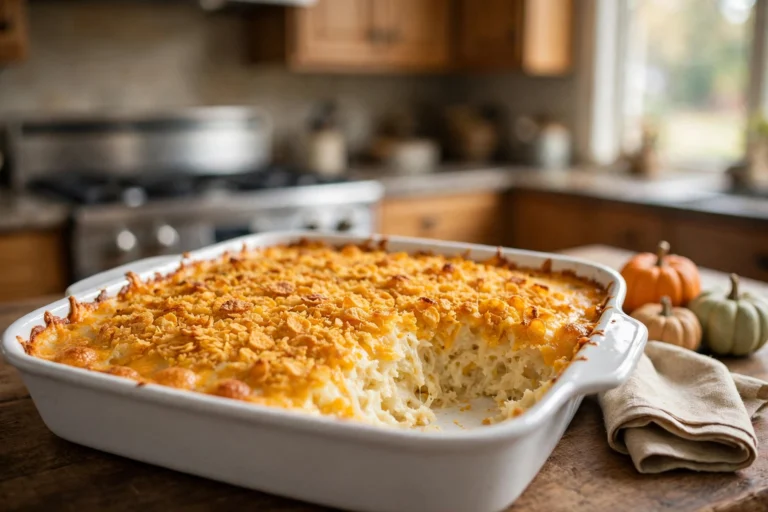
Hash Brown Casserole: Cheesy, Creamy and Crisp on Top
Shredded hash browns folded into a from-scratch cheddar and sour cream sauce, with no canned soup, baked until bubbling and finished with a buttery cornflake top that goes on at the end so it stays crisp. Assembles the night before and bakes while the Thanksgiving turkey rests.
- Total Time: 1 hour 10 minutes
- Yield: 12 servings 1x
Ingredients
1 bag (30 ounces, 850 g) frozen shredded hash brown potatoes, thawed
1 cup (150 g) finely diced yellow onion
2 cloves garlic, minced
1/4 cup (31 g) all-purpose flour
1 cup (240 g) whole milk
1 cup (240 g) low sodium chicken broth
1 teaspoon (6 g) fine sea salt
1/2 teaspoon (1 g) black pepper
1/2 teaspoon (1 g) dry mustard powder
1 cup (240 g) sour cream, at room temperature
2 1/2 cups (283 g) shredded sharp cheddar, divided
2 cups (60 g) cornflakes, lightly crushed
2 tablespoons (28 g) unsalted butter, melted
Instructions
Heat the oven to 350°F. Butter a 9 by 13 inch baking dish and set it aside.
Squeeze the thawed hash browns in a clean kitchen towel, a handful at a time, until no more water drips out. Set them in a large mixing bowl.
Melt the 4 tablespoons (57 g) of butter in a medium saucepan over medium heat. Add the onion and cook for 4 to 5 minutes, until soft and sweet.
Stir in the garlic and cook for 30 seconds. Sprinkle the flour over the onions and cook, stirring, for 1 full minute.
Slowly whisk in the milk, then the broth. Simmer for 2 to 3 minutes, whisking, until the sauce thickens enough to coat the back of a spoon.
Take the pan off the heat. Stir in the salt, pepper and mustard powder, then the sour cream, until smooth.
Fold 2 cups (226 g) of the cheddar into the warm sauce until mostly melted. Pour the sauce over the potatoes and fold until every shred is coated.
Scrape the mixture into the prepared dish and smooth the top. Scatter the remaining 1/2 cup (57 g) of cheddar over it.
Bake uncovered for 35 minutes, until the edges are bubbling. Toss the crushed cornflakes with the 2 tablespoons (28 g) of melted butter and scatter them over the top.
Bake for 12 to 15 minutes more, until the topping is deep golden and the center is hot and set. Rest for 10 minutes before serving.
Notes
Squeeze the thawed potatoes very dry; their water is the main cause of watery casseroles. The dish can be assembled, without the cornflake topping, up to 24 hours ahead and refrigerated; add 10 minutes to the bake when it goes in cold.
- Prep Time: 20 minutes
- Cook Time: 50 minutes
Nutrition
- Calories: 290
- Sodium: 410
- Saturated Fat: 11
- Protein: 9
- Cholesterol: 51