
In this article:
- Why pizzelle never miss an Italian Christmas
- Lace like a snowflake, crunch like a wafer
- The iron does the decorating
- Eggs beaten to the ribbon
- What goes in the batter
- Pressing the pizzelle, step by step
- Read the steam, not the clock
- Flat, rolled or cupped while warm
- Anise first, then lemon, almond and cocoa
- Keeping the crunch until the cookie exchange
- A stack tied with string
- Questions from the iron
Pizzelle arrive at Christmas the way snow does, quietly, and then all at once, in stacks. One afternoon at the iron produces dozens of lacy, golden rounds, and by evening they are dusted, stacked and tied into every cookie box on the street.
They ask for no frosting, no filling and no decorating skill. The iron stamps the pattern, the batter takes forty seconds a round, and the cook’s only real work is timing, trimming and resisting the warm ones that never make the stack.
Why Pizzelle Never Miss an Italian Christmas Table
Pizzelle work because they are engineered generosity. One simple batter, pressed in under a minute per cookie, produces the volume a holiday table actually consumes, and the cookies keep their crunch for weeks in a tin.
The recipe comes from Abruzzo, on Italy’s Adriatic coast, where the cookies are among the oldest in Europe. According to Wikipedia’s history of the pizzelle, traditional irons were forged with family initials and crests, so every household literally signed its own cookies.
That heritage explains the flavor discipline. Anise is the classic seasoning, warm and faintly licorice, and the batter carries nothing else that could crowd it. Butter, eggs, sugar, flour: the list reads like a pantry inventory because it is one.
On our own Christmas table they sit beside the soft cookies on purpose. My Italian ricotta Christmas cookies are pillowy and glazed, the pizzelle are crisp and plain, and a cookie box needs exactly that argument between the two textures.
Lace Like a Snowflake, Crunch Like a Wafer
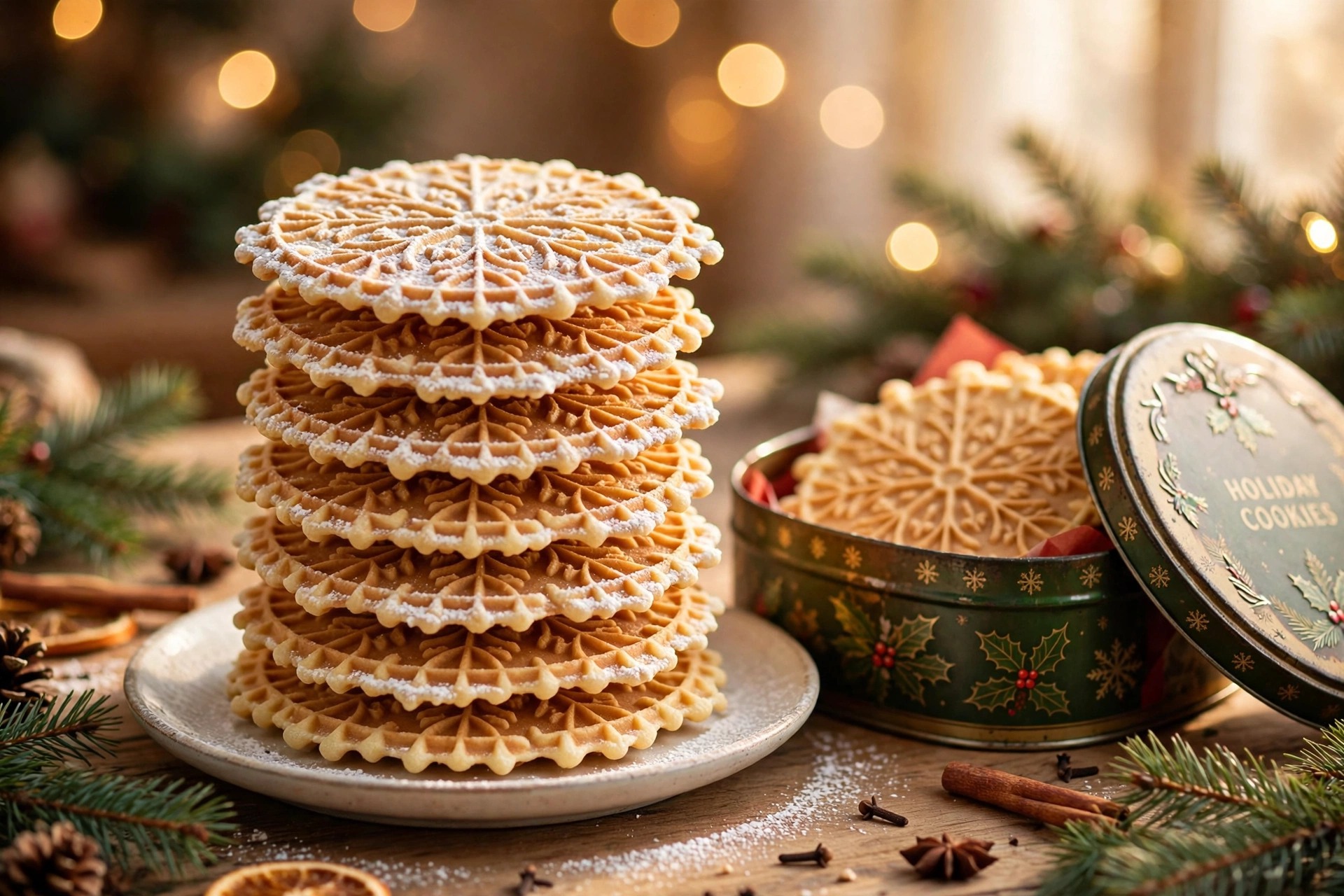
A good pizzella is two experiences stacked. The eye gets the pattern first, a deep stamped snowflake or floral medallion, sharp enough to hold a drift of powdered sugar in every groove. Then the ear gets involved: the cookie breaks with an audible snap.
The flavor is gentler than the crunch suggests. Butter and vanilla round the edges, the anise arrives as a warm perfume rather than a licorice candy hit, and the sweetness stays modest, closer to a wafer than to a frosted sugar cookie.
Temperature changes the texture completely. Warm off the iron, a pizzella is flexible enough to bend around a wooden spoon handle. Ninety seconds later it sets into glass. That brief soft window is a feature the shaping section below puts to work.
Dusted, the cookies look like they were left out in the first snow of December. Left plain, the pattern reads more clearly and the gold deepens at the ridges. Both presentations belong on the same platter, and most Italian grandmothers serve them mixed.
Break one and look inside before you judge a batch. The interior should be dry, pale gold and finely textured, never gummy or translucent at the center. A gummy middle means the steam cue was cut short, and that cookie will never crisp, no matter how long it sits.
The Iron Does the Decorating
The pizzelle iron, electric today and forged for the hearth in earlier centuries, is a press with two patterned plates. The batter spreads under its weight into a round barely thicker than a cracker, and the plates emboss both faces at once.
Electric irons vary more than ovens do. Some run hot and finish a cookie in thirty seconds; older, heavier plates take a full minute. This is why the recipe below teaches a steam cue instead of promising a number of seconds that your iron may not keep.
Nonstick plates need almost nothing, perhaps a whisper of butter on the first round only. Cast iron and older plates want a light brushing before the first few cookies, then the butter in the batter takes over the job for the rest of the batch.
Heat the iron fully before the first cookie and give it a moment to recover between rounds if your stack starts coming out pale. A steady iron makes identical cookies; a cycling iron makes a gradient from gold to tan that no amount of dusting can hide.
Size deserves a word, because irons disagree. Classic plates press rounds of about five inches, mini irons make three inch cookies that suit a cookie box, and the batter amount scales with the plate. Whatever the size, the cookie should end thin enough to snap cleanly in two hands.
Eggs Beaten to the Ribbon, Batter Rested Ten Minutes
The batter is a thick, spoonable dough, closer to a soft cookie dough than to a pancake batter. Its structure comes from the eggs, beaten with the sugar until the mixture turns pale and falls from the whisk in a slow ribbon.
That ribbon stage is not ceremony. Beaten eggs hold air, and that air is the only leavening lift the thin cookie ever gets beyond its pinch of baking powder. Underbeaten eggs make dense, tough pizzelle that bend instead of snapping.
The flour goes in last and gets mixed only until the streaks disappear. Overmixing develops gluten in a batter that has nowhere to hide it, and the pattern softens as the cookie spreads unevenly under the lid.
Then the batter rests for ten minutes on the counter. The flour hydrates, the batter firms to a clean scoop, and the rounds spread predictably. Skipping the rest produces the lacy, holey edges that beginners blame on their iron.
What Goes in the Batter for Pizzelle
- 3 large eggs, at room temperature
- 3/4 cup granulated sugar
- 1/2 cup unsalted butter, melted and cooled slightly
- 1 teaspoon vanilla extract
- 3/4 teaspoon anise extract, or 1/2 teaspoon anise oil
- 1 3/4 cups all-purpose flour
- 2 teaspoons baking powder
- 1/4 teaspoon fine sea salt
- Powdered sugar, for dusting
The anise dose deserves one honest warning. Extract and oil are not interchangeable by volume: anise oil is several times stronger, and a full teaspoon of oil will perfume the whole house and overpower the cookie. Start low, press one test cookie, and adjust the batter, never the other way around.
Pressing the Pizzelle, Step by Step
- Whisk the flour, baking powder and salt together in a medium bowl. Set aside.
- Beat the eggs and sugar in a large bowl for about 3 minutes, until pale, thickened and falling from the whisk in a ribbon.
- Stir in the melted butter, vanilla and anise until the batter looks glossy and even.
- Fold the dry ingredients into the egg mixture just until no flour streaks remain. Rest the batter for 10 minutes.
- Heat the pizzelle iron until its ready light cycles off. Brush the plates very lightly with butter if your iron is not nonstick.
- Place a heaping tablespoon of batter slightly behind the center of each grid. Close the lid, latch it if your iron latches, and press until the steam slows, 30 to 45 seconds.
- Lift the cookie out with a fork or thin spatula. Trim the ragged edge at once with a round cutter if you want perfect rounds, then lay the cookie flat on a rack.
- Repeat until the batter is gone, letting the cookies cool completely and crisp before stacking. Dust with powdered sugar before serving.
Work in a rhythm: one cookie cooks while you trim and move the previous one. By the fourth round the motions settle, the stack grows evenly, and the whole batch of about two dozen is pressed in roughly twenty minutes.
Read the Steam, Not the Clock
Here is the cue that frees you from your iron’s personality. When the lid closes, steam escapes in a steady hiss as the batter’s moisture flashes off. That steam is the cookie telling you it is still wet inside.
When the hissing slows to an occasional wisp, the cookie is set. Lift the lid then, and the pizzella should be evenly golden at the ridges with a pattern that reads sharply. Steam still pouring out means ten more seconds, whatever the timer claims.
Color follows the same logic. Pale and soft means underdone, and underdone pizzelle go leathery by morning. Deep brown spots mean the iron is running hot; give it an unplugged minute, or shorten each press and accept a darker, more caramelized batch.
The first two cookies of every session are scouts. Press them, taste them, adjust the anise and the timing, and only then settle into production. The scouts are also, by long tradition, the cook’s portion, eaten warm over the sink.
Flat, Rolled or Cupped While Warm
A pizzella leaves the iron soft for about a minute, and that minute is a design studio. Left flat on the rack, it becomes the classic stacking cookie, the shape that fills cookie boxes and travels across the country in tins.
Draped over a small inverted bowl, it sets into a cup that holds berries, whipped cream or a scoop of ice cream. Wrapped around a wooden spoon handle or a cannoli form, it sets into a tube ready for a ricotta filling.
Rolled into a cone and held for twenty seconds, it becomes the crispest ice cream cone you will ever make, the summer second life of a Christmas cookie. My easy Christmas spritz cookies never get this second career; the pizzella’s warm flexibility is a talent all its own.
Whichever shape you choose, commit in the first seconds. A half cooled cookie resists shaping and cracks along the pattern lines, and a cracked cup, while still delicious, belongs in the cook’s private pile rather than the gift box.
Anise First, Then Lemon, Almond and Cocoa
Anise is the tradition and the right place to start, but the batter is a friendly base for a whole family of flavors. Lemon pizzelle swap the anise for a tablespoon of fresh lemon zest and taste like winter sunshine next to tea.
Almond extract, used at half the anise measure, pushes the cookies toward the marzipan end of the Italian bakery case, especially with a few sliced almonds pressed on top of the batter before the lid closes.
For the chocolate batch, whisk three tablespoons of cocoa powder and two extra tablespoons of sugar into the flour. The pattern shows less against the dark crumb, so dust those generously; the contrast of white sugar on dark cookie is the prettiest stack of the season.
Orange zest with a pinch of cardamom makes the most modern tasting batch, bright and faintly spiced. Keep each flavor in its own tin, because pizzelle trade aromas in storage, and a mixed tin slowly turns every cookie into the same cookie.
Keeping the Crunch Until the Cookie Exchange
Pizzelle keep beautifully and fail in exactly one way: moisture. Cool every cookie completely on the rack before stacking, because trapped steam is the enemy and a warm stack seals that steam against the crispest surfaces you made all afternoon.
Store them in a metal tin at room temperature, layered with parchment, for up to three weeks. Plastic tubs trap humidity and soften the edges; a tin breathes just enough. Beside them in the box, my snowball cookies keep the same three weeks, which is why the two travel together so often.
If a batch does soften, the oven forgives it. Lay the cookies in a single layer and warm them at 300 degrees for three to four minutes, then cool on the rack. The crunch returns almost completely, a rescue no frosted cookie allows.
Freezing works too, with care. Freeze the cookies flat in a rigid container with parchment between layers for up to two months, and thaw them uncovered so condensation lands on the counter instead of on the cookies. They emerge tasting pressed yesterday.
A Stack Tied With String
Pizzelle ask for almost nothing: one batter, one hot iron, and the patience to read the steam. In return they give you the oldest cookie on the Christmas table, crisp for weeks and beautiful without a minute of decorating.
Stack them, tie them with string, and hand them to anyone who knocks. Press one batch this December, learn your iron’s moods, and it will never spend another holiday forgotten at the back of the cupboard.
FAQ
Why did my pizzelle come out soft instead of crisp?
They were either underbaked or stacked while still warm. Press until the steam slows to a wisp, and cool every cookie completely, flat on a rack, before stacking. Soft cookies can be rescued in a 300 degree oven for three to four minutes.
How much batter goes on the pizzelle iron?
A heaping tablespoon per grid, placed slightly behind center because the lid pushes batter forward as it closes. Too much batter overflows the edges and trims away; too little leaves the pattern incomplete at the rim. Your first two cookies calibrate the scoop for your iron.
Can I make pizzelle without anise?
Yes. Vanilla alone makes a delicate, plain wafer, and lemon zest or almond extract are the classic alternatives. Anise is the tradition from Abruzzo, not a requirement, and many Italian families press a vanilla batch alongside the anise one for children.
Why do my pizzelle stick to the iron?
The iron was not fully hot, or the plates needed a light brushing of butter for the first rounds. Let the ready light cycle off before the first cookie, brush once if your plates are not nonstick, and lift cookies with a fork slipped under the edge, never a knife.
How far ahead can I make pizzelle for a cookie exchange?
Two to three weeks ahead is safe in a metal tin at room temperature, and two months in the freezer. That keeping quality is exactly why pizzelle anchor the Christmas baking calendar early, alongside my gingerbread cookies, while frosted cookies wait for the final week.