
In this article:
- Why Parker House Rolls Begin With a Buttered Fold
- Pillowy Middles, Golden Tops, and a Salty Finish
- Shape Them Wednesday, Bake Them While the Turkey Rests
- Whole Wheat, Dairy Free, and a Lighter Basket
- Parker House Rolls Ingredients
- How to Make Parker House Rolls
- The Crease Trick and Four More Secrets for Rolls That Stay Folded
- Garlic Herb Folds, Cloverleaf Pans, and the Leftover Roll Plan
- Freeze Them Shaped, Reheat Them Soft
- Questions Cooks Ask About Parker House Rolls
Parker house rolls are the folded, butter brushed dinner rolls born in a Boston hotel kitchen in the 1870s, and they still earn their place on the Thanksgiving table. Each one opens like a small book, with a soft layered middle and a golden top that shines with butter. They look like bakery work. They are, honestly, a simple dough and one clever fold.
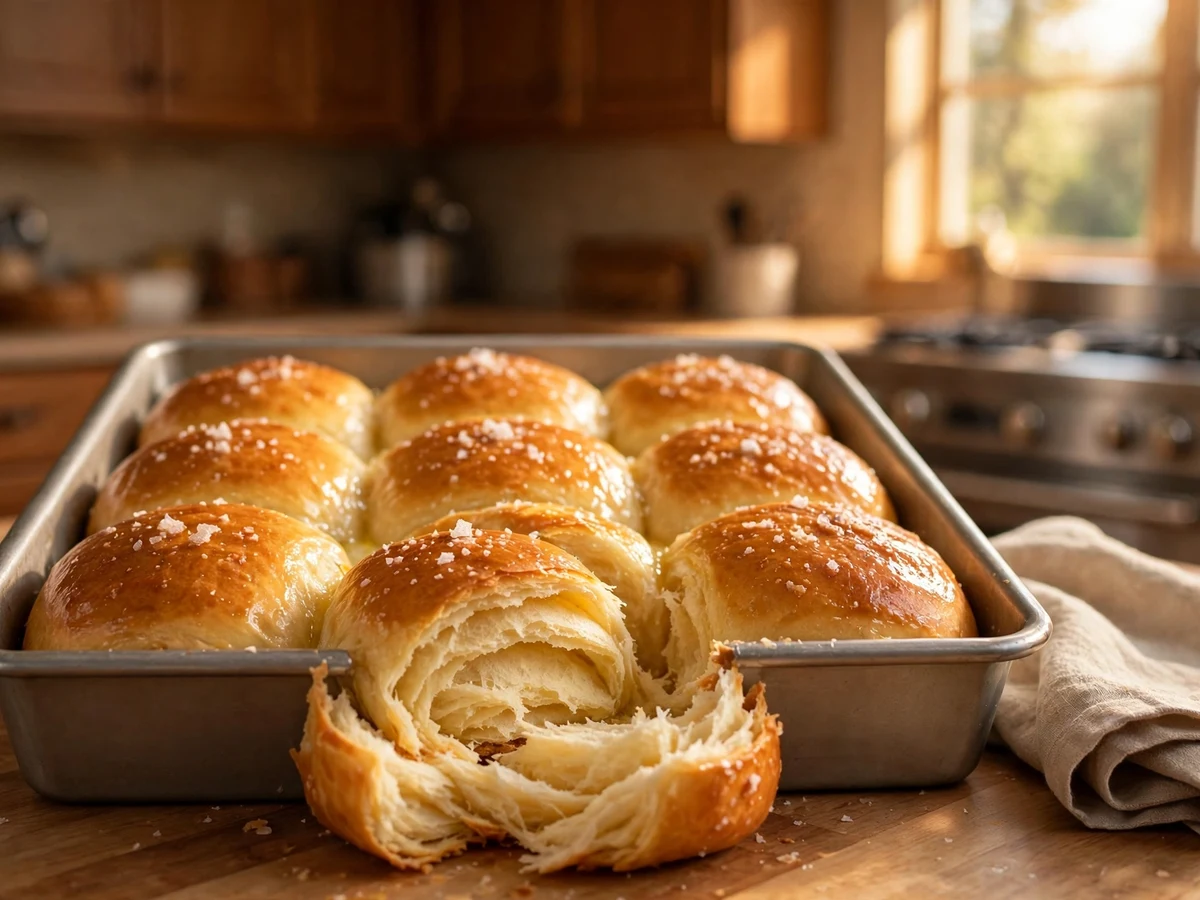
The fold is the whole secret. A rectangle of dough is brushed with melted butter, creased sharply down the middle, and folded over so the top half peeks past the bottom. In the oven, the butter keeps the two halves from sealing, so the finished roll pulls apart in tender layers instead of tearing like plain bread.
This version is built for the holiday cook, which means it is built to wait. The rolls are shaped on Wednesday, sleep in the refrigerator overnight, and bake on Thursday while the turkey rests. Twenty four rolls, one pan, and the bread course of Thanksgiving handled before the big day even starts.
Why Parker House Rolls Begin With a Buttered Fold
Parker house rolls work because the fold does three jobs at once. It traps a film of butter inside every roll, it creates the layered crumb that makes them famous, and it gives each roll its shape without a mold or a special pan. A plain round roll is bread. A folded roll is an event, and the difference costs you four minutes with a pastry brush.
The dough itself is an enriched dough, softened with milk, egg, and butter. Enriched doughs rise a little more slowly than lean ones, and in exchange they stay tender for hours instead of minutes. That tenderness is exactly what a holiday table needs, because the rolls are baked before the meal and eaten across a long, slow dinner.
The last piece is salt, in two places. Fine salt seasons the dough from inside, and a pinch of flaky salt on the buttered tops wakes up every bite. Sweet butter, soft crumb, a saline sparkle at the surface: the contrast is small and it is everything. Pull one apart while it is warm and the layers steam gently, which is the moment this recipe exists for.
Pillowy Middles, Golden Tops, and a Salty Finish
The first bite gives you the top: thin, golden, faintly crisp where the butter browned, with flakes of salt that dissolve on the tongue. Underneath, the crumb is pale, fine, and almost feathery, the kind of softness that compresses under your fingers and springs back slowly. It is a gentle texture, closer to a milk bread than to a crusty roll.
Then the fold opens. The inside surfaces, protected from the oven heat by the butter between them, stay paler and softer than the crust, and they carry the purest butter flavor in the roll. Eating one properly means pulling it open along the crease and eating the two halves separately, the way the hotel guests who made it famous presumably did.
Warmth matters more here than with most breads. Ten minutes out of the oven, the butter is still liquid in the layers and the crumb steams when torn. An hour later the rolls are still lovely, especially beside herb butter roast turkey and a pool of gravy, but the first warm quarter hour is the one people remember.
The flavor is deliberately quiet. Milk, butter, a little sugar, good salt: nothing competes with the rest of the plate. On a table carrying cranberry, sage, brown butter, and spice, a calm roll is not a plain roll. It is the bite that lets every other flavor rest, and it is the first thing to disappear anyway.
Shape Them Wednesday, Bake Them While the Turkey Rests
Thanksgiving morning has no spare oven space and no spare cook, so these rolls are planned backwards from the turkey. The dough is mixed and shaped on Wednesday, the pan goes into the refrigerator covered, and the slow cold rise does the second proof overnight. Cold dough is also easier to love: the butter firms up, the folds hold their crease, and the flavor deepens a shade.
On Thursday, the pan comes out of the fridge about 45 minutes before baking, while the turkey finishes roasting. The rolls go into the oven as the bird comes out to rest, which means they bake in the emptiest oven of the day and arrive at the table hot, at the exact moment everything else is carved and sauced. Beside them, the make ahead mashed potatoes reheat on the stove, and nobody is juggling.
If Wednesday is impossible, the same dough works in one day: mix in the morning, shape after the first rise, proof until puffy, and bake. The rolls lose a little depth, not their softness. And if even Thursday fills up, shaped rolls freeze beautifully for a month, a plan covered in the storage notes below.
Whole Wheat, Dairy Free, and a Lighter Basket
For a whole wheat leaning basket, replace one cup of the all purpose flour with whole wheat flour and add one extra tablespoon of milk. The crumb stays soft, the flavor gains a gentle nuttiness that suits the holiday table, and the fold behaves exactly the same. Replacing more than a third of the flour makes the rolls dense, so stop at one cup.
Dairy free rolls work with oat milk in place of the milk and a firm plant based baking stick in place of both butters. Melt the stick gently for brushing and watch the tops: plant based brushes brown a little faster, so pull the pan when the rolls are deep golden rather than waiting for a darker color. The layers still separate cleanly.
For a lighter everyday version, cut the brushing butter by a third and skip the final butter brush, keeping only the flaky salt. The rolls lose some shine and richness and keep their softness, which makes them a reasonable Sunday dinner roll rather than a holiday indulgence. The sugar can drop to two tablespoons without changing the rise.
Parker House Rolls Ingredients
- 1 cup whole milk (240 ml)
- 2 1/4 teaspoons instant yeast (1 packet)
- 3 tablespoons granulated sugar
- 4 cups all-purpose flour (480 g), plus more for dusting
- 1 1/2 teaspoons fine sea salt
- 1 large egg, at room temperature
- 5 tablespoons unsalted butter, softened
- 6 tablespoons unsalted butter, melted, for brushing
- Flaky sea salt, for finishing
How to Make Parker House Rolls
- Warm the milk in a small saucepan or the microwave until it reaches 105 to 110 degrees F, warm to the touch but not hot. Pour it into a large bowl or the bowl of a stand mixer, whisk in the yeast and sugar, and let it stand for 5 minutes, until foamy.
- Add the flour, fine salt, and egg. Mix until a shaggy dough forms, then add the softened butter one tablespoon at a time, letting each piece blend in. Knead for 8 to 10 minutes, until the dough is smooth, elastic, and slightly tacky.
- Shape the dough into a ball, place it in a lightly buttered bowl, cover, and let it rise in a warm place for 1 to 1 1/2 hours, until doubled.
- Roll the dough on a lightly floured surface into a 16 by 12 inch rectangle, about 1/3 inch thick. Cut it into 24 rectangles of about 4 by 2 inches with a sharp knife or pizza wheel.
- Brush each rectangle with melted butter. Press a deep crease just off center across each rectangle with the handle of a wooden spoon or a chopstick, then fold the larger half over the smaller half so it peeks past the edge. Press the crease again to seal the fold.
- Arrange the rolls in a buttered 9 by 13 inch baking pan, seam side down, in tight rows so they touch. Cover the pan. For the make ahead plan, refrigerate overnight, up to 16 hours. For same day baking, let them rise at room temperature for 45 to 60 minutes, until puffy.
- Heat the oven to 375 degrees F. If the pan was refrigerated, let it stand at room temperature for 45 minutes while the oven heats. Brush the tops generously with melted butter.
- Bake for 18 to 22 minutes, until the rolls are deep golden and the center roll reads 190 degrees F on an instant read thermometer.
- Brush once more with melted butter, sprinkle with flaky sea salt, and rest for 10 minutes. Serve warm, and let everyone pull their roll open along the fold.
The Crease Trick and Four More Secrets for Rolls That Stay Folded
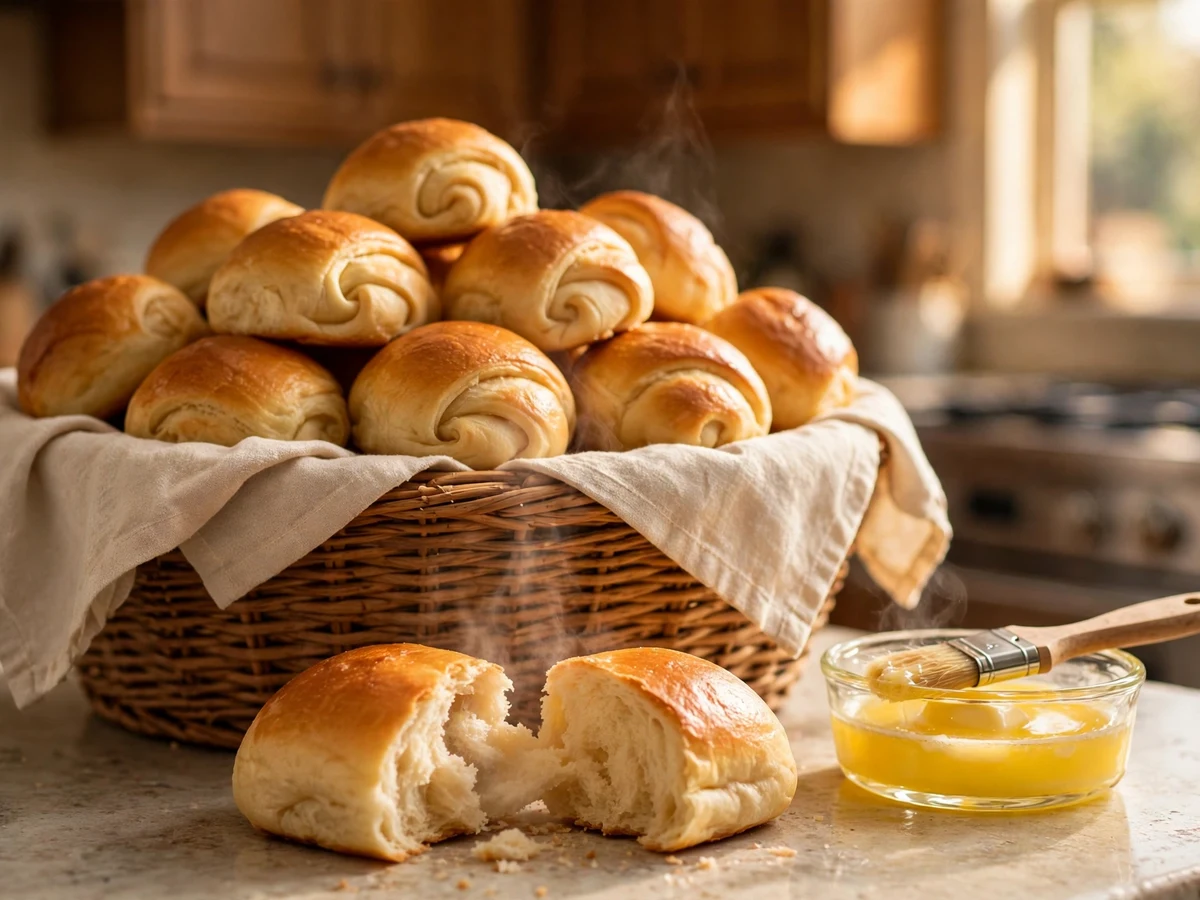
The crease is the difference between a folded roll and a round one that gave up. Press it deep, just off center, with the handle of a wooden spoon, and press it again after folding. A shallow crease relaxes in the oven and the roll opens like a clam. A deep, confident crease holds the fold shut from the first minute of baking to the last.
Second, mind the milk temperature. Above 120 degrees F, yeast starts to die, and the rolls rise slowly and bake up dense. Warm, not hot, is the rule: the milk should feel like a warm bath on your wrist. Third, add the softened butter gradually. Dumped in at once, it slicks the dough and refuses to combine; added a spoonful at a time, it disappears into a supple, stretchy dough.
Fourth, pack the pan snugly. Rolls that touch as they rise support each other and grow upward into tall, soft sided pillows. Scattered rolls spread sideways and dry out. Fifth, trust the thermometer over the color. Buttered tops brown early and lie to you; 190 degrees F at the center is the true signal that the crumb is set and feathery.
Garlic Herb Folds, Cloverleaf Pans, and the Leftover Roll Plan
For a garlic herb version, stir a teaspoon of finely grated garlic and a tablespoon of chopped parsley into the melted brushing butter. The fold carries the flavor inside, so every layer tastes seasoned, and the rolls sit beautifully beside wild rice stuffing and anything with gravy. Keep the flaky salt; it still works.
For a cloverleaf shape, skip the rolling and folding entirely. Divide the dough into 72 small balls, place three balls in each cup of a buttered muffin tin, proof, and bake. The look is old fashioned and pretty, and children can pull the sections apart one leaf at a time. Bake 2 to 3 minutes less than the pan version.
Leftovers have a second career. Split and toast, the rolls make the best day after turkey sandwiches of the year, sturdy enough for cranberry sauce and soft enough to bite cleanly. Cubed and dried overnight, they become a tender bread pudding base. And torn into a bowl beside creamed pearl onions, a warm roll is the correct tool for the last of the cream sauce.
Freeze Them Shaped, Reheat Them Soft
Baked rolls keep for 2 days in a sealed bag at room temperature, and they reheat best wrapped in foil at 325 degrees F for 8 to 10 minutes, which returns the crumb to softness without crisping the tops. The FoodKeeper guidance is the reference for the rest of the holiday table, and it treats fresh rolls as a short keeping food, so the freezer is the better plan for anything longer.
The shaped, unbaked freeze is the real gift of this recipe. Freeze the folded rolls on the pan until solid, move them to a freezer bag for up to 1 month, then arrange them in the baking pan, cover, and thaw overnight in the refrigerator. The next day they need only the 45 minute counter rest before baking, exactly like the Wednesday plan, which means a holiday caliber roll with almost no day of work.
Questions Cooks Ask About Parker House Rolls
My rolls opened up flat in the oven. What went wrong?
The crease was too shallow. Press it deep with the handle of a wooden spoon, just off center, and press again after folding. Cold shaped rolls also hold their fold better, which is one more reason the overnight refrigerator plan works so well.
Can I shape the rolls two days before Thanksgiving?
One night in the refrigerator is the sweet spot. At two days, the dough can overproof and the tops may wrinkle. For a longer head start, freeze the shaped rolls and thaw them overnight in the fridge on Wednesday instead.
Why is my dough sticky after kneading?
Enriched dough stays slightly tacky; that is correct. It should pull away from the bowl and stretch thin without tearing. If it sticks to your hands in strings, knead in flour one tablespoon at a time, and stop as soon as it turns manageable. Too much flour is what makes rolls heavy.
Do I need a stand mixer for this dough?
No. The dough kneads well by hand in about 10 minutes on a lightly floured counter. Use a push, fold, and turn rhythm, and add the softened butter gradually just as the mixer method does. The dough is ready when it stretches into a thin, nearly transparent sheet without ripping.
What pan can I use instead of a 9 by 13?
Two 9 inch round pans or a large cast iron skillet work well. Keep the rolls touching in tight rows, whichever pan you choose. A sheet pan alone leaves them too much room to spread, and they bake up flatter and drier.
Why did my Parker House rolls open flat in the oven?
The crease was too shallow. Press it deep with the handle of a wooden spoon, just off center, and press again after folding. Cold shaped rolls also hold their fold better, which is one more reason the overnight refrigerator plan works so well.
Can I shape Parker House rolls two days ahead?
One night in the refrigerator is the sweet spot. At two days the dough can overproof and the tops may wrinkle. For a longer head start, freeze the shaped rolls and thaw them overnight in the fridge on Wednesday instead.
Why is my Parker House roll dough sticky after kneading?
Enriched dough stays slightly tacky, and that is correct. It should pull away from the bowl and stretch thin without tearing. If it sticks in strings, knead in flour one tablespoon at a time. Too much flour is what makes rolls heavy.
Can I knead Parker House roll dough by hand?
Yes. The dough kneads well by hand in about 10 minutes on a lightly floured counter, using a push, fold, and turn rhythm. It is ready when it stretches into a thin, nearly transparent sheet without ripping.
What pan can replace a 9 by 13 for Parker House rolls?
Two 9 inch round pans or a large cast iron skillet work well, as long as the rolls touch in tight rows. A sheet pan alone gives them too much room to spread, and they bake up flatter and drier.
Parker House Rolls
The folded Boston hotel rolls, brushed with butter before and after baking: a soft enriched dough, a deep crease so the fold holds, and a plan that shapes them Wednesday night and bakes them Thursday while the turkey rests. Twenty four pillowy rolls with a flaky salt finish.
- Total Time: 3 hours 30 minutes
- Yield: 24 rolls 1x
Ingredients
- 1 cup whole milk (240 ml)
- 2 1/4 teaspoons instant yeast (1 packet)
- 3 tablespoons granulated sugar
- 4 cups all-purpose flour (480 g), plus more for dusting
- 1 1/2 teaspoons fine sea salt
- 1 large egg, at room temperature
- 5 tablespoons unsalted butter, softened
- 6 tablespoons unsalted butter, melted, for brushing
- Flaky sea salt, for finishing
Instructions
- Warm the milk until it reaches 105 to 110 degrees F. Pour it into a large bowl, whisk in the yeast and sugar, and let it stand for 5 minutes, until foamy.
- Add the flour, fine salt, and egg. Mix until a shaggy dough forms, then add the softened butter one tablespoon at a time. Knead for 8 to 10 minutes, until smooth, elastic, and slightly tacky.
- Shape the dough into a ball, place it in a lightly buttered bowl, cover, and let it rise for 1 to 1 1/2 hours, until doubled.
- Roll the dough into a 16 by 12 inch rectangle, about 1/3 inch thick. Cut it into 24 rectangles of about 4 by 2 inches.
- Brush each rectangle with melted butter. Press a deep crease just off center with the handle of a wooden spoon, then fold the larger half over the smaller half so it peeks past the edge. Press the crease again.
- Arrange the rolls in a buttered 9 by 13 inch pan, seam side down, in tight rows so they touch. Cover. Refrigerate overnight, up to 16 hours, or let them rise at room temperature for 45 to 60 minutes, until puffy.
- Heat the oven to 375 degrees F. If the pan was refrigerated, let it stand at room temperature for 45 minutes. Brush the tops generously with melted butter.
- Bake for 18 to 22 minutes, until deep golden and the center roll reads 190 degrees F on an instant read thermometer.
- Brush once more with melted butter, sprinkle with flaky sea salt, and rest for 10 minutes before serving warm.
- Prep Time: 30 minutes
- Cook Time: 20 minutes
Nutrition
- Serving Size: 1
- Calories: 150
- Sodium: 170
- Saturated Fat: 4
- Protein: 3
- Cholesterol: 25