
In this article:
- Why Christmas Fruitcake Starts the Night Before
- Dark, Dense, and Generous in Every Slice
- Bake It Early December: The Week by Week Maturing Calendar
- Lighter Loaves, Nut Free Pans, and Other Adjustments
- Christmas Fruitcake Ingredients
- How to Make Christmas Fruitcake
- Fruit That Stays Suspended and Four More Fruitcake Secrets
- Loaf Pans, Round Cakes, and Mini Cakes for the Gift Box
- Wrapped, Fed Weekly, and Ready to Mail
- Questions Cooks Ask About Christmas Fruitcake
Christmas fruitcake, done properly, is a dark and generous loaf where every slice carries more fruit than cake, moist from an overnight soak and deepened by weeks of patient resting. This is not the dry brick of holiday jokes. It is a spiced, buttery crumb holding raisins, cherries, cranberries, and apricots in suspension, baked low and slow in November or early December.
The method has two quiet hinges. First, the dried fruit drinks a full night in orange juice, so it enters the batter plump and stays tender instead of stealing moisture from the crumb. Second, the finished cake is brushed with juice once a week while it matures, so Christmas week finds it at its richest.
Because the work is spread across weeks in minutes, this is the friendliest big bake of the season. One evening of soaking, one slow morning of baking, and a standing weekly appointment of two minutes with a pastry brush. The calendar does the rest.
Why Christmas Fruitcake Starts the Night Before
Christmas fruitcake works because the fruit is hydrated before it ever meets the batter. Dry raisins and cherries are thirsty, and added straight to a cake they pull moisture out of the crumb for days, which is exactly how a fruitcake turns dry. A night in orange juice reverses the flow: the fruit arrives swollen and gives flavor back.
The batter is built to carry weight. Brown sugar and a spoon of molasses give it a dark caramel base, butter keeps the crumb tender, and a measured hand with flour leaves just enough structure to hold nearly four cups of fruit and nuts. Too much flour makes a bread with fruit in it. This ratio makes a fruitcake.
Low heat is the final protection. At 300 degrees F the cake bakes evenly from edge to center over nearly two hours, setting the middle before the surface can scorch. The result slices cleanly, keeps for weeks, and improves on a schedule you can plan around, which no hurried version can promise.
Dark, Dense, and Generous in Every Slice
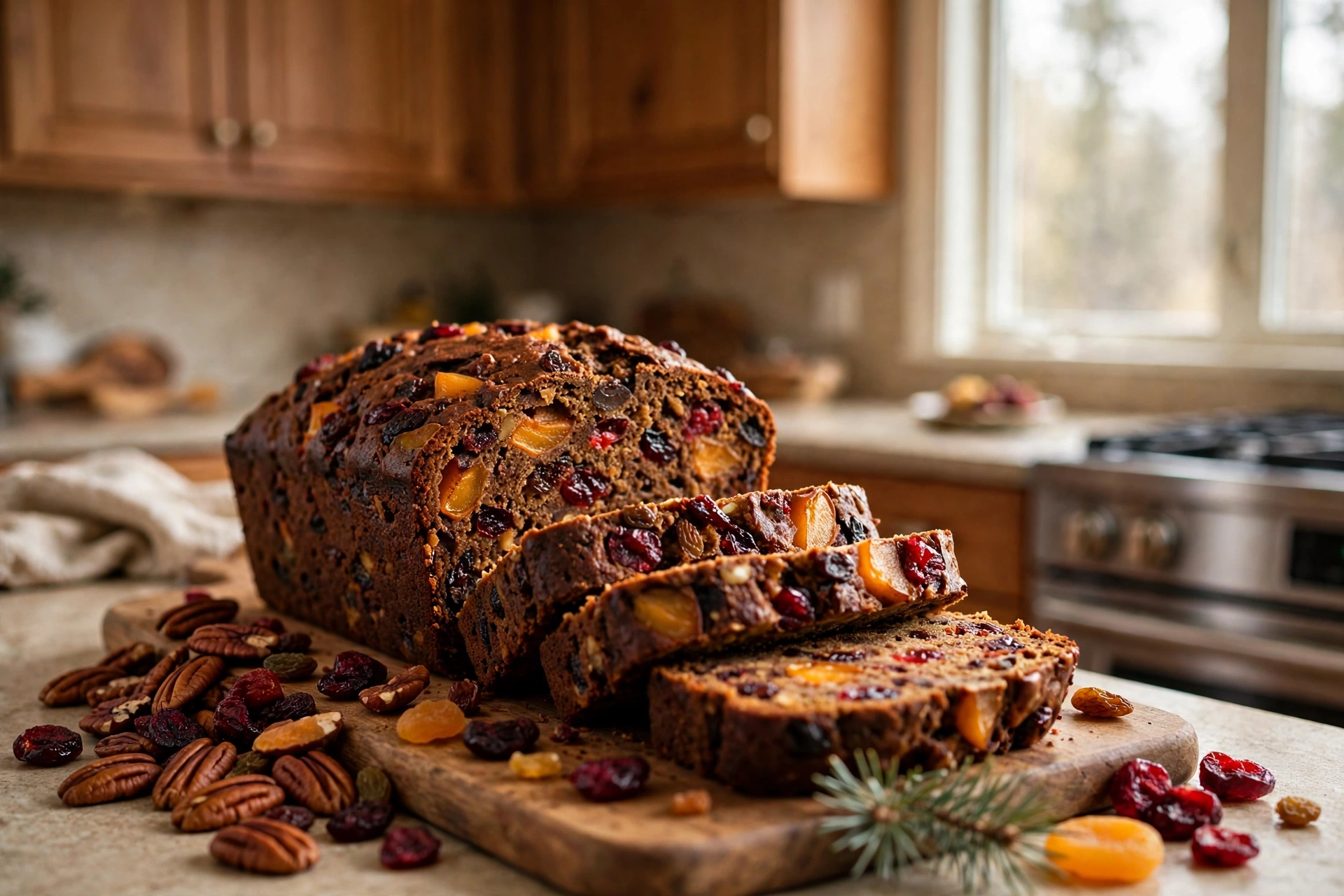
A slice should look like stained glass held together by cake: amber raisins, ruby cranberries, deep red cherries, and pale gold apricots in a dark spiced crumb. The first taste is molasses and brown sugar, then warm cinnamon and nutmeg, then the bright lift of orange that keeps the richness from sitting heavily.
The texture is dense but never gummy. Plumped fruit gives a soft chew, pecans break it with a clean crunch, and the crumb itself stays moist and fine. Served in half inch slices, a single piece satisfies like a much larger serving of ordinary cake, which is why one loaf stretches across a week of visitors.
It keeps changing as it rests, too. In the first days the spices stand apart and the orange is loud. By the second week the flavors merge into one deep, round taste that no single ingredient owns, next to a slice of sharp cheddar or a cup of strong tea beside our yule log on the same holiday table.
Bake It Early December: The Week by Week Maturing Calendar
Week one is for settling. Once the cake is cool, brush it all over with two tablespoons of orange juice, wrap it tightly, and store it in a cool dark cupboard or the refrigerator. The crumb firms, the fruit shares its moisture evenly, and the slice already tastes complete if curiosity wins.
Weeks two and three are when the cake becomes itself. Repeat the juice brushing once a week, turning the loaf each time so every face gets its share. The spice softens into the fruit, the color deepens, and the texture turns silky at the edges of each slice.
By week four the fruitcake is at its peak and ready for the table or the gift box. Baked in the first days of December, it lands on Christmas week exactly on schedule, and a loaf baked in late November simply waits, patient and improving, the way this Christmas fruitcake has been designed to do for generations of bakers.
Lighter Loaves, Nut Free Pans, and Other Adjustments
The fruit itself is flexible within its total weight. Swap the apricots for chopped dried figs, the cherries for more cranberries, or the golden raisins for currants, keeping the total near five cups so the batter ratio holds. What matters is the soak and the balance of tart fruit against sweet.
For a nut free loaf, leave out the pecans and add an extra half cup of mixed dried fruit plus two tablespoons of sunflower seeds for a little crunch. The cake slices slightly more tenderly, so chill it well before cutting and use the serrated knife method described below.
A lighter reading of the classic is possible without losing its soul. Cut the brown sugar to one and a quarter cups and lean on very ripe, sweet dried fruit; the molasses and orange still deliver depth. Dried fruit nutrition varies by type, and the USDA FoodData Central entries make it easy to compare swaps before you commit to a batch.
Christmas Fruitcake Ingredients
- 1 1/2 cups raisins
- 1 cup golden raisins
- 3/4 cup dried cranberries
- 3/4 cup dried cherries
- 1/2 cup dried apricots, chopped
- 1/2 cup chopped dates
- 1 cup orange juice, plus more for brushing
- 1 tablespoon orange zest
- 1 cup unsalted butter, softened
- 1 1/2 cups dark brown sugar, packed
- 4 large eggs, at room temperature
- 1/4 cup molasses
- 1 teaspoon vanilla extract
- 2 1/2 cups all-purpose flour, divided
- 1 teaspoon baking powder
- 1 teaspoon ground cinnamon
- 1/2 teaspoon ground nutmeg
- 1/4 teaspoon ground cloves
- 1/4 teaspoon ground allspice
- 3/4 teaspoon fine sea salt
- 1 cup pecans, roughly chopped
How to Make Christmas Fruitcake
- The night before, combine the raisins, golden raisins, cranberries, cherries, apricots, and dates in a large bowl. Pour in the orange juice, add the zest, stir well, cover, and refrigerate overnight, at least 8 hours and up to 24.
- On baking day, heat the oven to 300 degrees F. Line a 9 by 5 inch loaf pan with parchment, leaving an overhang on the long sides. Drain the fruit in a colander set over a bowl, saving the juice that remains for brushing later.
- Toss the drained fruit and the pecans with 1/2 cup of the flour until every piece wears a thin coat. This dusty jacket is what keeps the fruit suspended in the batter instead of sinking.
- Whisk the remaining 2 cups of flour with the baking powder, cinnamon, nutmeg, cloves, allspice, and salt.
- Beat the butter and brown sugar until pale and fluffy, about 3 minutes. Beat in the eggs one at a time, then the molasses and vanilla. The mixture may look curdled; the flour will bring it back together.
- Add the flour mixture in two additions, mixing on low just until no dry streaks remain. Fold in the floured fruit and pecans with a sturdy spatula until evenly distributed.
- Scrape the batter into the pan and smooth the top, pushing a little batter from the center toward the corners so the loaf rises evenly. Bake for 1 hour 45 minutes to 2 hours, until a skewer in the center comes out with a few moist crumbs and the top feels firm.
- If the top colors deeply before the center is done, lay a loose sheet of foil over the pan for the last 30 minutes.
- Cool the cake in the pan for 30 minutes, then lift it out with the parchment and cool completely on a rack. Brush the warm top with a tablespoon of the reserved juice as it cools.
- Wrap the cooled loaf tightly in parchment, then in foil or a sealed container. Brush weekly with 2 tablespoons of orange juice and rewrap. Rest at least 1 week before slicing, and up to 4 weeks for the fullest flavor.
Fruit That Stays Suspended and Four More Fruitcake Secrets
The flour coat is the whole anti sinking system, and it only works when the fruit is drained first. Wet fruit wears a paste instead of a jacket, and paste slides. Drain for a full ten minutes, toss until every raisin looks dusty, and your slices will show fruit at the top, middle, and bottom in even measure.
Weigh the pan choice to the batter. This batch fills a 9 by 5 inch loaf generously; in a smaller 8 by 4 pan it will dome and crack. Two 8 by 4 pans, baked 1 hour 15 minutes to 1 hour 30 minutes, make the gift format, and an 8 inch round takes about 1 hour 40 minutes. Same batter, three presentations.
Slice like a professional: chill the wrapped loaf overnight, then cut half inch slices with a serrated knife in slow sawing strokes, wiping the blade clean between cuts. Warm blades drag the fruit and tear the crumb. Cold cake and a clean knife give you the stained glass slices that make this cake worth photographing.
If a loaf ever does come out dry, it can be rescued. Brush it generously with orange juice, wrap it, and give it a week of rest plus a second brushing. The crumb drinks slowly, and most dry fruitcakes return to tenderness on this plan rather than needing to be rebaked or discarded.
Loaf Pans, Round Cakes, and Mini Cakes for the Gift Box
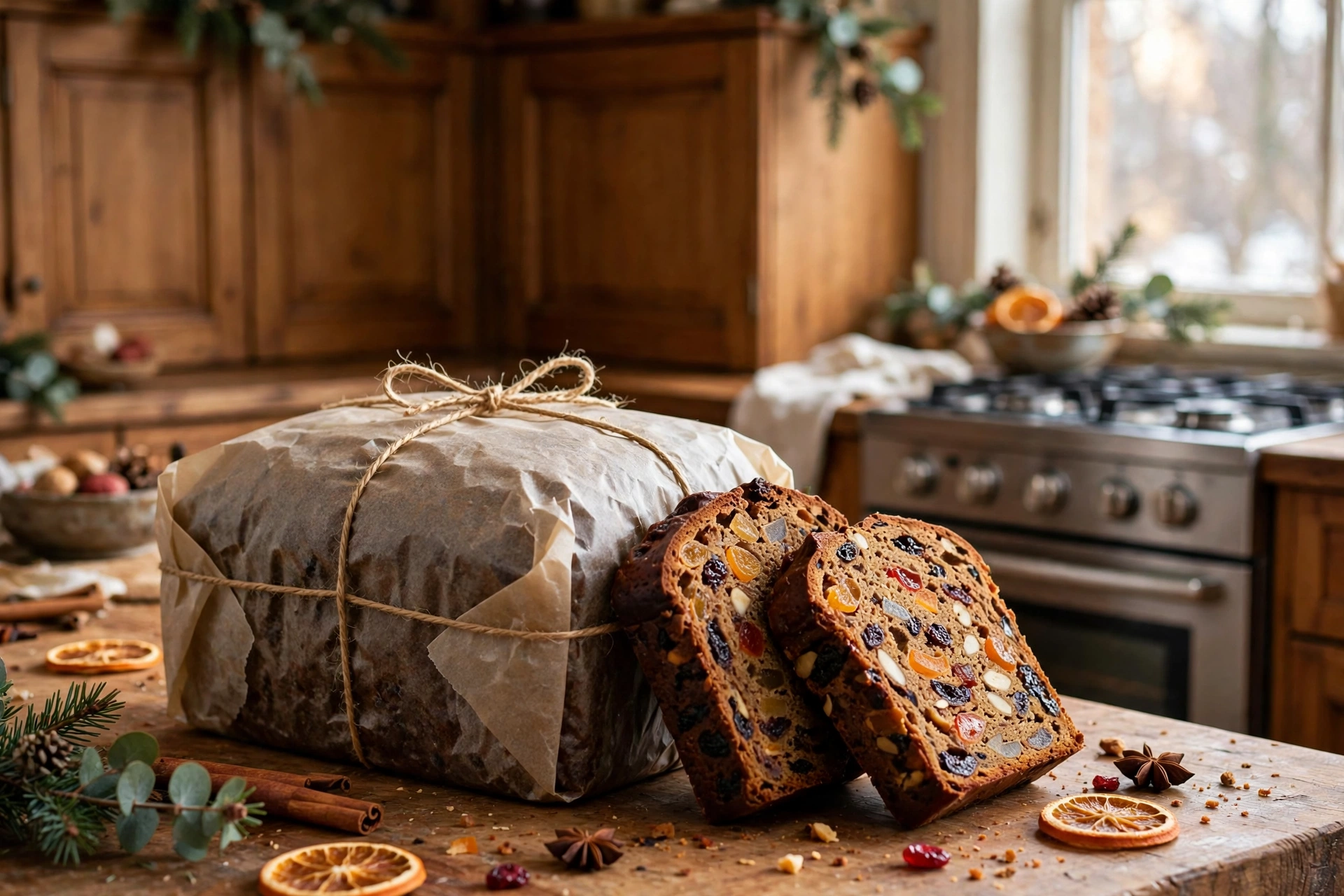
Mini loaves are the gift box heroes of the season at our house. Divided among four 5 by 3 inch pans, the batter bakes in about 55 to 65 minutes, and each small cake wraps in parchment and twine like a parcel. Bake them the same week as the big loaf so one soaking session covers every gift on the list.
A cranberry forward variation suits cooks who find classic fruitcake too sweet: raise the cranberries to one and a half cups, drop the dates, and add a second tablespoon of orange zest. Beside our cranberry pistachio biscotti, it builds a December cookie and cake box with a clear house style.
For a chocolate edged batch, fold in half a cup of dark chocolate chips with the fruit and swap the allspice for a pinch of espresso powder; the crumb turns nearly black and the cherries read louder. Keep the soak and the slow oven unchanged, since those two habits are what make the cake reliable across every variation.
Wrapped, Fed Weekly, and Ready to Mail
Wrapped tightly and kept cool, the maturing loaf holds for up to 4 weeks with its weekly juice brushing, and a further 2 weeks in the refrigerator once sliced. For long storage, wrap slices individually and freeze for up to 3 months; thaw at room temperature for an hour and the texture returns almost completely, a keeping quality few cakes can match. The FoodKeeper guidance covers the cakes and pies sharing the holiday shelf.
For mailing, choose a loaf at the two week mark, wrap it in parchment and then in a sealed layer, and cushion it snugly so it cannot shift. Sent early in the week, it arrives still improving, which makes this Christmas fruitcake the rare homemade gift that tolerates the postal calendar gracefully.
Bake it once, brush it weekly, and let December arrive at its own pace. Among all the cookies and pies of the season, the fruitcake is the one already finished, already wrapped, and already at its best: a calm, dark, generous loaf that rewards the baker who started early. If a cookie plate is also on your list, our Italian anise cookies and kolaczki cookies keep it company beautifully.
Questions Cooks Ask About Christmas Fruitcake
Why did all the fruit sink to the bottom of my fruitcake?
The fruit went into the batter wet and uncoated. Drain the soaked fruit for a full ten minutes, then toss it with half a cup of the flour until every piece looks dusty. That dry jacket grips the batter and holds the fruit at every level of the slice.
Can I soak the fruit for less time if I forgot the overnight step?
Yes. Warm the orange juice until steaming, pour it over the fruit, and rest it for 1 hour, stirring twice. The fruit will be softer and the flavor a little brighter than the overnight version, and the cake still works well. The overnight soak remains the better plan when the calendar allows it.
What juice should I brush on the cake while it matures?
Orange juice is the house choice, two tablespoons once a week, brushed over every face of the loaf before rewrapping. Apple juice works for a milder background note. Keep the loaf wrapped and cool between brushings so the moisture moves inward instead of evaporating.
How do I keep the top of the fruitcake from getting too dark?
Bake low at 300 degrees F and check the color at the one hour mark. If the top is already deep brown, lay a loose tent of foil over the pan for the remaining time. A dark top is mostly cosmetic, but the foil also guards the exposed fruit from scorching.
Can I freeze Christmas fruitcake, and for how long?
Yes. Freeze the whole wrapped loaf for up to 3 months, or freeze individual slices wrapped separately for quick servings. Thaw at room temperature for about an hour. Freezing pauses the maturing, so give a thawed loaf a fresh juice brushing before it goes to the table.
Why did the fruit sink to the bottom of my Christmas fruitcake?
The fruit went into the batter wet and uncoated. Drain the soaked fruit for a full ten minutes, then toss it with half a cup of the flour until every piece looks dusty. That dry jacket grips the batter and holds the fruit at every level of the slice.
Can I shorten the fruit soak for Christmas fruitcake?
Yes. Warm the orange juice until steaming, pour it over the fruit, and rest it for 1 hour, stirring twice. The fruit will be softer and the flavor a little brighter than the overnight version, and the cake still works well. The overnight soak remains the better plan when the calendar allows it.
What should I brush on a fruitcake while it matures?
Orange juice is the house choice, two tablespoons once a week, brushed over every face of the loaf before rewrapping. Apple juice works for a milder background note. Keep the loaf wrapped and cool between brushings so the moisture moves inward instead of evaporating.
How do I keep the top of a fruitcake from getting too dark?
Bake low at 300 degrees F and check the color at the one hour mark. If the top is already deep brown, lay a loose tent of foil over the pan for the remaining time. A dark top is cosmetic, but the foil also guards the exposed fruit from scorching.
Can I freeze Christmas fruitcake, and for how long?
Yes. Freeze the whole wrapped loaf for up to 3 months, or freeze individual slices wrapped separately for quick servings. Thaw at room temperature for about an hour. Freezing pauses the maturing, so give a thawed loaf a fresh juice brushing before it goes to the table.
Christmas Fruitcake
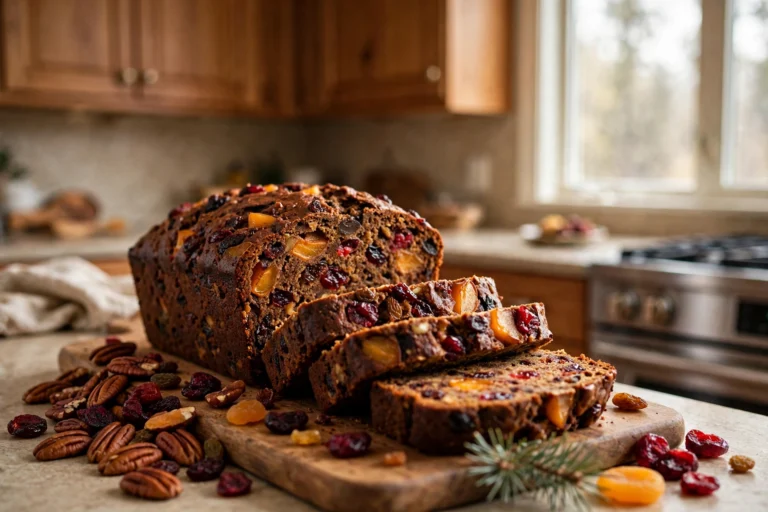
A dark, moist Christmas fruitcake loaded with fruit: raisins, cherries, cranberries, and apricots soaked overnight in orange juice, folded into a spiced brown sugar batter, baked low and slow, then brushed with orange juice once a week as it matures. Bake it in early December and it peaks right at Christmas.
- Total Time: 2 hours 15 minutes
- Yield: 1 loaf, 16 slices 1x
Ingredients
- 1 1/2 cups raisins
- 1 cup golden raisins
- 3/4 cup dried cranberries
- 3/4 cup dried cherries
- 1/2 cup dried apricots, chopped
- 1/2 cup chopped dates
- 1 cup orange juice, plus more for brushing
- 1 tablespoon orange zest
- 1 cup unsalted butter, softened
- 1 1/2 cups dark brown sugar, packed
- 4 large eggs, at room temperature
- 1/4 cup molasses
- 1 teaspoon vanilla extract
- 2 1/2 cups all-purpose flour, divided
- 1 teaspoon baking powder
- 1 teaspoon ground cinnamon
- 1/2 teaspoon ground nutmeg
- 1/4 teaspoon ground cloves
- 1/4 teaspoon ground allspice
- 3/4 teaspoon fine sea salt
- 1 cup pecans, roughly chopped
Instructions
- The night before, combine the raisins, golden raisins, cranberries, cherries, apricots, and dates in a large bowl. Pour in the orange juice, add the zest, stir well, cover, and refrigerate overnight, at least 8 hours and up to 24.
- Heat the oven to 300 degrees F. Line a 9 by 5 inch loaf pan with parchment, leaving an overhang on the long sides. Drain the fruit over a bowl, saving the remaining juice for brushing.
- Toss the drained fruit and the pecans with 1/2 cup of the flour until every piece wears a thin coat.
- Whisk the remaining 2 cups of flour with the baking powder, cinnamon, nutmeg, cloves, allspice, and salt.
- Beat the butter and brown sugar until pale and fluffy, about 3 minutes. Beat in the eggs one at a time, then the molasses and vanilla.
- Add the flour mixture in two additions, mixing on low just until no dry streaks remain. Fold in the floured fruit and pecans until evenly distributed.
- Scrape the batter into the pan and smooth the top. Bake for 1 hour 45 minutes to 2 hours, until a skewer in the center comes out with a few moist crumbs. Tent loosely with foil for the last 30 minutes if the top colors deeply.
- Cool in the pan for 30 minutes, then lift out and cool completely on a rack. Brush the top with a tablespoon of the reserved juice as it cools.
- Wrap the cooled loaf tightly in parchment, then in foil or a sealed container. Brush weekly with 2 tablespoons of orange juice and rewrap. Rest at least 1 week before slicing, and up to 4 weeks for the fullest flavor.
- Prep Time: 25 minutes
- Cook Time: 1 hour 50 minutes
Nutrition
- Serving Size: 1
- Calories: 380
- Sodium: 190
- Saturated Fat: 6
- Protein: 4
- Cholesterol: 65